
 Search Articles


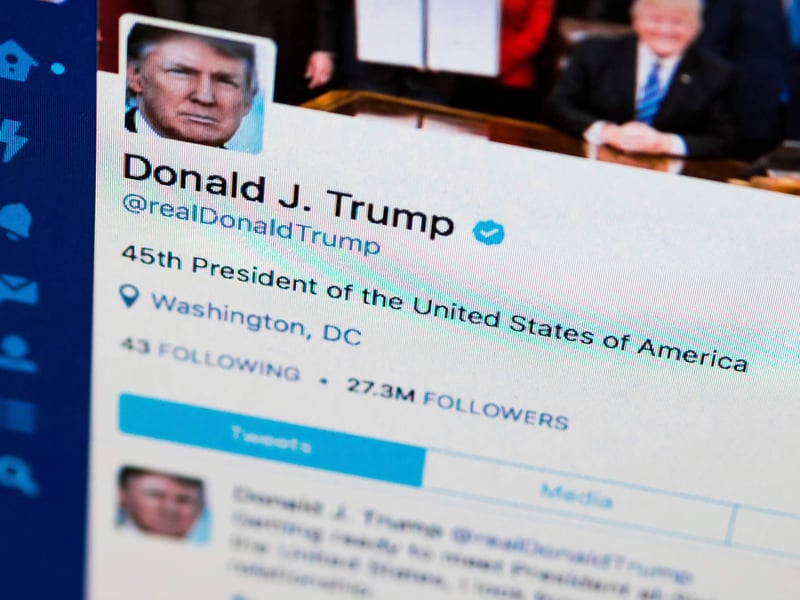
SAN FRANCISCO (CN) — A federal judge signaled a strong inclination Thursday to dismiss former President Donald Trump’s lawsuit against Twitter for kicking him off its platform in 2021.
U.S. District Judge James Donato told a lawyer representing the former president that while technology and law might change and evolve, “one thing that’s been more or less a constant going back 20 years is that private companies like Twitter are not subject to the First Amendment.”
Trump has been permanently banned from Twitter over incendiary posts that, among other things, challenged the legitimacy of the 2020 presidential election which he lost to Joe Biden. He was also indefinitely suspended by Facebook, now called Meta, and Google-owned YouTube.
Social media platforms can moderate their services under Section 230 of the 1996 Communications Decency Act, and can remove posts that are obscene or violate their terms of services as long as they are acting in “good faith.” The law also broadly exempts internet companies from liability for content posted by users.
Trump responded to his de-platforming by suing all three companies for unspecified damages and the restoration of his accounts. He and a proposed class of de-platformed individuals have also demanded that Section 230 be declared unconstitutional, calling the law, “a blank check issued to private companies holding unprecedented power over the content of public discourse to censor constitutionally protected speech with impunity, resulting in a grave threat to the freedom of expression and to democracy itself.”
Other named plaintiffs include the American Conservative Union, which claims Twitter “purged” thousands of followers from its @CPAC Twitter account without explanation, and Austen Fletcher, who claims to have had multiple YouTube videos removed for violations of YouTube’s medical misinformation policy. One of the removed videos discussed the “demonization of hydroxychloroquine," a drug Trump promoted as a Covid-19 cure despite clinical evidence to the contrary.
“You’ve got a mountain of law saying ‘no’ to your First Amendment claim. It’s not clear to me how you are traversing that,” Donato told Trump’s attorney Marie Fiala.
He said the U.S. Supreme Court made a “very definitive statement” in its 2019 ruling Manhattan Community Access Corp. v. Halleck that private entities cannot be considered state actors bound by the First Amendment.
In that case, two filmmakers objected to being kicked off the Manhattan Neighborhood Network for producing a film criticizing the public access channel. The high court found the channel did not function as a state actor because “operating public access channels on a cable system is not a traditional, exclusive public function.”
The Ninth Circuit also axed similar claims by Prager University, a conservative media outlet, in a lawsuit against YouTube for restricting its videos.
Fiala argued the well-worn theory that Twitter and the state government acted in concert to restrict and censor free speech. She said that Twitter, trembling under the threat of Section 230’s possible repeal during a Senate committee hearing last year, acquiesced to Democratic lawmakers’ demands to censor Trump and others who expressed “speech different from the official narratives.”
Donato rejected her line of reasoning.
“It’s perfectly fine for a politician to express dissatisfaction with conduct. I’m not looking for what a Democrat said at a committee hearing but an actual threat,” Donato said. “We’re talking express threats of government prosecution, some kind of criminal sanction, a taking. Just saying ‘I have an idea that we might amend the CDA ’— the threat factor there seems pretty low.”
Wilmer Hale attorney Patrick Carome, representing Twitter and its CEO Jack Dorsey, agreed.
“The allegations are extremely paltry,” Carome told Donato. “Jawboning and haranguing individual legislators — which is what elected officials do — is not the stuff of coercive state action.”
Carome said the plaintiffs shouldn’t be given leave to amend their case with more details. “They’ve amended already once. If there was something here to show that Twitter was coerced — that it was not Twitter’s decision — they’d have found it.”
Donato said it might take some time to rule on the dismissal motion, but his reasoning seems in line with that of his colleague Senior U.S. District Judge Susan Illston, who ruled in June 2021 that Meta did not unconstitutionally censor an anti-vaccine group’s social media posts at the behest of the federal government.
U.S. District Judge Edward Chen, who is considering a similar case against Twitter for suspending a doctor’s account over tweets about Covid-19 and vaccines, observed at a recent hearing that the state coercion theory seems to have no limit in its application.
“It seems every time the government jawbones and tries to move the public or businesses to do a certain thing — whether it’s encouraging people to get vaccinated or encouraging vigilance against sex harassment on campus or urging diversity — that any time a private player goes along with that there’s a risk that’s going to be deemed a conspiracy. Suddenly everything is a state action,” he said. “Isn’t that a problem? If it’s accepted I’m not sure where the limit is.”
Chen has yet to rule on a motion to dismiss the doctor’s case.
 Follow @MariaDinzeo
Subscribe to our free newsletters
Our weekly newsletter Closing Arguments offers the latest about ongoing trials, major litigation and rulings in courthouses around the U.S. and the world, while the monthly Under the Lights dishes the legal dirt from Hollywood, sports, Big Tech and the arts.