
 Search Articles


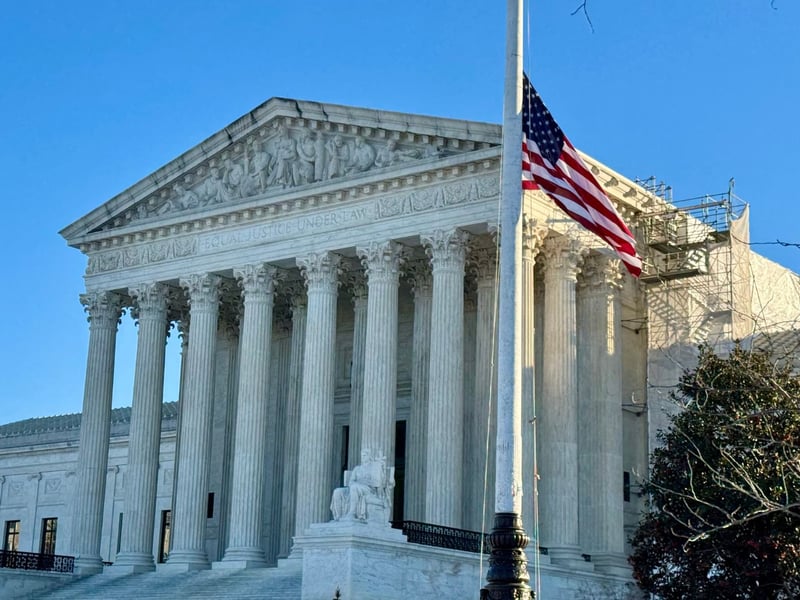
WASHINGTON (CN) — As the first challenge to President Donald Trump’s firing spree rises to the Supreme Court, a government watchdog employee who was fired in a one-sentence email this month will ask the justices to affirm his win in the lower courts and find that the administration was wrong to seek his ouster.
Independent agency leaders like Hampton Dellinger, the head of the Office of Special Counsel, typically enjoy job protections so political leaders cannot fire them at will. But Trump is no longer following that norm, Dellinger says in his lawsuit against the administration.
“The president did not purport to remove Special Counsel Dellinger on the basis of ‘inefficiency, neglect of duty, or malfeasance in office,’” Dellinger wrote in his complaint filed in the U.S. District Court for the District of Columbia. “In fact, the president’s termination email provided no justification at all for Special Counsel Dellinger’s termination. As a result, the president’s termination of Special Counsel Dellinger is ultra vires and is a clear violation of the statute." (Emphasis in original.)
U.S. District Judge Amy Berman Jackson, a Barack Obama appointee, allowed Dellinger to stay in his role until a hearing scheduled for Feb. 26. Late Saturday night, a panel on the D.C. Circuit upheld her ruling and said it would be premature for the appeals court to step in while the underlying issues were unresolved in the lower court.
On Sunday, the Justice Department brought the case to the justices, seeking to remove Dellinger before Jackson’s hearing. After the appeal was docketed Tuesday morning, the high court called for briefing from Dellinger by Wednesday at 2 p.m.
In the second Trump administration’s first Supreme Court appeal, the president raised the high court’s 2024 broad presidential immunity ruling and reasoned that since Congress and the courts cannot examine core presidential authorities, the president has unrestricted power to remove officers from their posts.
“This court should not allow lower courts to seize executive power by dictating to the President how long he must continue employing an agency head against his will,” the Department of Justice wrote.
Because the appeal was filed on the emergency docket, the justices will rule only whether the temporary restraining order keeping Dellinger in office irreparably harms the government. However, the administration’s underlying legal arguments are likely to feature in major disputes before the Supreme Court in the coming months and years.
Trump says presidents’ broad Article II powers can be challenged only rarely based on the unitary executive theory, giving the president wide-ranging authority to shape the federal government with few checks from Congress or the courts.
The Supreme Court has embraced that theory over the past decade, slowly chipping away at guardrails restraining presidential authority. The Trump administration already has indicated it wants the justices to expand executive power further.
Last week, acting Solicitor General Sarah Harris told the House Judiciary Committee the administration will attempt to overturn Humphrey’s Executor v. United States , a 1935 ruling that requires presidents to show cause before dismissing board members who oversee independent agencies including the Federal Trade Commission, National Labor Relations Board and Consumer Product Safety Commission.
According to Harris, independent board members are exercising substantial executive power that has no basis in history and no place in the constitutional structure.
Once the lower courts hear the merits of Dellinger’s case, the Supreme Court could be asked to review or overturn Humphrey’s Executor on appeal.
The Supreme Court’s tight deadline for Dellinger’s response suggests the justices are likely to rule on the application later this week.
 Follow @KelseyReichmann
 Follow @kelseyreichmann.bsky.social
Subscribe to our free newsletters
Our weekly newsletter Closing Arguments offers the latest about ongoing trials, major litigation and rulings in courthouses around the U.S. and the world, while the monthly Under the Lights dishes the legal dirt from Hollywood, sports, Big Tech and the arts.