
 Search Articles



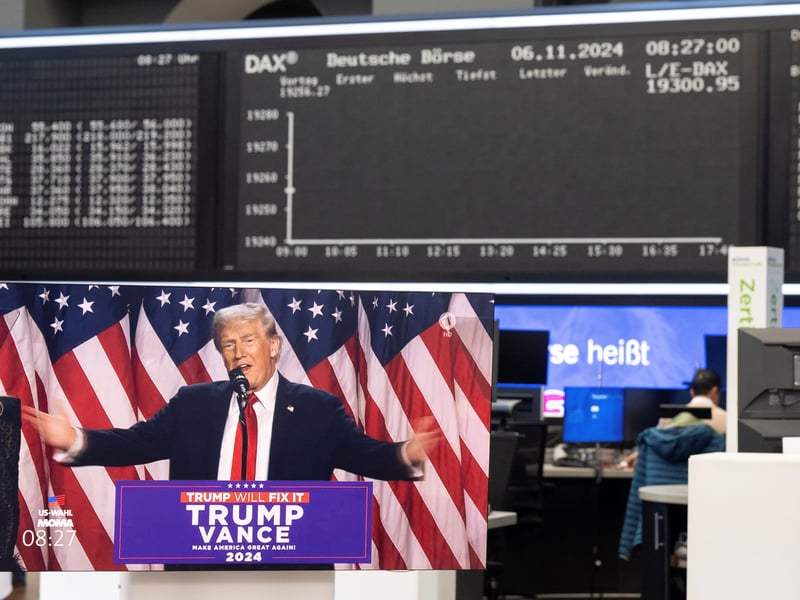
MARSEILLES, France (CN) — Gati Gleo, a 75-year-old retiree, was blunt in his assessment about the return of Donald Trump to the White House.
“The U.S. is going to shit, that’s how it is,” he said as he hung out Wednesday morning inside a neighborhood butcher shop in this French port city, chatting with the friendly butcher. “It’s a mess,” he said. “He’s a huge bastard.”
With those few words, Gleo seemed to sum up the feelings of many Europeans when it comes to Trump and the right-wing, nationalistic and protectionist direction the United States is taking.
Polls show an overwhelming majority of Europeans would not vote for Trump given the chance, though that’s not the case in many former communist countries such as Serbia, Hungary and Russia where conservative authoritarianism has taken root.
Trump’s victory was both stunning and shocking for many Americans and Europeans alike.
And it spells big trouble for Europe, which was already battered by the war in Ukraine, economic stagnation and the rise of the far right. Trump’s return to power in Washington marks a new crisis because his “America First” agenda is anything but friendly to European interests and it dangerously exposes Europe’s biggest weakness — a vassal-like dependence on American military, political, cultural and economic might.
Even as European leaders quickly congratulated Trump on his victory Wednesday morning, unease, disgust and panic spread across much of the continent as the prospect of four more years of Trump dawned.
It’s such a disruptive moment because Trump may upend the NATO alliance and its pro-Ukraine stance; give sustenance to Europe’s far-right leaders, such as Marine Le Pen in France; once again drop out of the Paris Agreement on tackling climate change and quash the push for renewable energy; and eagerly open up trade disputes with Europe.
“It presents Europe with an existential crisis,” said Ben Tonra, an international relations professor at University College Dublin, in a telephone interview. “It’s the highest level of red, DEFCON 1.”
On Wednesday morning, European leaders, though, were careful to play nice with Trump.
French President Emmanuel Macron kicked off the paeans with a message on X saying he was “ready to work together” once again with Trump.
“With your convictions and with mine,” Macron said. “With respect and ambition. For more peace and prosperity.”
Similar messages about “working together” were sent by German Chancellor Olaf Scholz, British Prime Minister Keir Starmer and European Commission President Ursula von der Leyen.
But behind the seemingly felicitous messages, Trump’s stunning landslide victory cast a dark cloud over Europe and upended European strategies across a broad spectrum.
“Diplomacy continues on every level and, as you have seen with all the welcoming statements, they’re all perfectly pro forma, perfectly diplomatic,” Tonra said. “The reality underpinning those statements, however, is much more serious. And that is to say, clearly there’s a crisis for Europe as a result of these elections. I would argue it’s a near-existential crisis, certainly for Ukraine but also for Europe.”
In his first presidency, Trump rocked the Transatlantic alliance as he openly questioned his commitment to NATO, tore up a European-brokered nuclear treaty with Iran, dropped out of arms control treaties with Russia, called for tariffs against European “freeloaders” and cozied up with far-right and authoritarian leaders in Europe and around the world.
Tonra said the biggest threat for Europe is Trump’s antagonism to NATO and his willingness to see Ukraine surrender to Russian President Vladimir Putin, whom he has called a friend.
“He doesn’t believe in the principle of collective defense,” Tonra said. “He doesn’t believe he should be obligated to defend NATO member states and he views NATO in some senses as some sort of racketeering operation, where member states are paying fees to the United States for their defense.”
On Ukraine, Tonra said it appears Trump would be ready to cut off support for Kyiv. During the campaign, Trump made ending the war in Ukraine a centerpiece.
“He can end the war in one day by making Ukraine surrender,” Tonra said. “If he pulls out all the military aid and assistance to Ukraine,” he said, “what does Ukraine defend itself with? Its only option is to surrender.”
In theory, Trump’s return to power should be the cataclysmic event that propels Europeans to finally spend what’s necessary to defend themselves without relying on the U.S., but Tonra said he was doubtful that would happen.
Instead, he feared European leaders would seek the best deals they can get for their own countries from Trump. He said far-right Hungarian Prime Minister Viktor Orbán, an ardent Trump supporter, would likely be the first to take this approach.
“Led by the Hungarians, a number of European capitals will beat a path as quickly and swiftly that they possibly can to Washington to pay homage to the incoming U.S. president and secure from him whatever possible bilateral security guarantees they can secure, on whatever terms they can secure them,” he said.
He said many countries, particularly those close to Russia’s borders, may see this as “the only game in town” for guaranteeing their security because “there’s nothing else on the table offered by the European Union or indeed by France and Germany.”
Meanwhile, he said Trump’s success will fuel the rise of the far right in Europe, which has made big gains in recent elections in Germany, Austria, France, the Netherlands and elsewhere.
“There will be a lot of money, a lot of prestige, a lot of power emanating from Washington supporting precisely all of these elements in Europe,” Tonra said. “It is almost the antithesis to the concert of democracies that Hillary Clinton used to talk about: It’s the reverse mirror image of the concert of democracies, this is a concert of authoritarians.”
He said the next chapter for the EU will be particularly rough and could even threaten the union’s survival.
“It can survive,” he said. “Europe has that capacity; Europe has that wherewithal. It requires the political leadership to light that spark and it requires the political will to make it happen. That spark and that will, we will wait to see whether it’s there.”
He said the EU has proved it can overcome moments of crisis, such as when it saved the euro currency stemming from the 2008 financial meltdown and pooled its resources to stave off a total collapse during the coronavirus pandemic.
But he said the EU has been preparing only half-heartedly for the possibility of a new Trump presidency and that those efforts must now kick into high gear.
“My sense over the last number of years has been that Europe and Europeans have been whistling past this graveyard for some time now,” he said.
In Marseilles, meanwhile, a mood of frustration with America and the state of the world simmered among residents.
Michel Lando, a 50-year-old cheesemaker, was pessimistic.
“The world isn’t advancing, it’s going backwards, unfortunately,” he said, standing behind his shop counter covered with varieties of cheese.
“It’s economic interests that people have,” he mused. “Women’s rights, immigrant rights will not be prioritized, it’ll be slavery.”

Cedric Sarkassir, a 41-year-old cashier, also saw ominous signs in Trump’s win.
“He is angry,” he said. “For women, it’s extremely concerning; they can’t abort for rape or incest, that’s crazy, no? He’s extremely sexist and was angry that a woman could have taken his power.”
Courthouse News reporters Cain Burdeau and Lily Radziemski are based in the European Union.
 Follow @cainburdeau
Subscribe to our free newsletters
Our weekly newsletter Closing Arguments offers the latest about ongoing trials, major litigation and rulings in courthouses around the U.S. and the world, while the monthly Under the Lights dishes the legal dirt from Hollywood, sports, Big Tech and the arts.