
 Search Articles


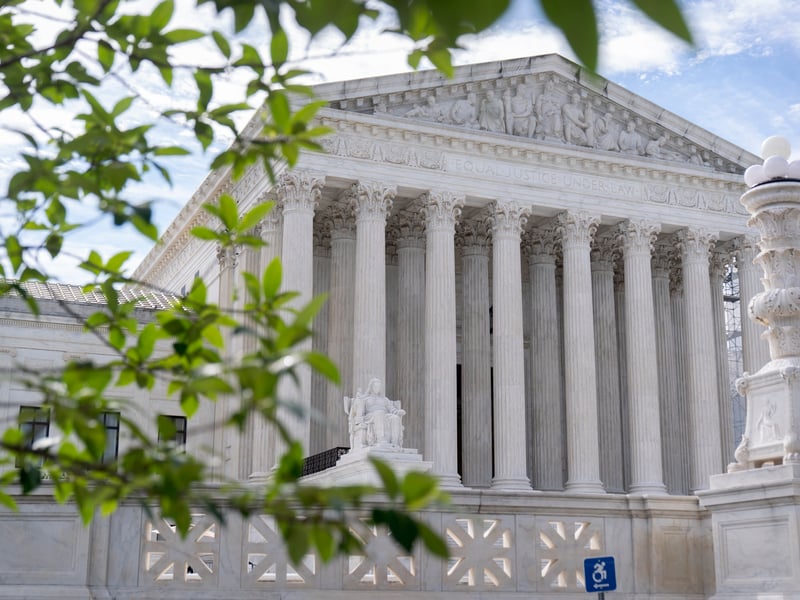
WASHINGTON (CN) — The Supreme Court will consider overturning nearly a century of precedent next month to give President Donald Trump broad authority over the executive branch.
At baseline, the Dec. 8 oral argument in *Trump v. Slaughter *will force the justices to fully confront the sweeping executive branch terminations they have greenlit on the shadow docket. But experts from both sides of the aisle said the justices’ ruling could have dire consequences for the rule of law and the U.S. constitutional system.
Retired federal judges warned that overruling the Supreme Court’s 1935 decision in Humphrey’s Executor v. United States could also open up presidential influence over independent regulatory bodies and shift the constitutional power balance that underpins the rule of law.
“Overruling Humphrey’s Executor would constitute an expansive constitutional reinterpretation of executive power conferring on the president absolute, unchecked removal authority,” a group of retired federal judges wrote. “This carries serious implications to the constitutional balance of powers and risks the constitutional equilibrium.”
If the court rules against Trump, however, conservative advocacy groups warned that unelected bureaucrats would undermine the public’s faith that the government was run by and for the people.
“At stake is not merely the structure of the government, but, more fundamentally, the ability of Americans to enjoy elective control over those who govern them,” New Civil Liberties Alliance wrote. “When agencies act independently of that control, they become free to rule Americans without electoral accountability, creating populist resentment and calling into question the democratic nature and very legitimacy of our government.”
One foot out the door
*Humphrey’s Executor *is a landmark ruling limiting presidential authority over regulatory commissions. The president appoints board members, who the Senate confirms. Members then maintain for-cause removal protections, creating limited circumstances for their termination, such as misconduct.
The 1935 precedent was born out of a dispute between President Franklin D. Roosevelt and a Republican member of the Federal Trade Commission. Roosevelt fired William Humphrey to install someone more ideologically aligned with the New Deal. Humphrey’s estate sued for back pay after he died, putting the question of presidential removals before the Supreme Court.
In a unanimous decision, the justices held that the president could remove a commissioner only for inefficiency, neglect of duty or malfeasance in office.
Over the last two decades, the Roberts court has chipped away at protections secured by Humphrey’s Executor. In 2010, the court ruled that Congress unlawfully protected a financial oversight board from presidential removal in Free Enterprise Fund v. Public Co. Accounting Oversight Board.
Chief Justice John Roberts said for-cause removal protections insulated the board members from presidential oversight, preventing the president from faithfully executing his oath of office. A decade later, in Seila Law LLC v. Consumer Financial Protection Bureau, Roberts cemented a legal rule barring any statute that limits the president’s ability to oversee the executive branch.
By September of this year, *Humphrey’s Executor *appeared to be a dead letter after the conservative majority allowed Trump to ignore the 90-year-old precedent to terminate Federal Trade Commissioner Rebecca Slaughter.
In the months prior, the Supreme Court gave Trump permission to terminate independent officials heading the National Labor Relations Board, Merit Systems Protection Board and Consumer Product Safety Commission.
However, Slaughter’s firing posed a direct challenge to Humphrey’s Executor because of the nearly identical underlying dispute. Although the justices allowed Trump to bypass the precedent on the shadow docket, the high court scheduled oral arguments to decide if Humphrey’s Executor should be overruled once and for all.
The headless fourth branch
Proponents of the unitary executive theory — a legal doctrine embracing an expansive version of the Constitution’s Article II — argue that Humphrey’s Executor created a well of unchecked bureaucratic power.
The Constitution requires that the president “take care that the laws be faithfully executed.” Trump says that removal power is an indispensable tool of control presidents must maintain to prevent transferring executive power to a “headless fourth branch.”
“Under our Constitution, the ‘buck stops with the president’ in no small part because he can ‘remove those who assist him in carrying out his duties,’” U.S. Solicitor General John Sauer wrote. “Congress and the courts cannot divert accountability ‘somewhere else’ by empowering unelected agency heads to wield executive power walled off from presidential control and electoral accountability.”
In Humphrey’s Executor, the court determined that the FTC was a quasi-legislative, quasi-judicial body that was disconnected from the executive branch. Trump argued that the assessment hasn’t withstood the test of time, stating the FTC and similar regulatory boards issue binding rules, adjudicate claims when businesses or individuals violate the law, investigate wrongdoing and bring civil suits seeking fines.
Trump pushed the justices to overrule Humphrey’s Executor, arguing it was “egregiously wrong from the start.”
“The notion that some agencies that exercise executive power can be sequestered from presidential control seriously offends the Constitution’s structure and the liberties that the separation of powers protects,” Sauer wrote. “Moreover, because Humphrey’s Executor was poorly reasoned, this court has repeatedly whittled its foundations away.”
The Cato Institute, a public policy research group, said it was important for the legislative, executive and judicial branches to remain independent of each other, rather than creating regulatory boards independent of presidential influence.
“Without this removal power, the executive power exists partly outside his control — resting instead with agency heads unaccountable to the people,” the group wrote. “Such a system has no place in our constitutional structure.”
A balm against industry capture
Slaughter said the justices need not look to executive power under Article II when Congress’ expansive Article I authority resolves the dispute. Under the necessary and proper clause, Slaughter argued, Congress can make all laws to carry out all constitutional powers vested throughout the government, including the executive.
Starting with the Sinking Fund Commission of 1790, Slaughter said Congress has exercised its powers to create multimember agencies with members protected from at-will removal. She argued that independent multi-member bodies reflect the larger values of the Constitution.
“Multimember agencies limit arbitrary decision-making by avoiding extreme concentrations of power and requiring both collective deliberation and individualized judgment,” Slaughter wrote. “They promote stability through commissioners’ staggered terms. And commissioners’ dissents can serve as fire alarms by alerting Congress, the public, and reviewing courts that an agency may be diverging from its mission.”
The FTC was created in 1914 to prevent unfair methods of competition in commerce. Throughout its history, the commission has enacted policies to protect consumers despite political opposition, such as requiring warnings on cigarettes in the 1960s.
Consumer advocates said it is vital that regulatory boards make decisions based on facts, rather than political ideology. Executive agencies like the Federal Aviation Administration can succumb to “agency capture,” the groups warned, which happens with corporate interests replacing the public-policy agenda of the agency.
The National Transportation Safety Board recommended that commercial airlines be equipped with smoke detectors in 1975, but it took over a decade and a fire that killed 23 passengers for the FAA to adopt the rule.
“When the independent NTSB called for the same safety measures to extend to older aircrafts, the nonindependent FAA again declined to act until after an airplane fire killed 110 people,” the groups wrote. “A congressional investigation later revealed that the FAA had rejected the NTSB recommendations due to its belief that ‘the gain in safety would not justify the cost.’”
Two roads diverged
Business groups backed Trump’s call to overturn Humphrey’s Executor, with one exception. The Chamber of Commerce argued that the president’s removal power does not extend to the Federal Reserve.
“The court should make clear that its ruling in this case does not implicate the Federal Reserve,” the chamber wrote. “Its independence is essential to the credibility of our monetary policy and the status of the US dollar as the preeminent global reserve currency.”
Trump attempted to fire Federal Reserve member Lisa Cook from the board of governors earlier this year. Unlike his attempts to fire members from other regulatory boards, Trump advanced unsubstantiated claims of mortgage fraud to justify Cook’s termination.
After she was reinstated by a lower court, Trump asked the justices to remove Cook from the board. The justices delayed a decision on Trump’s request, scheduling a separate argument in January.
 Follow @KelseyReichmann
 Follow @kelseyreichmann.bsky.social
Subscribe to our free newsletters
Our weekly newsletter Closing Arguments offers the latest about ongoing trials, major litigation and rulings in courthouses around the U.S. and the world, while the monthly Under the Lights dishes the legal dirt from Hollywood, sports, Big Tech and the arts.