
 Search Articles


MANHATTAN (CN) — President Donald Trump asked the Second Circuit Tuesday to overturn the $83.3 million defamation award jurors granted to writer E. Jean Carroll in the second of two trials concerning Trump’s denial that he sexually assaulted Carroll in the mid-1990s.
“This court should reverse to protect the presidency and to prevent drastic departure from its precedents,” attorney Justin Smith of James Otis Law Group argued before the three-judge panel.
Trump says presidential immunity protects him from Carroll’s claim that he defamed her in his 2019 remarks denying he’d ever even met her, who says Trump raped her in a dressing room at the famed Fifth Avenue department store Bergdorf Goodman.
Ahead of trial, in late 2023, the Second Circuit tossed out that very defense.
“Why wasn’t the immunity waived, and didn’t we already so hold?” U.S. Circuit Judge Denny Chin, a Barack Obama appointee, asked Smith.
Smith argued that presidential immunity is not waivable. He pointed to precedent in the 1979 Supreme Court decision United States v. Helstoski . The high court found that a member of Congress, who appeared before grand juries 10 times before invoking privilege under the speech or debate clause, had not waived that protection.
Whether or not Trump can waive his immunity, however, was not at issue in the Supreme Court case Trump now argues should grant him immunity against Carroll’s claims — that is, the court’s 2024 ruling in Trump v. United States , which granted him broad presidential immunity.
U.S. Circuit Judge Maria Araújo Kahn, a Joe Biden appointee, pressed Smith on the timing of the argument. Two years ago, then-Trump attorney Alina Habba conceded that if presidential immunity could be waived, then it had been.
“Why should that change now?” Kahn asked.
Smith argued that the Supreme Court’s subsequent immunity finding “cast doubt” on the circuit’s ruling and “results in the need for a different decision in this case.”
“There has been no finding that President Trump unequivocally and explicitly renounced his immunity in this case,” Smith argued.
Carroll’s attorney, Roberta Kaplan, looked to hang Trump on his words when Carroll’s first lawsuit was still in state court.
In a February 2020 letter to the court, Trump wrote that “no one is seeking to ‘escape accountability’ here. Plaintiff is free to pursue this action when the president is no longer in office.”
Trump’s appellate cases have so far gone the same way as his two losing defenses against Carroll’s claims. On June 13, the Second Circuit en banc affirmed Carroll’s first win against Trump. Jurors in that case awarded Carroll $5 million.
“If that doesn’t mean explicitly and unequivocally that Donald Trump would not be asserting absolute immunity later in the case, then I’m not sure what it was intended to convey,” Kaplan said.
In terms of the jury’s award, the $65 million punitive damages award was high, Kaplan said, “but so was the situation,” she said.
Carroll continues to receive horrific death and rape threats on a daily basis, Kaplan said.
“She lies in a world, as she said, that is incomprehensible to most of us — where every day she has to worry if someone spurred on by those statements in 2019 is going to try to do her harm,” Kaplan said.
In addition, “President Trump showed up at this trial, showed his hatred and disdain for Ms. Carroll every single day in that courtroom”; continued to defame her in post-trial press conferences; disobeyed judge’s orders; and posted on Truth Social about evidence the trial judge ruled inadmissible.
“I don’t think there’s a record like that in any case, anywhere,” Kaplan said, and it “certainly justified” the jury’s price tag.
Smith said the court should have limited punitive damages to a one-to-one scale, citing the lack of testimony about specific medical conditions: “This case clearly falls in the garden variety category.”
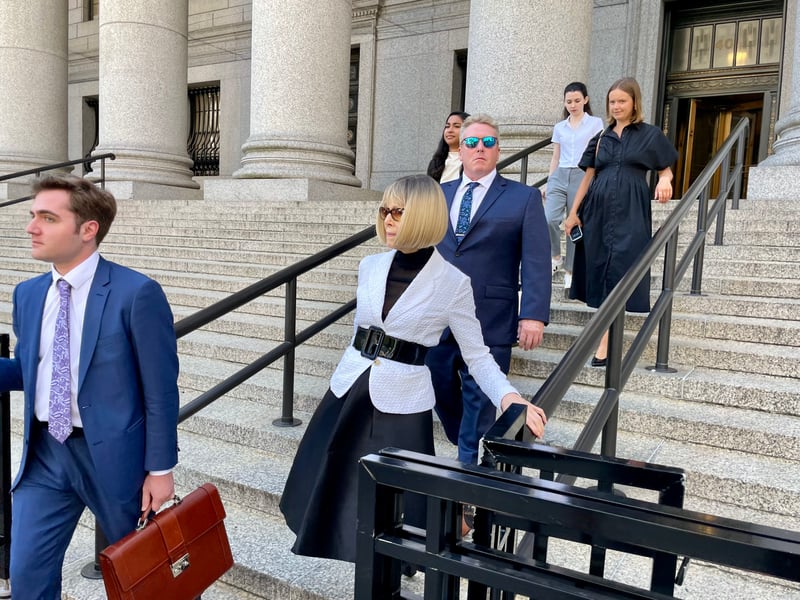
Exiting court, Carroll kept her comment on the hearing brief and positive.
“It went very well,” she told Courthouse News.
U.S. Circuit Judge Sarah A.L. Merriam, a Joe Biden appointee, completed the panel, which reserved ruling.
 Follow @NinaPullano
Subscribe to our free newsletters
Our weekly newsletter Closing Arguments offers the latest about ongoing trials, major litigation and rulings in courthouses around the U.S. and the world, while the monthly Under the Lights dishes the legal dirt from Hollywood, sports, Big Tech and the arts.