
 Search Articles


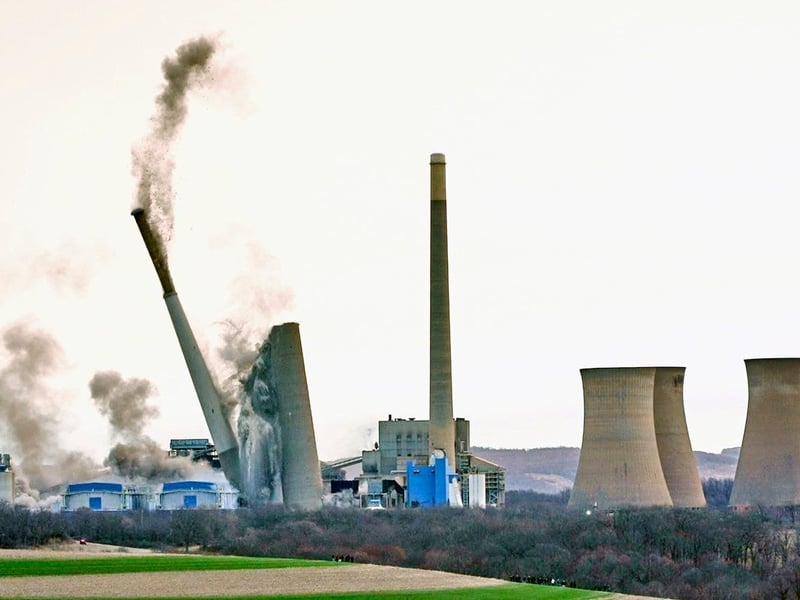
(CN) — President Donald Trump signed four executive orders on Tuesday aimed at boosting the declining U.S. coal industry.
Standing in front of a group of coal miners in hard hats at the White House, Trump announced that he is “bringing back an industry that was abandoned” as part of his efforts to roll back some of former President Joe Biden’s climate and environmental regulations and to meet the nation’s rising power demand.
Driven by data center growth and transportation electrification, U.S. electricity demand will increase 2% annually and 50% by 2050, the National Electrical Manufacturers Association said in a study published Monday.
The executive orders allow for some older coal-fired power plants set for closure to remain operating, accelerate funding permits for new coal projects on federal land, put a moratorium on coal policies issued by his predecessor and direct the executive branch to ensure its positions are not discriminatory against coal industries.
Trump also signed an order directing the Justice Department to “vigorously” investigate policies that “discriminate” against coal issued by Democratic-controlled states to determine if they are illegal.
He said he also plans on enshrining guaranteed protections for coal mining industries from future elected officials who may seek to shut them down.
“They’ll have to go through hell to close it up,” Trump said.
The Republican added that he will be granting “immediate relief” to 47 companies operating 66 coal plants in the country.
The Interior Department has already approved an expansion of a Montana coal mine, and the Bureau of Land Management is considering an “emergency” lease to mine coal on public lands in North Dakota, after Trump issued executive orders in January to prioritize energy development by lifting regulations that impede development of fossil fuels.
As a result, the Environmental Protection Agency last month began the process of dismantling certain restrictions on coal plants’ carbon emissions, mercury pollution and wastewater runoff.
“Our electric cooperative in Kentucky understands the importance of reliable, affordable and American-made energy, especially coal and natural gas. Coal fuels most of the electricity generated by our cooperative,” Tony Campbell, president of the East Kentucky Power Cooperative, said onstage alongside Trump. “America will need more electric-generated power such as coal.”
The National Mining Association, an industry lobbying group, praised Trump for reversing what it called the Biden administration’s “hostility” toward fossil fuels.
“Today’s reported executive actions by President Trump clearly prioritize how to responsibly keep the lights on, recognize the enormous strategic value of American mined coal and embrace the economic opportunity that comes from American energy abundance,” Rich Nolan, the association’s president, said in a statement. “It’s a stark shift from the prior administration’s punitive regulatory agenda, hostile energy policies and unlawful land grabs.”
Despite Trump’s repeated references to what he calls “beautiful, clean coal,” its electricity generation accounts for one-quarter of U.S. carbon emissions, according to the EPA. His long-standing promises to reverse coal plant closures face opposition from environmentalists who fear the implications on climate change and air pollution.
However, the industry surrounding the heavily polluting fuel has been in dramatic decline for decades, amid surging investments in U.S. natural gas production and technological innovation that has slashed the cost of renewable energy.
Facing competition from cheaper and cleaner natural gas sources, 290 coal power plants, representing 40% of the U.S. coal generating capacity, closed between 2010 and May 2019.
In 2023, coal accounted for about 16% of U.S. electricity generation, with natural gas being the largest source at 43% and fossil fuels overall making up about 60% of the total, according to the U.S. Energy Information Administration.
But companies that are acquiring data centers to power the constant demand for artificial intelligence and computing services are seeking more energy sources as the massive facilities consume huge amounts of electricity. They are turning to coal-fired electricity because it can run around the clock with only periodic downtime for maintenance, unlike solar and wind power, which are subject to vagaries of weather conditions unless they’re paired with battery storage.
There are now over 5,000 data centers in the country, with new ones being built every day, each consuming as much electricity as 50,000 homes.
But while tech firms that want off-the-grid power might invest in a coal-fired power plant that would be cheaper to operate, such retiring plants need time to fire back up, unlike natural gas plants that can stop and start generation daily.
At the front line of what Trump’s allies call the “war on coal” is the Powder River Basin of Wyoming and Montana, a sparsely populated section of the Great Plains with the nation’s largest coal mines. It’s also home to a massive coal-generating power plant in Colstrip, Montana, that emits more toxic air pollutants such as arsenic, lead and mercury than any other U.S. facility of its kind, according to the EPA.
On Tuesday, Trump said he also plans to revive coal-powered plants set for retirement under the Biden administration in Arizona and West Virginia.
 Follow @Megwiththenews
Subscribe to our free newsletters
Our weekly newsletter Closing Arguments offers the latest about ongoing trials, major litigation and rulings in courthouses around the U.S. and the world, while the monthly Under the Lights dishes the legal dirt from Hollywood, sports, Big Tech and the arts.