
 Search Articles


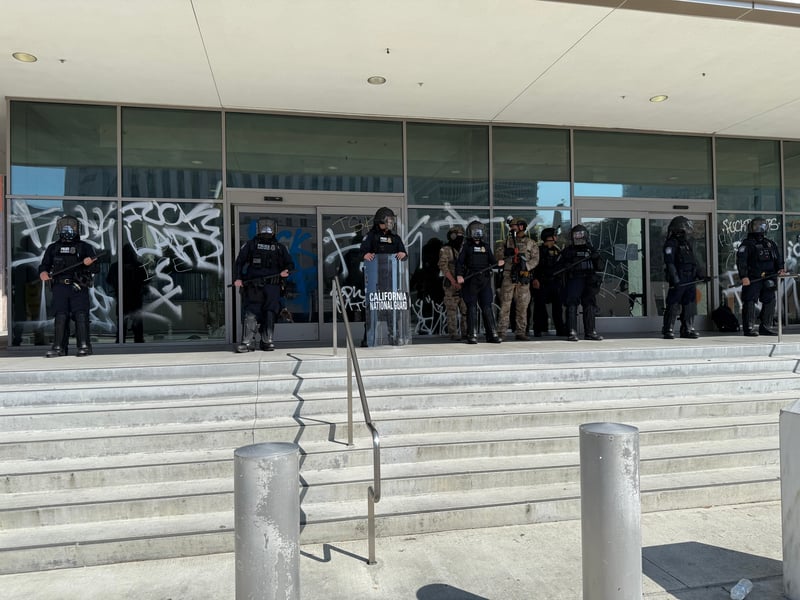
SAN FRANCISCO (CN) — A Ninth Circuit panel of judges seemed to bristle at arguments by President Donald Trump on Tuesday that his federalization of the California National Guard in the Los Angeles anti-ICE protests was “unreviewable” by the courts.
“Courts don’t just defer to the president’s judgment — they don’t review the president’s judgment,” attorney Brett A. Shumate of the U.S. Attorney’s Office, which represented Trump, told the panel.
The president’s position is part of his high-profile struggle with California Governor Gavin Newsom over control of the National Guard, which Newsom argues has been unlawfully deployed without his consent.to the Los Angeles protests against immigration enforcement actions by U.S. Immigration and Customs Enforcement.
The White House was absolute in its view, even going as far as saying that a president could hypothetically call up the militia of every state at once in an action that would still be unreviewable by the courts.
“Our view is that the statute commits the decision whether to call up the forces to the president’s unreviewable discretion. So no, there’s no role for the court to play in reviewing that decision,” Shumate said.
The president called Newsom’s view of the law was “extraordinarily dangerous,” saying it would essentially allow the governor a “pocket veto” on the president’s actions if the court were to side with him.
Ultimately, the government asked the panel for an immediate stay of a lower court ruling that would otherwise bar it from taking control of the state National Guard without Newsom’s permission.
Meanwhile, Newsom said that such a decision would “profoundly injure” both California and the U.S. by harming state sovereignty and allowing the president to reach for the most extreme means of enforcing the law without first considering “more modest” alternatives to a military response.
Newsom further cautioned the panel against violating the “strong norm” in this country that keeps military involvement out of “civilian affairs.”
U.S. Circuit Judge Mark Jeremy Bennett, a Trump appointee, pinpointed the issue before the panel in a question to Newsom’s attorneys: “How much discretion does the president have when it comes to when to federalize?”
The panel heard arguments Tuesday from both Newsom and Trump but gave no timeline for a ruling. Just over a week ago, Newsom sued the president for taking control of the California National Guard, claiming the deployment violates the Constitution and federal law by bypassing the governor’s consent. He warned that the move threatens state sovereignty and could escalate unrest.
The White House said in court that the National Guard currently plays an essential role in quelling the “sustained mob violence” against ICE agents and federal law enforcement in L.A.
Trump reiterated claims that he followed federal rules that these orders “shall be issued through the governors of the states,” stressing that the troops were ultimately federalized by the adjutant general, a senior member of the state National Guard, acting on Newsom’s behalf.
Trump defended his decision by citing Title 10, Section 12406 of the U.S. Code, which allows federal use of state National Guard troops during a “danger of rebellion.” He argued in court filings that such actions aren’t subject to judicial review, saying federal law leaves those decisions to the president.
“Nearly 200 years ago, the Supreme Court made clear that these judgment calls are for the president to make, not a governor, and certainly not a federal court,” he said, citing Martin v. Mott .
Overall, the president said that requiring a governor’s consent to activate the National Guard could create a poor legal precedent.
“Nothing in the statute requires the governor’s consent to mobilization — a legal theory that would have empowered the governor of Arkansas to block President Eisenhower from deploying the National Guard to desegregate Arkansas’ public school,” the White House said in its filings.
Newsom countered that Trump’s interpretation of federal law would empower the president to commandeer a state’s National Guard based merely on evidence that some civilians opposed his authority, disobeyed his commands or presented difficulties for local law enforcement.
“Considered individually, defendants’ legal arguments are meritless. Considered in the aggregate, they are terrifying,” Newsom said in court documents.
Carl Tobias, a Law Professor at the University of Richmond, said he thought the proceedings went “reasonably well” for California and said that Bennett could be a key figure in the decision.
“I think he has a pretty centrist, moderate kind of reputation as a former attorney general for Hawaii and then on the court. He was the senior judge on the panel, and I thought the others were deferring to him to some extent,” Tobias told Courthouse News.
The panel was rounded out by U.S. Circuit Judges Eric D. Miller, another Trump appointee, and Jennifer Sung, a Joe Biden appointee.
Tobias also noted that the panel seemed impressed by Newsom’s arguments that the deployment of one-third of the National Guard to L.A. diverted resources from their other core functions, like responding to emergencies and fighting wildfires.
Tobias also expected that the panel would rule soon, given the urgency of the issue, although he said it was anyone’s guess what the decision would be.
“Oral argument is always hard to read what is happening there,” Tobias told Courthouse News.
Despite a brief court victory for Newsom last week, a Ninth Circuit Court of Appeals panel ruled that the president could keep “federalizing” the state’s National Guard during protests over ICE immigration raids while the matter was appealed.
This case was filed in the Northern District of California and heard remotely.
The L.A.-based protests have spread nationwide since early June. Their messages were only further amplified by the “No Kings” protests on June 14, which opposed Donald Trump’s recent policies.
Subscribe to our free newsletters
Our weekly newsletter Closing Arguments offers the latest about ongoing trials, major litigation and rulings in courthouses around the U.S. and the world, while the monthly Under the Lights dishes the legal dirt from Hollywood, sports, Big Tech and the arts.