
 Search Articles


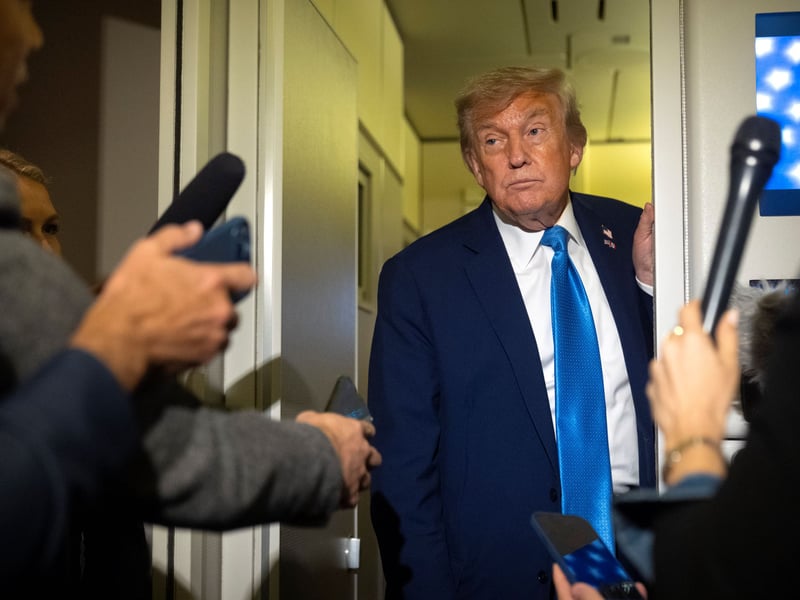
WASHINGTON (CN) — President Donald Trump on Wednesday said the White House would need to take “long-term” control of the Washington, D.C., Metropolitan Police Department as part of his administration’s crackdown on the capital city.
The president suggested that he could seize that authority without congressional approval and in violation of federal law.
Trump announced Monday he would invoke a 1973 D.C. Home Rule Act provision, which gives the president limited power to federalize the capital’s police force, citing “special conditions of an emergency nature.” He also mobilized 800 National Guard members and hundreds of federal agents for what he called a “massive enforcement operation” tackling crime and relocating the homeless.
Federal law sets clear limits on the White House’s power to federalize D.C. police, allowing presidents to federalize D.C. police for 48 hours without notice, or up to 30 days with congressional notification.
However, at a news conference Wednesday, Trump said that the monthlong period would not be enough.
“We’re going to be asking for extensions on that,” he said. “Long-term extensions, because you can’t have 30 days.”
Although Trump said the White House would be “asking” to extend its authority to federalize D.C. police, he suggested the administration could keep control of the MPD without lawmakers’ approval. He cited his deployment of thousands of military personnel to the southern border as proof.
“Everyone said it would take years, and you’d have to go back to Congress — I never went back to Congress for anything,” Trump said. “I just said, ‘close the border,’ and they closed the border.”
The president added that if he declared a “national emergency,” the White House could federalize D.C. police without Congress’ involvement. It was unclear whether he meant the initial 30-day window under the Home Rule Act or an extension to that authority.
Any attempt to extend control of the MPD would likely face a legal challenge from the city, which has condemned the move as an unprecedented bid to assert federal power over its justice system.
The 30-day window for federalizing the MPD expires early next month, shortly after lawmakers return from their August recess.
As Trump toys with extending his control over the D.C. police department, the National Guard on Wednesday began its first full day of deployment in the nation’s capital. The guard will largely be tasked with protecting federal buildings and supporting law enforcement — they are not trained to make arrests.
Federal agents from an assortment of agencies, including the FBI and Homeland Security Department, were spotted across the nation’s capital Tuesday night, patrolling D.C.’s Union Station and its Shaw neighborhood, among others. Law enforcement presence was heightened even in areas not traditionally associated with high crime rates, such as Georgetown.
The Trump administration has long accused the D.C. government of failing to properly address crime in the capital city, though recent statistics show that violent crime rates in D.C. are at a 30-year low and have dropped significantly. Crime in D.C. spiked in 2023, which local officials have blamed on the aftermath of the COVID-19 pandemic.
Critics of Trump’s D.C. crackdown have framed it as an authoritarian show of force, warning that the administration’s strategy could serve as a blueprint for other major cities.
Speaking to reporters on Wednesday, Trump said he would ask Congress to pass crime legislation for D.C., which he described as a “very positive example.”
“We expect to be before Congress very quickly,” he said. “We’re going to need a crime bill that we’re putting in.”
Beyond cracking down on crime in D.C., the president has also signaled his desire to take more control over the capital city’s physical appearance. On Monday, Trump mused about the state of “medians” on the city’s roadways — and on Wednesday, he turned his attention to D.C.’s parks, which he said were “old, tired and exhausted.”
“I know a lot about grass, because I own a lot of golf courses,” said the president.
 Follow @BenjaminSWeiss
Subscribe to our free newsletters
Our weekly newsletter Closing Arguments offers the latest about ongoing trials, major litigation and rulings in courthouses around the U.S. and the world, while the monthly Under the Lights dishes the legal dirt from Hollywood, sports, Big Tech and the arts.