
 Search Articles


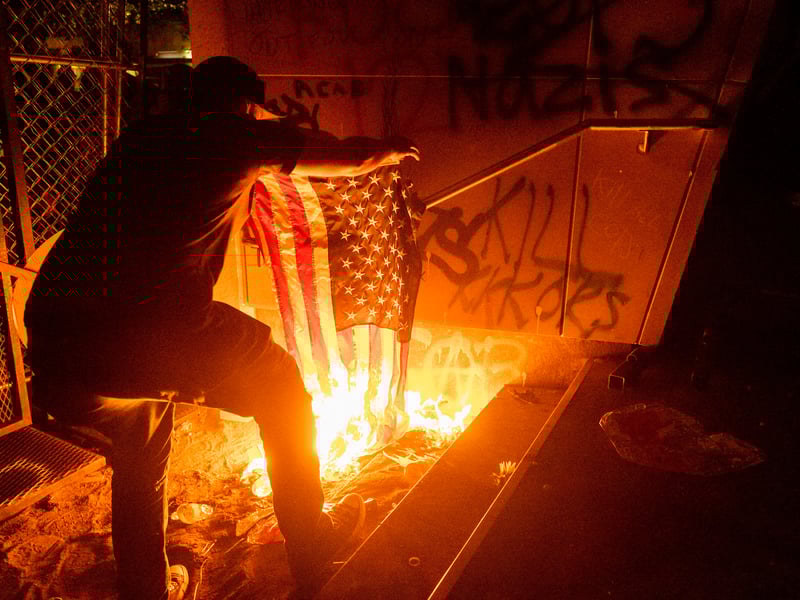
WASHINGTON (CN) — President Donald Trump on Monday signed an executive order aimed at cracking down on flag burning as a form of protest, a move that has already drawn criticism as a potential violation of protected speech under the First Amendment.
The decree, which seeks to tie flag burning to a wide array of crimes, appears designed to relitigate more than 30 years of Supreme Court precedent shielding the act as a constitutional form of protest.
“When you burn the American flag, it incites riots, at levels we’ve never seen before,” Trump told reporters in the Oval Office on Monday. “People go crazy.”
The executive order doesn’t make flag burning a standalone crime but directs the Justice Department to prosecute cases that “violate applicable, content-neutral laws, while causing harm unrelated to expression consistent with the First Amendment.” Offenses could include violent crime, hate crimes, illegal discrimination, or local laws against open burning and disorderly conduct.
It also targets non-citizens and visa holders, instructing the Secretary of State and the Secretary of Homeland Security to deny or revoke visas, residency, or naturalization for individuals who burn the flag under the new criminal framework.
The order is aimed at prosecuting people who “incite violence or otherwise violate our laws while desecrating” the American flag, the administration said.
Trump said Monday that the penalty for burning the flag would be one year in prison, “no early exits, no nothing.” The order itself does not enumerate a sentence for the offense.
“The people in this country don’t want to see our American flag burned and spit on,” the president added.
Trump has long argued that flag burning should be criminal, but that view conflicts with Supreme Court precedent. In 1989, Texas v. Johnson , the Supreme Court ruled flag burning is protected First Amendment speech, and has also held that laws passed by Congress aimed at criminalizing the act are unconstitutional.
Still, the president said Monday that it was a “very sad court” that handed down those rulings.
The White House executive order contended that certain aspects of the issue had yet to be litigated by the Supreme Court and that there was legal leeway for the administration to regulate flag burning. “[T]he Court has never held that American Flag desecration conducted in a manner that is likely to incite imminent lawless action or that it an action amounting to ‘fighting words’ is constitutionally protected,” the directive read.
Members of Congress, including Democrats and even some Republicans, chimed in Monday to criticize Trump’s order as an assault on settled constitutional rights.
“If Trump wants to throw the book at people who commit ‘violent crime’ while desecrating the American flag, why did he pardon people who on Jan. 6, 2021, violently assaulted our cops with American flags-on-poles, calling them heroes and rewarding their bloody flag desecration?” wrote Maryland Representative Jamie Raskin in a post on X.
Kentucky Representative Thomas Massie, a Republican, slammed any executive action to clamp down on burning the American flag.
“Neither Congress nor the President nor a Judge can make it illegal,” he said.
Other Republicans, however, congratulated the president on his order. Wyoming Senator Cynthia Lummis offered her full support for measures to criminalize flag burning.
“In Wyoming, we honor the American flag, we don’t desecrate it,” said Lummis. “I urge Democrats & left-wing protesters to stop this grotesque & offensive American flag burning & come together in treating the flag with dignity.”
But despite complaints and plaudits from lawmakers over Trump’s crusade against flag-burners, some legal experts were skeptical. Matthew Glassman, a senior fellow at Georgetown University’s Government Affairs Institute, said that laws targeting the protest were the “greatest gambit of right populism.”
“[T]hey pit a pure expression of nationalism against a pure expression of liberalism; have almost no substantive opposition; and are strong grist of elite conspiracy when inevitably struck down,” said Glassman. “A flag burning news cycle is also a great marker of ‘late in the August recess’ D.C.,” he added.
Trump has for years said that burning the American flag should be a crime. Weeks after winning the election for his first term in 2016, the then-president-elect made a similar call.
“Nobody should be allowed to burn the American flag — if they do, there must be consequences — perhaps loss of citizenship or year in jail!” he wrote at the time.
 Follow @BenjaminSWeiss
Subscribe to our free newsletters
Our weekly newsletter Closing Arguments offers the latest about ongoing trials, major litigation and rulings in courthouses around the U.S. and the world, while the monthly Under the Lights dishes the legal dirt from Hollywood, sports, Big Tech and the arts.