
 Search Articles


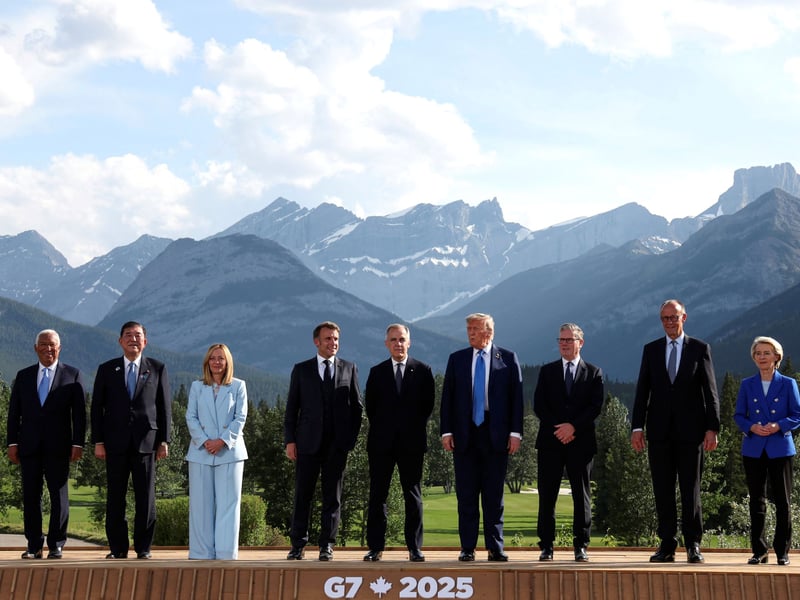
BRUSSELS (CN) — Before his abrupt departure Monday night, President Donald Trump secured concrete trade agreements with key allies at the G7 summit in western Canada, potentially reshaping the landscape for cross-border commerce while the European Union pivoted toward building a coordinated regulatory response to Chinese market practices.
Trump’s early departure from the summit, citing Middle East developments, means he will miss meetings with non-G7 leaders Tuesday, including Indian Prime Minister Narendra Modi and Ukrainian President Volodymyr Zelenskyy. His absence could affect ongoing discussions about trade agreements and security partnerships.
The summit’s approach to Middle East tensions was notably restrained, with G7 leaders issuing only a brief statement reaffirming Israel’s right to self-defense and calling Iran “the principal source of regional instability.”
Trump joined the other leaders in issuing a statement saying Iran “can never have a nuclear weapon” and calling for a “de-escalation of hostilities in the Middle East, including a ceasefire in Gaza.”
The limited response reflects this year’s modified summit format, which avoids a traditional joint communiqué in favor of short statements on specific issues — a diplomatic strategy designed to prevent the kind of breakdown that occurred when Canada last hosted in 2018, when Trump withdrew his support for the final statement and publicly attacked then-Prime Minister Justin Trudeau over tariff disputes.
Trade deals signal regulatory shift
Trump finalized a U.K.-U.S. trade deal with Prime Minister Keir Starmer that eliminates tariffs on British aerospace and reduces automotive duties from 25% to 10%, potentially providing a framework for resolving disputes in sectors that have faced uncertainty.
He said Tuesday that the European Union had yet to offer a “fair deal” on trade.
“We’re talking but I don’t feel that they’re offering a fair deal yet,” Trump said, speaking to reporters aboard Air Force One before arriving back in the United States. “And we’re either going to make a good deal or they’ll just pay whatever we say they will pay.”
At the summit, the president agreed with Canadian Prime Minister Mark Carney to pursue a comprehensive trade deal within 30 days, setting a timeline that could affect pending trade negotiations between the countries. Canada imposed 25% retaliatory tariffs on $30 billion worth of U.S. goods in March.
In their bilateral meeting, Trump immediately argued that removing Russia from the G8 was a mistake, claiming there would be no war in Ukraine if Russia had remained in the group. Russia was expelled from the G8 in 2014 following its annexation of Crimea, though Trump incorrectly attributed the decision to former Prime Minister Justin Trudeau when it actually occurred under Stephen Harper’s government.
Despite the diplomatic tangent, Trump offered an optimistic assessment of trade negotiations with Canada, acknowledging fundamental differences in approach.
“There’s not so much holding up. I think we have different concepts. I have a tariff concept. Mark has a different concept, which is something that some people like,” Trump told reporters. “I’m a tariff person. I’ve always been a tariff person. It’s simple, it’s easy, it’s precise, and it just goes very quickly. And I think Mark has a more complex idea, but also very good.”
The agreements come as Trump’s administration faces multiple trade-related challenges and reviews, with the new deals potentially providing frameworks that could influence ongoing disputes over tariff authorities and trade remedy procedures.
EU targets China’s ‘weaponized’ trade practices
European Commission President Ursula von der Leyen used the summit to outline what she termed a “new China shock” — Beijing’s flooding of global markets with subsidized goods — while proposing coordinated G7 regulatory responses that could establish new precedents for addressing non-market economies.
“China is using this quasi-monopoly not only as a bargaining chip, but also weaponizing it to undermine competitors in key industries,” von der Leyen said, holding up a rare earth magnet as evidence of supply chain vulnerabilities. Her remarks suggested potential new regulatory frameworks that could affect trade law interpretations and anti-dumping procedures.
Von der Leyen’s focus on China appeared calculated to align with Trump’s trade priorities while avoiding contentious discussions about U.S. tariff policies that have triggered retaliatory measures and spawned numerous trade disputes. The approach reflected a broader pattern among Western leaders, who adopted notably cautious, non-confrontational strategies with Trump throughout the summit, signaling a diplomatic shift from previous tensions.
The EU president proposed creating a “metals club” to coordinate responses to Chinese steel dumping — a mechanism that could establish new multilateral frameworks for addressing trade distortions and potentially influence how U.S. trade authorities interpret similar cases involving subsidized imports.
Von der Leyen’s China strategy included proposals for diversifying critical supply chains and building “an alternative network of trusted suppliers” — initiatives that could require new frameworks for supply chain due diligence and could influence how authorities interpret national security exceptions in trade policy.
The China focus builds on existing partnerships among G7 allies, including the U.K.-Canada agreement announced before the summit that established joint initiatives in semiconductors, quantum communications and artificial intelligence. That deal, which includes Canada’s commitment to ratify Britain’s entry into the Comprehensive and Progressive Trans-Pacific Partnership, explicitly excludes China and operates independently of U.S. trade policy.
The EU chief’s approach reflected what she called a strategy of “de-risking, not de-coupling” from China, potentially establishing distinctions that could affect how trade authorities evaluate economic security measures versus protectionist policies.
EU seeks Iran diplomatic role
Meanwhile, EU High Representative Kaja Kallas issued separate warnings about Iran’s nuclear program from Brussels following an emergency EU Foreign Affairs ministers meeting Tuesday morning. She called Tehran’s activities “unacceptable” and cited International Atomic Energy Agency findings that Iran is breaching non-proliferation obligations, statements that could affect interpretations of sanctions compliance and nuclear-related trade restrictions.
Kallas positioned the EU as a potential mediator in Iran-U.S. talks that have reached “some kind of a standstill,” while emphasizing that “Russia cannot be a mediator” given its military cooperation with Tehran. However, the diplomatic positioning remains largely rhetorical, with no concrete mediation or timeline established, suggesting the EU’s role may influence future sanctions enforcement discussions more than immediate conflict resolution.
The G7 summit continues Tuesday with working sessions where the implications of the new trade frameworks will likely face further discussion, particularly as European leaders meet with non-G7 partners to explore broader multilateral approaches to economic security challenges. Tuesday’s agenda is expected to focus on Russian sanctions and Middle East developments, topics that received limited attention during Monday’s China-focused discussions.
Subscribe to our free newsletters
Our weekly newsletter Closing Arguments offers the latest about ongoing trials, major litigation and rulings in courthouses around the U.S. and the world, while the monthly Under the Lights dishes the legal dirt from Hollywood, sports, Big Tech and the arts.