
 Search Articles


WASHINGTON (CN) — President Donald Trump asked the Supreme Court on Wednesday night to take extraordinary actions to uphold his authority to unilaterally wage a global tariff war.
The government pushed the justices to undertake a rushed review of Trump’s “Liberation Day” tariffs in a matter of weeks. Under normal circumstances, such an appeal would require months of consideration, but the White House warned that an appeals court ruling had already undermined Trump’s authority on the world stage.
“World leaders are questioning the president’s authority to impose tariffs, walking away from delaying negotiations, and/or imposing a different calculus on their negotiating positions,” Treasury Secretary Scott Bessent wrote in a declaration to the court.
U.S. Solicitor General John Sauer gave the justices a Wednesday deadline to decide whether to review the petition. After an expedited briefing schedule, the government suggested holding oral arguments in the first week of November.
The high court ceded to a similar request when Trump asked the justices to review his attempt to limit birthright citizenship nationwide.
Trump claimed vast executive authority in April to levy “Liberation Day” tariffs under the International Emergency Economic Powers Act, a Nixon-era law granting presidents broad authority over economic matters during emergencies. IEEPA, as the 1977 statute is commonly known, was designed to curb earlier emergency powers under the Trading with the Enemy Act.
Instead, Trump declared a national emergency on trade deficits and fentanyl trafficking to implement sweeping global tariffs without congressional authority.
A federal appeals court rejected Trump’s novel use of the statute, ruling the president’s authority to regulate imports under IEEPA does not include sweeping “reciprocal” or trafficking tariffs.
“Reading the phrase ‘regulate … importation’ to include imposing these tariffs is ‘a wafer-thin reed on which to rest such sweeping power,’” the court wrote.
The White House claimed the ruling “cast a pall of legal uncertainty over the president’s efforts to protect our country by preventing an unprecedented economic and foreign policy crisis,” Sauer wrote in Trump’s appeal at the high court.
Bessent suggested that any delay in correcting the appeals court’s erroneous ruling could leave up to $1 trillion in tariffs in limbo.
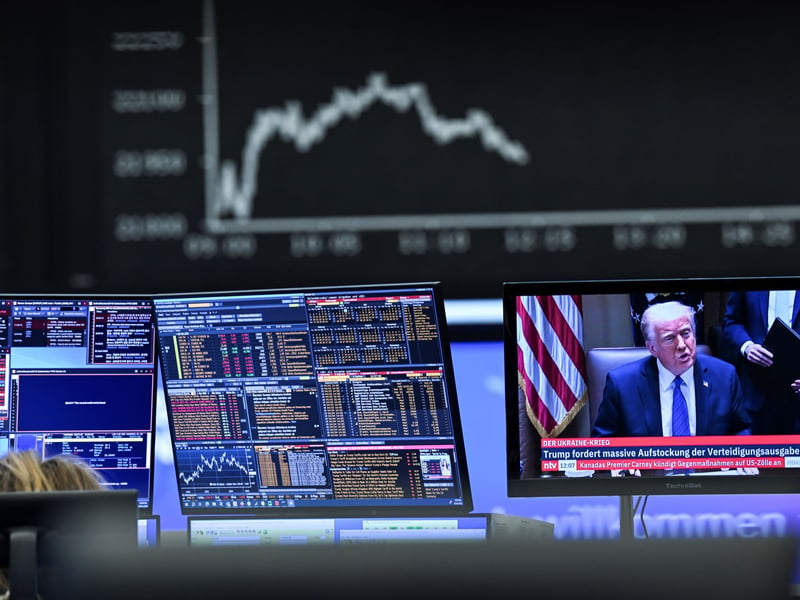
Trump implemented blanket 10% tariffs and varied “reciprocal” tariffs on April 2, leading to a stock market meltdown and a subsequent 90-day pause.
A coalition of small businesses and 12 states sued the administration, claiming that Trump’s blanket tariffs were unlawful under the major questions doctrine — a legal theory endorsed by the Supreme Court to shut down President Joe Biden’s student loan forgiveness plan. Under the major questions doctrine, executive agencies can only act on issues of national significance with clear congressional authorization.
The D.C. Circuit noted that Trump’s tariffs are projected to have a much larger economic impact than either of the two cases the Supreme Court found implicated the major questions doctrine — Biden v. Nebraska and Alabama Association of Realtors v. Department of Health & Human Services — where the cases were expected to leave a $50 billion and $519 billion impact, respectively.
“As noted, the government’s estimates of the reciprocal and trafficking tariff’s impacts are at least five times larger,” the court wrote. “And given the president’s continued invocation of IEEPA to impose additional expansive tariffs during the pendency of this appeal, the overall economic impact of the tariffs imposed under the government’s reading of IEEPA is even larger still.”
Brent Skorup, a legal fellow at the CATO Institute, said that while the appeals court’s ruling left the tariffs in place for now, the administration should rescind its duties and follow precedent.
“The government’s reliance on IEEPA as a source of tariff authority misreads the statute and departs from longstanding legal tradition,” Skorup said in a statement. “The Constitution, IEEPA’s text, and more than two centuries of history all point in the same direction: Tariff authority rests with Congress. The court was right to reject the president’s novel interpretation.”
If the Supreme Court is interested in taking up Trump’s request, the justices will likely ask the businesses and states to file a response to the petition in the coming days.
 Follow @KelseyReichmann
 Follow @kelseyreichmann.bsky.social
Subscribe to our free newsletters
Our weekly newsletter Closing Arguments offers the latest about ongoing trials, major litigation and rulings in courthouses around the U.S. and the world, while the monthly Under the Lights dishes the legal dirt from Hollywood, sports, Big Tech and the arts.