
 Search Articles


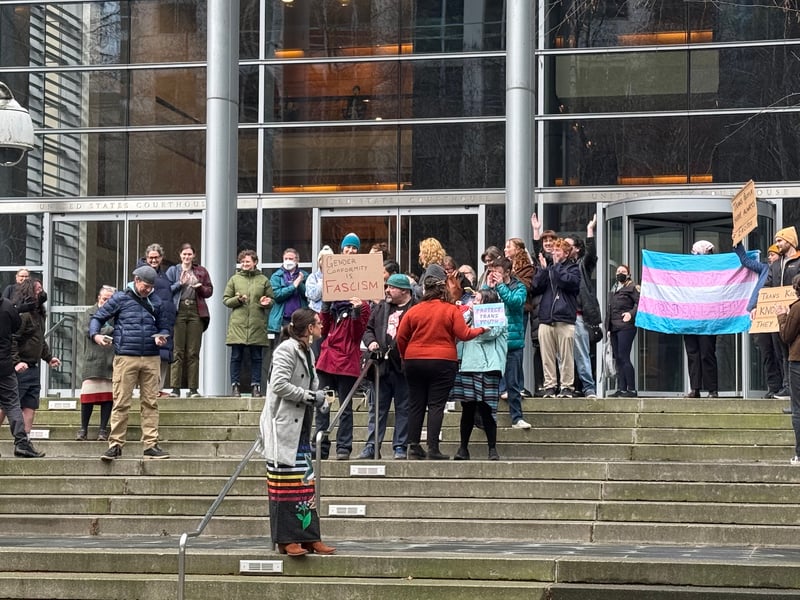
SEATTLE (CN) — The Trump administration on Thursday told the Ninth Circuit it should be allowed to implement its executive orders targeting gender-affirming care and urged the court to toss an injunction in Washington and other states that sued stop them.
“The president does not need to have affirmative authority to give instructions to his subordinates to analyze their authorities,” argued Eric Dean McArthur, Justice Department attorney.
President Donald Trump issued two executive orders targeting gender-affirming care shortly after taking office last year. The first, titled “Defending Women from Gender Ideology Extremism and Restoring Biological Truth to the Federal Government,” stripped federal funding from any federal institution that promoted “gender ideology” by accepting and recognizing the existence of transgender people.
The second, titled “Protecting Children from Chemical and Surgical Mutilation,” directed executive departments to pull funding from any medical institutions providing gender-affirming care to patients under 19. Gender-affirming care includes treatments like reversible puberty blockers and hormone therapy.
After Trump issued the orders, two agencies issued notices to grant recipients stating that grant funds cannot be used for purposes that don’t align with the orders. The notices were later rescinded.
Washington — joined by Minnesota, Oregon, Colorado and three individual doctors — sued the administration and quickly won an injunction from U.S. District Judge Lauren King.
Before the Ninth Circuit, the Trump administration argued the states and doctors sued too soon.
“The most salient aspect of this case is that, rather than await any particular agency action implementing the executive orders, plaintiffs brought a facial challenge to the executive orders themselves,” McArthur argued.
But U.S. Circuit Judge Richard Paez, a Bill Clinton appointee, pushed back on that.
“You know, I’m not a great academic scholar here, but as I understand standing, there was injury in fact, correct?” Paez asked.
McArthur argued the states and doctors had not shown that the funding notices had affected their funding.
“What plaintiffs are essentially asking you to do in this case is to pre-adjudicate … hypothetical disputes before the agencies have even proposed, let alone taken any action or set out what the statutory authorities they have or done the relevant legal and factual analysis to determine whether they can, in fact, implement the policies set out,” McArthur said.
U.S. Circuit Judge Margaret McKeown, a Bill Clinton appointee, noted the language within the orders clearly directed agencies to take steps to end federal funding.
“ It’s not a directive of like, ‘Think about this, figure out what you’re gonna do,’” McKeown said. “It says, ‘End. No more.’ So how could that be any clearer?”
But the government argued Trump was merely directing agencies to use their discretion to implement his priorities within the bounds of existing law.
“ We have 15 agency defendants with who knows how many different grant programs under who knows how many different statutes,” McArthur said. “Obviously, the president, as the head of the executive branch, doesn’t have the time to do all of that work.”
The states and doctors argued Trump lacked the authority to add conditions to grants that are not authorized by statute.
“The executive orders that we challenge in this case are profoundly harmful and hateful, but for today’s purposes, what matters most is that they’re unconstitutional under this court’s binding precedent,” said Noah Purcell, Washington solicitor general.
U.S. Circuit Judge Daniel Bress, a Trump appointee, questioned how the court should consider enjoining the orders in their entirety without examining the restrictions that impact each individual grant program.
Purcell argued the plaintiffs were harmed simply by being forced to choose between implementing their state policies or losing federal funding.
“Hospitals all across the country stopped providing gender-affirming care because of the threat of losing tens or hundreds of millions of dollars,” Purcell said. “They could not risk having to lay off staff, stop research and so on. So, that threat is happening right now.”
The states maintained they are seeking only to block the enforcement of the executive orders as to them.
“We brought a very narrow challenge to specific provisions that were having immediate impacts on us,” Purcell said.
Bress questioned how the court would even know if the terminations would be unlawful, but the states said the burden falls on the administration to prove it is acting within statutory authority. Bress also noted that many presidents have issued orders and directed agencies to carry them out consistent with the law.
“Presidents certainly have issued executive orders for many decades. Not like these ones,” Purcell said. “These ones, just across the board, attempt to establish nationwide health care policy in a way that no prior president has attempted to do.”
The Ninth Circuit did not indicate when it would rule.
Subscribe to our free newsletters
Our weekly newsletter Closing Arguments offers the latest about ongoing trials, major litigation and rulings in courthouses around the U.S. and the world, while the monthly Under the Lights dishes the legal dirt from Hollywood, sports, Big Tech and the arts.