
 Search Articles


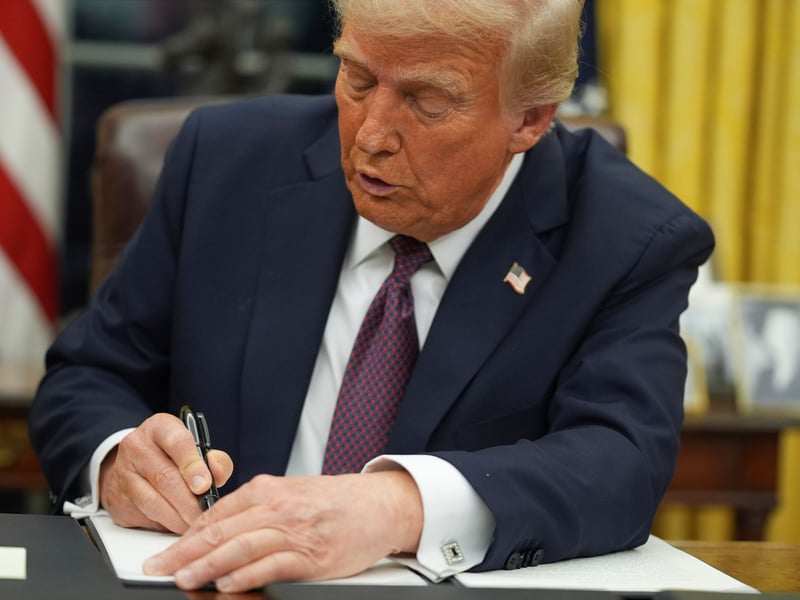
WASHINGTON (CN) — President Donald Trump asked the Supreme Court on Thursday to rein in judicial prohibitions on enforcement of an executive order ending birthright citizenship for certain children of immigrants.
Multiple judges across the country have blocked Trump’s Day 1 order unilaterally ending the long-recognized right, concluding that the president’s executive action was unconstitutional.
At the Supreme Court, Trump pushed the justices to limit the dueling nationwide injunctions, allowing the White House to enforce the order to those not directly involved in the lawsuits. However, instead of positing that his order is lawful, Trump focused on what he saw as overreach by federal judges.
“Whatever this court’s views of the lawfulness of the citizenship order, universal injunctions are plainly inappropriate means of redressing any harms to respondents,” Trump wrote in his emergency appeal.
The Justice Department filed three concurrent emergency appeals at the high court challenging the three lower court nationwide injunctions from Maryland, Massachusetts and Washington.
Trump wants the justices to limit those injunctions to the two advocacy groups, seven individuals, and potentially the 22 states who joined legal challenges against the policy. The Department of Justice noted the 22 states lack standing to challenge the policy and asked the justices to strike the injunctions from the states suit altogether.
Universal injunctions have been critiqued by former administrations and the justices themselves. The Justice Department noted comments from Justices Clarence Thomas, a George H.W. Bush appointee, and Neil Gorsuch and Brett Kavanaugh, both Trump appointees.
“The executive branch exists to carry out his policies. Courts play an important role in adjudicating the lawfulness of those policies in justiciable cases, but they irreparably injure our democratic system when they forbid the government from effectuating those policies against anyone anywhere in the Nation,” Trump wrote.
A Seattle judge was the first to issue nationwide relief in a lawsuit from Oregon, Arizona, Illinois, Washington state and two individuals.
U.S. District Judge Deborah Boardman said citizenship is a precious right granted by the Constitution and repudiated the administration’s order, stating that it was based on an outlier interpretation of the 14th Amendment. Boardman also ordered a nationwide pause on the order in a separate challenge from pregnant mothers and immigrant rights groups.
A judge in Massachusetts issued another injunction on behalf of New Jersey, 17 other states, the District of Columbia and San Francisco.
The challengers say Trump’s “Protecting the Meaning and Value of American Citizenship” executive order conflicts with the longstanding interpretation of U.S. citizenship law.
Trump wants to narrow birthright citizenship to people born to one or more parents who are already U.S. citizens — a move the states claim will affect hundreds of thousands of children nationwide.
Birthright citizenship was enshrined in the Constitution after the Civil War to repudiate Dred Scott v. Sanford , the 1857 Supreme Court decision that legalized slavery and denied the legality of Black citizenship. The 14th Amendment declared that “all persons born or naturalized in the United States and subject to the jurisdiction thereof, are citizens of the United States and of the state wherein they reside.”
Despite widespread consensus, the Trump administration adopted a novel reading of the right, arguing that people in the country illegally or temporarily are not “subject to the jurisdiction” of the United States.
As a backstop, Trump said the Supreme Court should at least allow the administration to develop and issue public guidance regarding the implementation of the order.
Trump’s flurry of executive orders set off a flood of lawsuits that threaten to reshape fundamental aspects of the U.S. democratic system. This week, Trump brought the Supreme Court the first of these challenges in an emergency request to fire a government watchdog employee.
Mounting legal challenges against the administration have led to frustration inside the White House. After one key policy proposal was put on hold by a federal judge, Vice President JD Vance suggested that the executive branch could choose to ignore court orders — an action legal scholars say would result in a constitutional crisis.
Trump suggests he has been unduly burdened by universal injunctions, comparing the 15 injunctions against his administration in February alone to the 14 injunctions against the Biden administration during its first three years.
“Government-by-universal-injunction has persisted long enough, and has reached a fever pitch in recent weeks,” Trump wrote. “It is long past time to restore district courts to their ‘proper — and properly limited — role in a democratic society.’”
Republican lawmakers formally moved to impeach a federal judge who halted billionaire Elon Musk and his Department of Governmental Efficiency’s effort to access the Treasury Department system for government payments. DOGE is not an official government department, and the White House says Musk is not the administrator of DOGE and has not provided information on who officially heads the effort.
The Ninth Circuit scheduled a hearing to review the states’ challenge to birthright citizenship in June.
 Follow @KelseyReichmann
 Follow @kelseyreichmann.bsky.social
Subscribe to our free newsletters
Our weekly newsletter Closing Arguments offers the latest about ongoing trials, major litigation and rulings in courthouses around the U.S. and the world, while the monthly Under the Lights dishes the legal dirt from Hollywood, sports, Big Tech and the arts.