
 Search Articles


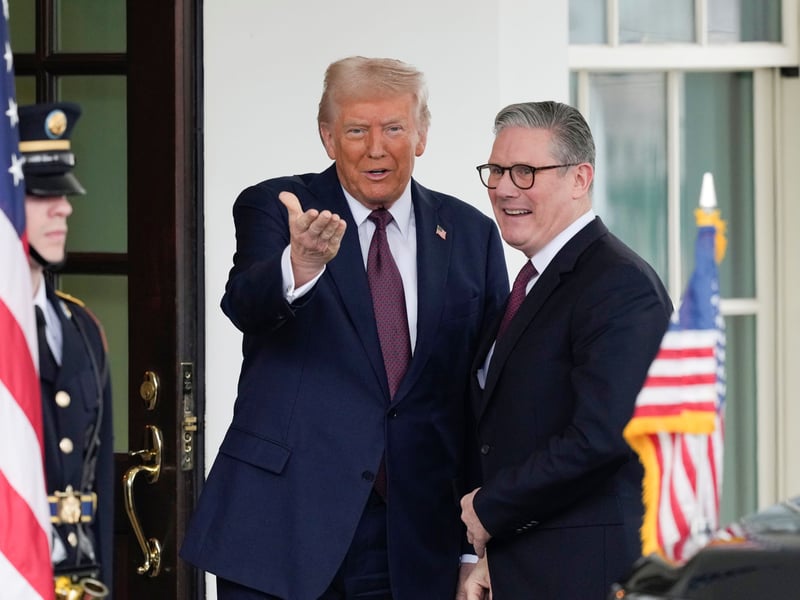
(CN) — U.K. Prime Minister Keir Starmer said Thursday in a meeting with U.S. President Donald Trump that the U.S.-U.K. relationship “matters more than ever” as they discussed a lasting peace deal in Ukraine that was “tough but fair.”
Trump praised his “tremendous relationship” with the prime minister, who reaffirmed his commitment to putting British troops on the ground in Ukraine if an agreement was reached, saying that Europe must step up and do more.
Earlier in the week, Starmer underscored his government’s commitment to increasing its defense spending to 2.5% of its GDP by 2027, the biggest boost in defense spending since the Cold War. To fund this increase, the U.K. will reduce its spending on foreign aid from 0.5% to 0.3% of its GDP.
During the joint press conference, Starmer sidestepped difficult questioning on whether he trusted Vladimir Putin as well as Trump’s previous comments on annexing Canada — a Commonwealth country where King Charles III is head of state.
Ahead of their joint press conference, Starmer presented Trump with a letter from the king, inviting him to a second state visit — an invitation the president accepted.
On trade, Trump announced that both countries are working on a new trade deal where tariffs may not be necessary, in contrast with the EU, which he threatened with tariffs of 25%.
In the U.K., the meeting between the two leaders was highly anticipated, with commentators, political strategists and former diplomats analyzing Starmer’s potential approach to the U.S. president and whether the relationship between the countries would hold.
“The special relationship between the U.S. and the U.K. isn’t simply about the relationship between the president and the prime minister,” said Victoria Honeyman, a professor specializing in British foreign policy in an interview with Courthouse News. “It exists beyond that and while it is much smoother when those two individuals have a good relationship, it can exist without it,”
“How Starmer deals with Trump is hard to answer currently. Being tougher might work, but Starmer was a very skilled lawyer for many years, so while he will take a strategy into negotiations, he will amend it if it isn’t working," Honeyman added.
Starmer’s move to increase defense spending can be seen as “an effort to show Trump the UK can be a trusted and reliable partner to the United States,” Evie Aspinall, Director of the British Foreign Policy Group, said in an interview.
With the increase, the U.K. “hopes to position itself to the United States as at the forefront of European security and as a potential bridge between the United States and Europe,” said Aspinall.
Starmer has rejected the “false choice” between one side of the Atlantic to the other, arguing that it is against the U.K.’s national interest.
“The challenge is that Starmer and Trump are ideologically very different… Balancing between the U.S. and Europe will be very difficult, and even if Trump is temporarily placated there will definitely be flashpoints over the coming months and years. Europe will come first but the U.K. will do everything it can to keep the U.S. on side too," Aspinall said.
Honeyman highlights that if the U.S. becomes isolationist, or focuses on building good relations with Russia, “it is likely that the U.K. will move closer to Europe," she said.
“While many in Europe would accept that the U.S. wants to reduce some of its exposure on the continent, what is being proposed goes way beyond that and European nations remember very well what can happen if nations are permitted to invade other sovereign nations and the issues are left to drift,” she added.
In the U.K., 58% of the public would support sending British troops to Ukraine, with half in favor of increasing defense spending.
“We must increase defense spending and I feel that it should be above this minimum of 2.5%,” said Adriana, a retired health professional from Greater Manchester. “We currently face aggression from Russia. Some would argue that we’ve been at war for the last 3 years since Putin invaded Ukraine.”
Andriana agreed that if there were a peace deal, there should be a united European peacekeeping force on the ground to ensure that the terms are adhered to.
Sam, a 30-year-old fitness coach from Manchester, broadly agrees but questions where this leaves domestic spending.
“I don’t have a problem with increased defense spending, as our armed forces are in a sorry state at the moment. And cuts to foreign aid isn’t something I’m totally against, but I’d rather the money be used on fixing the issues we have at home," he said.
He’s more cautious about deploying the British military.
“I don’t think sending troops to Ukraine is a good idea. Surely a peace deal would be sufficient?” added Sam. “I think putting troops in Ukraine will just be seen as a threat by Putin, leading to more fighting and more people being killed.”
 Follow @jayfranklinlive
Subscribe to our free newsletters
Our weekly newsletter Closing Arguments offers the latest about ongoing trials, major litigation and rulings in courthouses around the U.S. and the world, while the monthly Under the Lights dishes the legal dirt from Hollywood, sports, Big Tech and the arts.