
 Search Articles


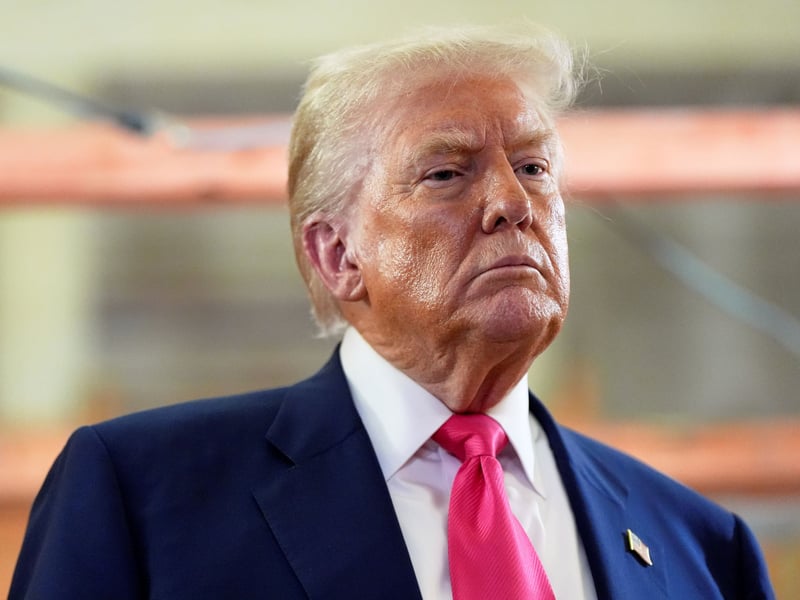
WASHINGTON (CN) — President Donald Trump on Monday announced that he would federalize Washington’s Metropolitan Police Department, a major escalation in the White House’s effort to crack down on crime and assert more federal control over the capital.
The president also said he would mobilize the D.C. National Guard, just days after he ordered law enforcement officers from an assortment of federal agencies to increase their presence in the city.
“Our capital city has been overtaken by violent gangs and bloodthirsty criminals, roving mobs of wild youth, drugged-out maniacs and homeless people, and we’re not going to let it happen anymore,” Trump said during a news conference at the White House Monday morning.
Declaring a “public safety emergency,” the president said that he had mobilized roughly 800 D.C. National Guardsmen in addition to the 500 federal law enforcement agents the administration rushed into the city last week. Trump said the agents, including personnel from the Drug Enforcement Agency, FBI, U.S. Park Police and U.S. Marshals Service, have already made “dozens of arrests.”
The president said Attorney General Pam Bondi is now in charge of the Metropolitan Police Department and DEA administrator Terrance Cole is the interim federal police commissioner. Trump added that he had directed MPD to begin “massive enforcement operations” targeting gangs, drug dealers and other criminals, suggesting people could be deported if they are in the U.S. illegally.
Under the 1973 D.C. Home Rule Act, the federal law that allows the capital city some self-governance, the president has the authority to take control of the municipal police department if “special conditions of an emergency nature exist.” Under the law, the White House can only take over MPD for a maximum of 30 days if it notifies Congress.
Meanwhile, the D.C. National Guard and its roughly 3,400 members are under the president’s direct control, unlike other branches of the military reserve force, which are commanded by state governors.
Defense Secretary Pete Hegseth, speaking alongside Trump, said D.C. residents should expect to see National Guard members in the city’s streets “in the coming week.” He added that the Pentagon was prepared to bring in other units if needed, such as additional guard or “other specialized units,” alluding to military operations at the country’s southwest border.
Trump did not rule out additional military involvement in D.C.
“We will bring in the military if needed,” the president said. “People say, ‘Oh, that’s so terrible.’ … It’s been used many times over the years. I don’t think we’ll need it.”
The White House has pulled legal levers to federalize the National Guard elsewhere. California Governor Gavin Newsom is suing the administration over its move to call up the state’s National Guard branch to respond to protests over federal immigration raids in Los Angeles.
Trump is also targeting the city council and its criminal justice policies, such as cash bail reform and laws, which the White House and U.S. Attorney for D.C. Jeanine Pirro have complained shield minors from appropriate criminal prosecution.
“I can’t touch you if you’re 14, 15, 16, 17 years old and you have a gun,” Pirro said at Monday’s news conference. “We need to go after the D.C. council and their absurd laws. We need to get rid of this concept of no cash bail.”
Forcing changes to D.C. laws would require an act of Congress. Trump expressed optimism that lawmakers could pass legislation changing the capital’s criminal statutes — but any such bill would need at least some Democratic support to survive a cloture vote in the Senate, lengthening its odds of passing.
D.C. local officials expressed outrage at Trump’s move to federalize their law enforcement. Brian Schwalb, the municipal attorney general, called the president’s actions “unprecedented, unnecessary and unlawful.” He did not rule out the possibility of a lawsuit challenging the White House directive, saying that D.C. officials were “considering all of our options.”
Speaking to reporters Monday afternoon, D.C. Mayor Muriel Bowser called the administration’s move “unsettling and unprecedented.”
“I can’t say, given some of the rhetoric of the past, that we’re totally surprised,” she added. “I can say to D.C. residents that we will continue to operate our government in a way that makes you proud.”
Bowser pushed back on Trump’s claims about D.C. crime rates, noting that the city experienced a spike in crime following the Covid-19 pandemic but that there had been a “huge decrease” in violent offenses following intervention from D.C. officials.
Though the Trump administration and Republicans have slammed D.C.’s government for its approach to crime, statistics published in January by the U.S. attorney’s office in the capital show that violent crime rates in D.C. were down 35% from 2023 figures — the lowest rate in more than 30 years.
White House officials have attempted to head off those statistics by pointing to reports last month that an MPD commander is under investigation for manipulating crime data in his district, covering parts of northwest D.C. The city’s police union has claimed that police supervisors are reclassifying crimes to make it appear that violent crime has decreased.
Still, Eduardo Ferrer, a law professor at Georgetown University and policy director of the Juvenile Justice Initiative, told Courthouse News that the Trump administration’s “scapegoating” of young people as criminals was a distraction from federal actions that would actually improve the city.
“Violent crime in D.C. is at the lowest it’s been in generations and youth arrests are well below where they were pre-pandemic,” Ferrer said. “If the federal government wants to help our capital community thrive, it should restore Medicaid cuts, allow D.C. to spend the tax revenue it raised and make us the 51st state.”
Democrats on Monday criticized the mobilization of the National Guard in D.C. as a brazen power grab.
“This is dictator level stuff,” the House Oversight Committee’s Democratic minority wrote in a post on X. “Deploying the military on D.C.’s streets only creates fear and chaos.”
House Minority Leader Hakeem Jeffries said Trump had “no basis” to take over MPD and “zero credibility on the issue of law and order.”
“Get lost,” he added.
Representative Eleanor Holmes Norton, D.C.’s nonvoting member of Congress, said in a statement that the federal takeover of MPD and mobilization of the National Guard was a “historic assault” on the city’s home rule and a “counterproductive, escalatory seizure” of its resources.
Norton pointed out that Trump had been reticent to activate the D.C. National Guard on Jan. 6, 2021, during the attack on the U.S. Capitol by his supporters.
“It does not escape me that the president is calling in the DCNG on the pretext of a surge in crime that the numbers do not support, while he was nowhere to be found for hours on January 6, 2021, as D.C. officials tried to get him to mobilize the DCNG as the U.S. Capitol was under siege,” she wrote.
Norton and Maryland Senator Chris Van Hollen have previously proposed legislation that would remove the provision from the D.C. Home Rule Act allowing the president to take temporary control over the city’s police force. Van Hollen said Monday that he would reintroduce such a bill.
And Maryland Representative Jamie Raskin said he would bring forward a resolution reversing the state of emergency announced for D.C. by the Trump administration, calling the move “plainly ridiculous.”
Republicans, meanwhile, were largely supportive of the president’s move to federalize D.C. law enforcement. Senate Majority Leader John Thune called it a “positive step,” framing it as part of Trump’s “commitment to protecting communities” across the country.
“Washington, D.C., should be a place where people can safely live, visit, work and raise a family,” he said.
Congress earlier this year slashed D.C.’s budget by more than $1 billion in a stopgap federal budget which inadvertently set the capital’s finances at 2024 levels, even though lawmakers normally allow D.C. officials to manage their own spending. Though the Senate has passed legislation fixing that discrepancy, the House has yet to act, leaving D.C. to grapple with significant funding shortfalls.
No reporters at Monday’s news conference asked Trump or other officials about the status of the budget fix.
Meanwhile, the president suggested that his efforts could be the start of a broader push to use federal forces to crack down on crime in other cities, though he later said that he hoped that what happens in D.C. will encourage other cities to act on their own accord.
“We have cities that are very bad,” Trump said. “New York has a problem, and then you have Baltimore and Oakland. We’re not going to lose our cities over this, and this will go further. We’re starting very strongly with D.C., and we’re going to clean it up real quick.”
Courthouse News’ Kelsey Reichmann contributed to this report.
 Follow @BenjaminSWeiss
Subscribe to our free newsletters
Our weekly newsletter Closing Arguments offers the latest about ongoing trials, major litigation and rulings in courthouses around the U.S. and the world, while the monthly Under the Lights dishes the legal dirt from Hollywood, sports, Big Tech and the arts.