
 Search Articles


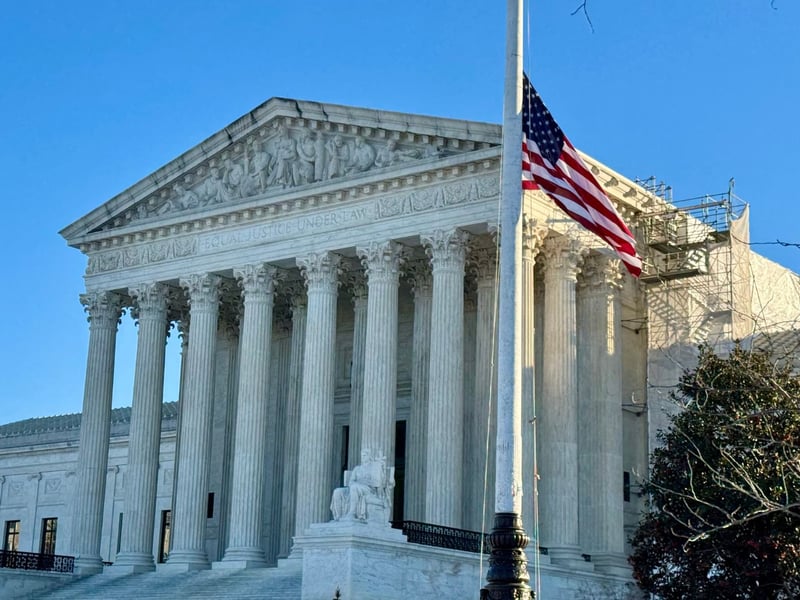
WASHINGTON (CN) — Casino mogul and Trump megadonor Steve Wynn has created an opening for the Supreme Court to overturn a six-decade-old press freedom ruling.
It’s an opening that several justices have been searching for — and one that conservative Justice Clarence Thomas has even explicitly requested in his writings from the bench.
For 61 years, New York Times v. Sullivan has allowed the press to report on public figures without the threat of costly libel suits. A bedrock of modern libel law and one of the Supreme Court’s most significant First Amendment rulings, the landmark 1964 decision says public officials must show actual malice to prevail in a libel suit.
More recently, some conservative legal scholars and media critics have pushed to overturn Sullivan to make it easier to sue the press.
Wynn says the Supreme Court should use his lawsuit against the Associated Press to do so.
“Sullivan is not equipped to handle the world as it is today," Wynn wrote in his petition filed before the court. “Media is no longer controlled by companies that employ legions of factcheckers before publishing an article.”
Calling for an end to the “golden era of lies,” Wynn says clickbait journalism has led the media to use libelous headlines to generate views.
“Sullivan encourages individuals to libel first and question never, promising them near-absolute immunity should they do so,” he wrote.
Wynn has seen himself the subject of negative headlines. In 2018, media reports uncovered dozens of sexual misconduct allegations against him. The Wall Street Journal reported that salon and spa employees accused him of sexual harassment, coercion and indecent exposure. He also reportedly paid $7.5 million to settle a sexual assault case. These allegations led him to resign as CEO of Wynn Resorts and resulted in tens of millions of fines for the company.
Wynn sued the AP in 2018 after the publication ran a story on a sexual assault complaint filed against him in the 1970s. Amid misconduct allegations from employees, the AP obtained police records for two women who accused Wynn of sexual assault.
One of the women, Halina Kuta, told police that Wynn raped her in Chicago during the 1970s and that she gave birth to their daughter in a gas station bathroom. Wynn claims the AP omitted details of Kuta’s complaint that would have cast doubt on her allegations. In his lawsuit, he says the article was published without the fact-checking or investigation of any of Kuta’s statements.
A trial court judge ruled that Kuta had indeed defamed Wynn — but Wynn couldn’t convince the courts that the AP unlawfully published her claims. Hence his appeal, which he says presents an ideal vehicle for the justices to overturn Sullivan .
“Respondents published an article accusing Wynn of ‘rape’ some forty years prior within an hour of obtaining the citizens’ complaint,” Wynn writes. “They did not investigate the allegations, nor did they wait to obtain a statement from Wynn. They simply published a provably false story, sanitized to prevent readers from questioning it.”
Some of the justices have indicated an openness or even eagerness to reviewing the landmark ruling. Among them is Justice Thomas, a George H.W. Bush appointee, who put out a call for challenges to Sullivan in a 2022 dissent.
Thomas lamented the ruling for allowing “media organizations and interest groups ’to cast false aspersions on public figures with near impunity.’” Justice Neil Gorsuch, a Donald Trump appointee, has likewise said that the actual malice doctrine “evolved into a subsidy for published falsehoods on a scale no one could have foreseen.”
Consternation with media coverage has made Sullivan a target of conservative legal circles. Last year, one of Project 2025’s partners suggested that President Donald Trump should try to throw out Sullivan .
“President Trump should make the case for revisiting the Sullivan ruling a more prominent and recurring part of his public rhetoric,” Carson Holloway, a Washington fellow in the Claremont Institute’s Center for the American Way of Life, wrote in a list of suggestions.
Wynn has donated millions to Trump’s presidential campaigns and reportedly attended his election night party.
First Amendment advocates say groundbreaking investigative reporting on the civil rights movement and the Vietnam War wouldn’t have been possible if not for the ruling’s protections.
Samantha Barbas, a professor and the director of the Baldy Center for Law and Social Policy at the University of Buffalo School of Law, said that libel suits could become weapons of blatant political suppression if Sullivan was overturned.
“Without the protections of Sullivan , the press would be greatly limited in its ability to engage in its ‘watchdog’ function, monitoring the conduct of public officials and holding them accountable to their constituents,” Barbas wrote in an essay for the Knight First Amendment Institute. “A rollback of Sullivan, moreover, could herald a return to the ‘libel warfare’ that existed before 1964.”
The AP has until March 6 to respond to Wynn’s petition.
 Follow @KelseyReichmann
 Follow @kelseyreichmann.bsky.social
Subscribe to our free newsletters
Our weekly newsletter Closing Arguments offers the latest about ongoing trials, major litigation and rulings in courthouses around the U.S. and the world, while the monthly Under the Lights dishes the legal dirt from Hollywood, sports, Big Tech and the arts.