
 Search Articles


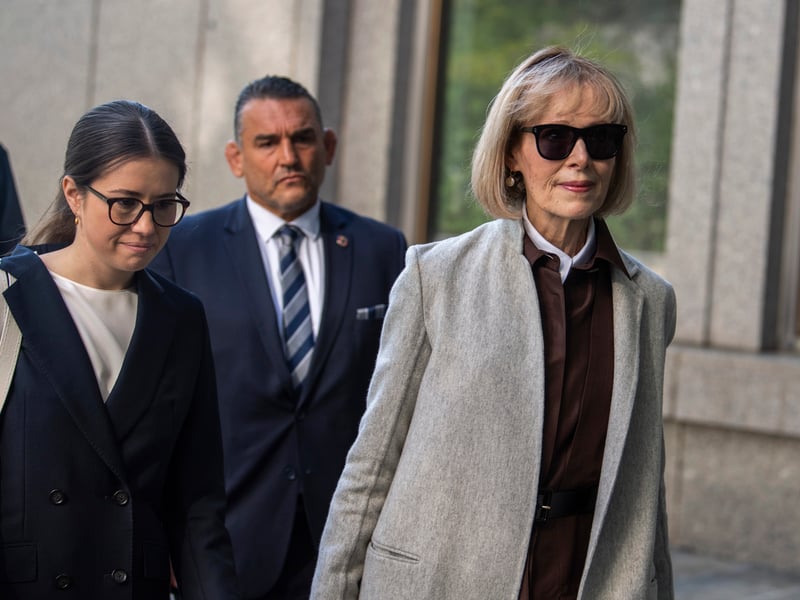
MANHATTAN (CN) — Donald Trump will face further defamation claims brought by E. Jean Carroll, the writer who won her sexual abuse lawsuit against the former president last month, a federal judge ruled Thursday.
Jurors awarded Carroll $5 million following the seven-day battery and defamation trial, where the former Elle magazine advice columnist accused Trump of raping her in the mid-1990s in the fitting room at Bergdorf Goodman department store.
That case, filed under a 2022 New York law allowing survivors a one-year window to file time-barred claims. Before the law took effect, Carroll had already sued Trump for defamation based on his 2019 denial of her account when she first publicly came forward, detailing the account in her book “What Do We Need Men For? A Modest Proposal” and an excerpt published in New York Magazine.
“I’ll say it with great respect: Number one, she’s not my type. Number two, it never happened,” Trump said in June 2019, among other repeated denials insisting Carroll was making up the story.
Carroll seeks $10 million in damages. She noted in an amended complaint that Trump had only doubled down on the statements jurors found to be defamatory. The day after the verdict, he told a national audience during a town hall event on CNN that Carroll was a “whack job” who made up the story.
In his motion for summary judgment, Trump argued he was entitled to absolute presidential immunity against Carroll’s claims, a claim U.S. District Judge Lewis Kaplan found to be both meritless and too late in the game.
“Failure to assert an affirmative defense, including absolute immunity, in an answer or other responsive pleading results in waiver of that defense,” Kaplan wrote in the 46-page order.
At issue are not only Trump’s statements, but also their context, Kaplan explained.
“Mr. Trump did not merely deny Ms. Carroll’s accusation of sexual assault. Instead, he accused Ms. Carroll of lying about him sexually assaulting her in order to increase sales of her book, gain publicity, and/or carry out a political agenda. Even assuming that the president’s decision to deny publicly an accusation of personal wrongdoing comes within the outer perimeter of his official duties, it does not follow that the president’s own personal attacks on his or her accuser equally fall within that boundary,” the judge wrote.
“Mr. Trump does not identify any connection between the allegedly defamatory content of his statements — that Ms. Carroll fabricated her sexual assault accusation and did so for financial and personal gain — to any official responsibility of the president. Nor can the court think of any possible connection.”
Kaplan rejected in turn each of the federally indicted former president’s arguments, including that his comments were not defamatory per se, that they constituted mere opinions, and that Carroll consented to the statements by publishing her story.
“Mr. Trump’s 2019 statements reasonably can be construed as tending to disparage Ms. Carroll in the way of her profession and/or by exposing her to hatred, contempt or aversion or inducing an evil or unsavory opinion of her in the minds of a substantial number of the community,” Kaplan wrote.
On Wednesday, Trump countersued Carroll, claiming she has defamed him since the Manhattan jury found Trump liable for sexual abuse but not rape.
Trial is set to begin in January 2024. However, Kaplan’s ruling does not address a legal turning point that has held up proceedings for years: whether or not Trump can have the Department of Justice step in as a proxy defendant.
Kaplan initially denied Trump of that option, brought under the so-called Westfall Act, which is often used for cases such as car collision lawsuits brought against U.S. Postal Service employees. But the Second Circuit overturned the judge’s finding that the act does not apply to the president.
What remains to be answered is whether Trump was on the job when he denied Carroll’s allegation.
After getting clarification of its precedents from a Washington appellate court, the Second Circuit volleyed the question back to Kaplan, who gave the Biden administration until mid-July to file a letter explaining whether it will change its position on the unprecedented legal matter — that is, whether the current Justice Department will end the previous one’s push to defend Trump.
Crucially, the federal government has sovereign immunity from defamation claims, so a Justice Department proxy would mean the end of the case.
In the meantime, Carroll’s attorney Robbie Kaplan celebrated Thursday’s ruling.
“Judge Kaplan’s denial of summary judgment confirms that once again, Donald Trump’s supposed defenses to E Jean Carroll’s defamation claims don’t work,” the attorney Kaplan, who is not related to the judge, said in a statement. “Trump chose to waive presidential immunity and now he must live with the results of that decision.”
Trump’s attorney Alina Habba kept her response to the ruling brief, writing in a statement: “We disagree with the court’s decision and will be taking the appropriate steps to preserve all viable defenses.”
 Follow @NinaPullano
Subscribe to our free newsletters
Our weekly newsletter Closing Arguments offers the latest about ongoing trials, major litigation and rulings in courthouses around the U.S. and the world, while the monthly Under the Lights dishes the legal dirt from Hollywood, sports, Big Tech and the arts.