
 Search Articles


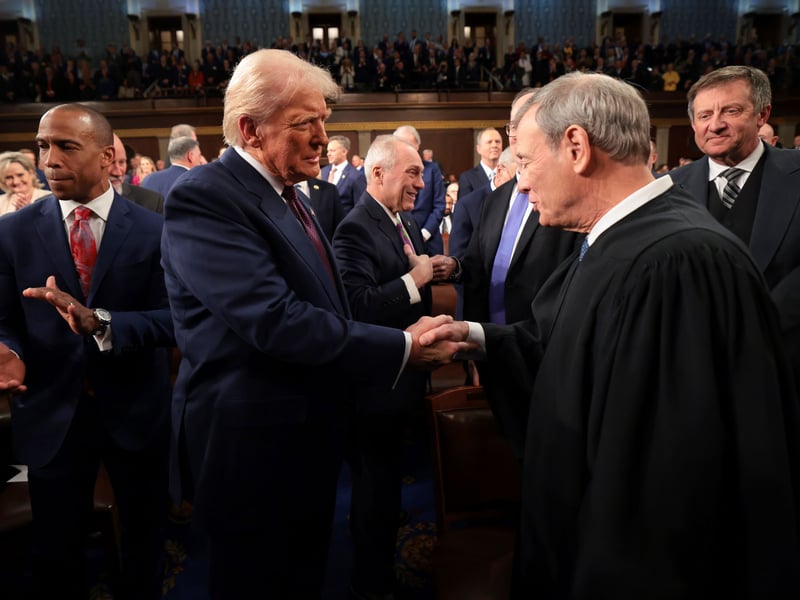
WASHINGTON (CN) — President Donald Trump called for a purge of federal regulations on Wednesday, directing his agency heads to use recent Supreme Court rulings to dismantle rules without notice or public comment.
“Notice-and-comment proceedings are ‘unnecessary’ where repeal is required as a matter of law to ensure consistency with a ruling of the United States Supreme Court,” Trump wrote in an executive order. “Agencies thus have ample cause and the legal authority to immediately repeal unlawful regulations.”
The order is framed as part of Trump’s deregulatory initiative through the Department of Government Efficiency, or DOGE. Trump said unnecessary and onerous regulation impeded American economic growth and innovation, calling for a course correction utilizing tools from the Supreme Court.
“In recent years, the Supreme Court has issued a series of decisions that recognize appropriate constitutional boundaries on the power of unelected bureaucrats and that restore checks on unlawful agency actions,” Trump wrote. “Yet, despite these critical course corrections, unlawful regulations — often promulgated in reliance on now-superseded Supreme Court decisions — remain on the books.”
Trump cited 10 rulings decided by the conservative majority — all except one including his appointees — leading with Loper Bright v. Raimondo . The landmark 2024 ruling overturned four decades of precedent giving federal agencies deference over the interpretation of federal law.
Writing for the majority, Chief Justice John Roberts refuted his dissenting colleagues’ claims that Loper Bright would upend decades of rulemaking.
“The holdings of those cases that specific agency actions are lawful — including the Clean Air Act holding of Chevron itself — are still subject to statutory stare decisis despite our change in interpretive methodology,” the George W. Bush appointee wrote.
Trump declared otherwise, stating that the justices’ ruling required the repeal of rules that rely on “now-superseded Supreme Court decisions.” The “unlawful regulations” should be repealed without notice and comment, Trump said, claiming that doing so would be consistent with an exception in the Administrative Procedure Act.
“That exception allows agencies to dispense with notice-and-comment rulemaking when that process would be ‘impracticable, unnecessary, or contrary to the public interest,’” Trump wrote. “Retaining and enforcing facially unlawful regulations is clearly contrary to the public interest.”
The Administrative Procedure Act follows a multi-step process to make or repeal rules, including notifying the public of a coming action and accepting public comments on the proposed action for 30 days.
Loper Bright nor any of the other cited precedents alter the rulemaking standard, which typically revolves around emergencies or inconsequential procedural rules.
Trump also cited West Virginia v. EPA , where the conservative majority cemented the major questions doctrine, requiring “major” agency actions to have explicit congressional authorization. The conservative majority used West Virginia to throw out President Joe Biden’s student loan plan.
Other rulings that made the cut included: disempowering agency enforcement in SEC v. Jarkesy ; unraveling rules for cross-state air pollution in Ohio v. EPA ; gutting affirmative action policies in Students for Fair Admissions v. Harvard ; tossing out power plant regulations in Michigan v. EPA ; limiting wetland rules in Sackett v. EPA ; and taxpayer funds for sectarian schools in Carson v. Makin .
 Follow @KelseyReichmann
 Follow @kelseyreichmann.bsky.social
Subscribe to our free newsletters
Our weekly newsletter Closing Arguments offers the latest about ongoing trials, major litigation and rulings in courthouses around the U.S. and the world, while the monthly Under the Lights dishes the legal dirt from Hollywood, sports, Big Tech and the arts.