
 Search Articles


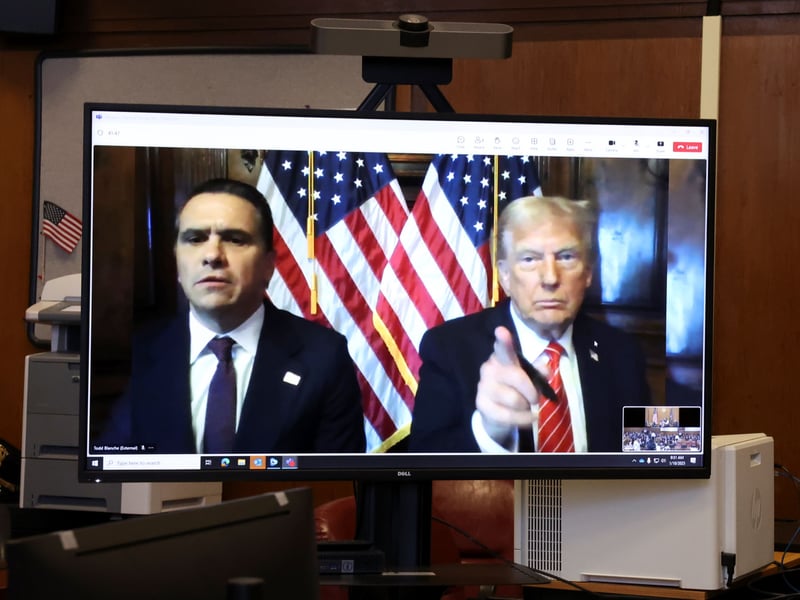
MANHATTAN (CN) — President Donald Trump’s criminal hush money case “should never have seen the inside of a courtroom, let alone resulted in a conviction,” he said in a late-night filing to a mid-level New York appellate court.
In the 111-page filing, Trump outlined his long-awaited arguments to toss his historic guilty verdict, claiming that the case judge allowed the prosecutors to use insufficient evidence and should have recused himself.
“This is the most politically charged prosecution in our nation’s history,” Trump claims in the filing.
The appeal filed late Monday is rife with claims that Manhattan District Attorney Alvin Bragg only brought the case to kneecap Trump’s 2024 presidential bid — claims Trump echoed on the campaign trail and at trial when speaking to news cameras outside of the courtroom.
“The DA, a Democrat, brought those charges in the middle of a contentious presidential election in which President Trump was the leading Republican candidate,” Trump argues in the filing. “These charges against President Trump were as unprecedented as their political context."
Last May, a Manhattan jury found Trump guilty of 34 counts of falsifying business records, which prosecutors said stemmed from a sweeping and salacious hush money scheme aimed at quelling bad press during his 2016 presidential campaign.
Trump’s former personal attorney and “fixer” Michael Cohen testified at trial that Trump directed him to carry out a $130,000 payment to adult film star Stormy Daniels, who Trump was concerned would share details from their 2006 sexual encounter at an inopportune time during the election.
When it was time for Cohen to be repaid, he said Trump signed off on a monthly payment plan to illegally disguise reimbursement checks as standard legal fees. Trump signed those illicit checks from the Oval Office during his first presidential term, according to witness testimony.
Trump could have faced jail time for the 34 felony convictions, but got off without punishment following his 2024 election win. New York Supreme Court Justice Juan Merchan deemed that unconditional discharge was the only conceivable way to sentence an incoming president.
Still, Trump is trying to clear his name by claiming that Merchan should have recused himself from the case based on his supposed political past.
“The trial was conducted by a judge who refused to recuse himself despite having made political contributions to President Trump’s electoral opponents and despite having disqualifying family conflicts,” Trump argues.
Merchan donated $15 to Trump’s Democratic rival Joe Biden in 2020. And his daughter, Loren, is the founder of Authentic Campaigns, a political media agency that helps Democrats win elections around the country. Prior to the trial, an independent judicial ethics committee concluded that these were not sufficient conflicts to require Merchan to recuse himself.
Trump disagrees, claiming prosecutors would have “cried foul” if Merchan had donated to Trump’s 2020 campaign, “and rightly so.”
Trump also argued that Merchan allowed the jury to see evidence that should have been off-limits pursuant to the Supreme Court’s ruling last year for broad presidential immunity. He pointed to testimony from Hope Hicks, one of his top White House aides during his first term, who told jurors how she was tasked with killing certain stories about Trump’s adulterous behavior.
“The U.S. Supreme Court mandated that violations of residential evidentiary immunity require automatic reversal of a conviction, without any harmless-error analysis,” Trump argues, calling the purportedly prohibited testimony “far from harmless.”
Merchan previously ruled that Hicks’ testimony had nothing to do with Trump’s “official acts” as the commander in chief.
“This court further finds that the evidence related to the preserved claims relate entirely to unofficial conduct and thus, receive no immunity protections,” the judge ruled in December.
That ruling came after Trump unsuccessfully asked Merchan to overturn the jury’s verdict against him. Now, he looks to the First Department Appellate Division — the same court that recently tossed civil fraud penalty against the president worth $500 million, which the court found to be “excessive” and unconstitutional.
With many of his one-time personal attorneys now holding various high-ranking government jobs, Trump is now being represented by the prestigious New York City-based firm Sullivan & Cromwell.
 Follow @Uebey
 Follow @uebey.bsky.social
Subscribe to our free newsletters
Our weekly newsletter Closing Arguments offers the latest about ongoing trials, major litigation and rulings in courthouses around the U.S. and the world, while the monthly Under the Lights dishes the legal dirt from Hollywood, sports, Big Tech and the arts.