
 Search Articles


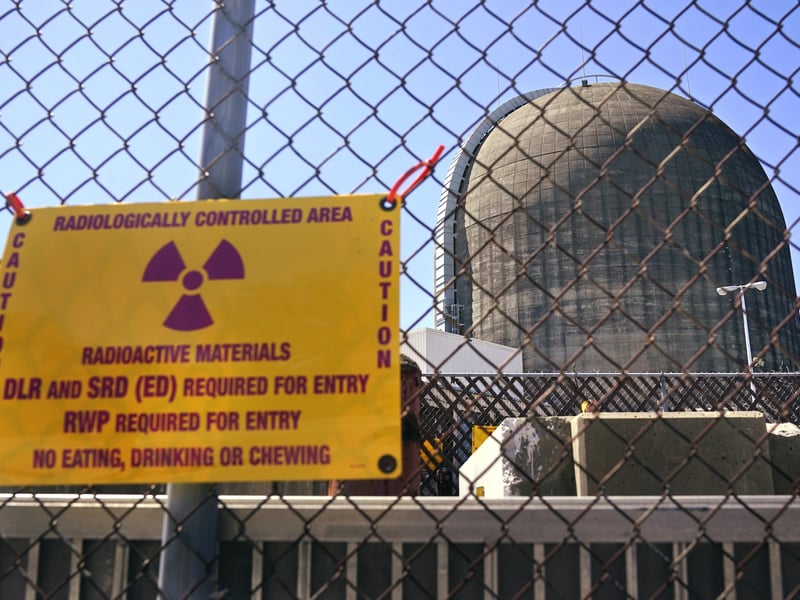
WASHINGTON (CN) — President Donald Trump on Friday signed executive orders aimed at supercharging the U.S. nuclear power industry and drastically reshaping the country’s primary nuclear power plant safety regulator.
The move, which would pare down some of the Nuclear Regulatory Commission’s processes for evaluating and licensing new nuclear reactor projects across the country, will likely be well-received by an industry that has long bristled at what some see as a bloated regulatory machine that has bottlenecked new nuclear construction.
But others see the Trump administration’s action as a dangerous deregulation of an agency that has long been considered the global standard-bearer of nuclear safety.
In a pair of executive orders signed Friday, Trump handed Energy Secretary Chris Wright authority to approve proposed designs for advanced nuclear reactors. The Energy Department has long been involved in the development of advanced nuclear technology, which includes downsized nuclear plants and reactors that use molten salt as fuel, but it’s the Nuclear Regulatory Commission that conducts safety analyses and issues operating licenses to nuclear facilities.
But, since the commission’s inception in the late 1970s, it has approved few new licenses. Only one new nuclear reactor has come online in that time, at Georgia’s Alvin W. Vogtle Electric Generating Plant — a project that was completed despite several delays and cost overruns.
Some in the nuclear industry — and now the Trump administration — have suggested that the nuclear safety commission’s extensive and often expensive licensing process is to blame for the lack of new reactors.
In a separate executive order Friday, the White House called the commission’s risk-averse process a “fundamental error.”
“Instead of efficiently promoting safe, abundant nuclear energy, the NRC has instead tried to insulate Americans from the most remote risks without appropriate regard for the severe domestic and geopolitical costs of such risk aversion,” the order read.
The Trump administration argued that the commission’s radiation protection model, which considers there to be no safe threshold for radiation exposure, lacks “sound scientific basis” and makes it unfairly difficult for nuclear license applicants.
“A myopic policy of minimizing even trivial risks ignores the reality that substitute forms of energy production also carry risk, such as pollution with potentially deleterious health effects,” they said.
According to Friday’s order, the White House will direct the Department of Government Efficiency to reorganize the commission — a process which it acknowledged could result in layoffs but which the administration said could also increase the size of some of the commission’s functions, such as new reactor licensing.
Among the agency’s teams facing a workforce reduction is its Advisory Committee on Reactor Safeguards, a panel charged with analyzing potential hazards at existing or proposed nuclear facilities. The executive order mandates that the committee be reduced “to the minimum necessary” to fulfill its duties under federal law and that it only focus on issues that are “truly novel or noteworthy.”
The order also demanded changes to the commission’s license review process, such as fixed deadlines for licensing rather than the “milestones” process the agency uses to track its progress. Under that new scheme, the commission would have 18 months to make a final licensing decision for new nuclear plants and one year to deliberate on extended licenses for existing facilities.
And the Trump administration also mandated that the nuclear safety commission take other steps to “reduce unnecessary burdens” on licensees, including streamlining the administrative hearings process — under which members of the public have traditionally been given the opportunity to voice concerns about proposed or existing nuclear facilities.
The executive order further suggested that the agency “reconsider” the 40-year limit on license extensions for currently operating nuclear plants.
Nuclear power skeptics warned Friday that Trump’s move puts nuclear safety measures on the back burner.
“Simply put, the U.S. nuclear industry will fail if safety is not made a priority,” said Edwin Lyman, director of nuclear power safety at the Union of Concerned Scientists and a longtime critic of nuclear power.
Lyman accused the administration of “fatally compromising” the independence of the Nuclear Regulatory Commission and said that the order encourages pathways for deploying nuclear technology that sidestep the agency entirely. He added that the White House is “virtually guaranteeing” a serious accident or radiological release in the U.S.
The nuclear industry and lawmakers have long sought to reduce regulatory barriers to deploying new and advanced nuclear power generation. Congress last summer passed a measure sponsored by West Virginia Senator Shelley Moore Capito, which slashed licensing fees for advanced reactor technologies.
There has long been anxiety in the U.S. over nuclear power, especially following the 1979 partial meltdown of Three Mile Island Nuclear Generating Station’s Unit 2 reactor.
Though there were no fatalities directly caused by the incident, the Three Mile Island accident remains one of the largest radiological releases in U.S. history, second only to the Church Rock uranium mill spill, which occurred that same year.
Several states still have legal moratoriums preventing the construction of new nuclear power plants.
 Follow @BenjaminSWeiss
Subscribe to our free newsletters
Our weekly newsletter Closing Arguments offers the latest about ongoing trials, major litigation and rulings in courthouses around the U.S. and the world, while the monthly Under the Lights dishes the legal dirt from Hollywood, sports, Big Tech and the arts.