
 Search Articles


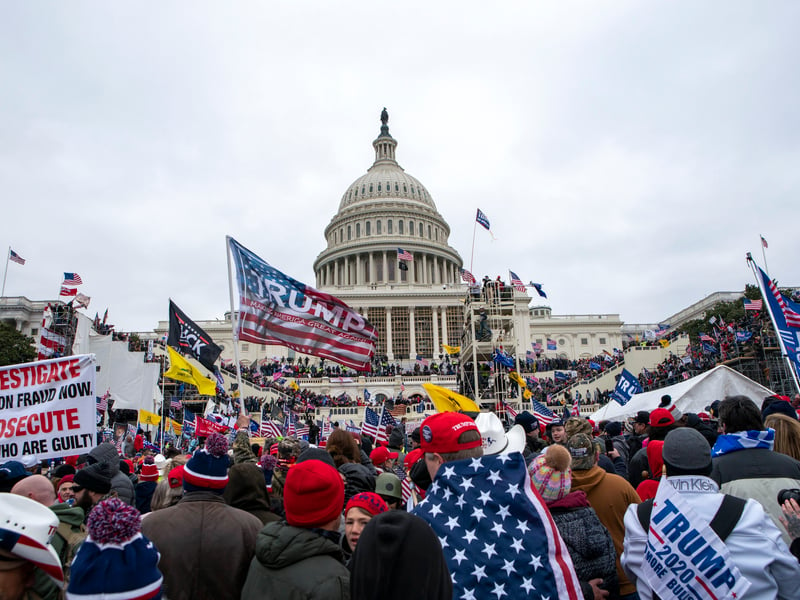
WASHINGTON (CN) — Over 1.500 individuals have been charged in connection to the U.S. Capitol riot on Jan. 6, 2021, but with Donald Trump’s electoral victory on Tuesday, the Justice Department’s largest prosecution in history appears at risk.
While on the campaign trail, Trump repeatedly promised to pardon his supporters who have been charged and indicated he could even grant clemency to leaders of far-right groups like the Oath Keepers and the Proud Boys, as well as those who assaulted police officers.
How exactly Trump will implement that promise remains unclear, although legal experts made clear Trump’s pardon power “is essentially unconstrained” once he’s president, as constitutional law professor Louis Seidman told Courthouse News in an interview.
But the mere idea that Trump could intervene in the cases that have dominated the federal courthouse in Washington for the last four years has seemingly opened up a new legal avenue for the defendants even before the president-elect takes office.
Immediately after the race was called in favor of Trump early Wednesday morning, several rioters who await sentencing have sought to delay their cases closer to Inauguration Day on Jan. 2o.
In a statement released Wednesday, lawyers who represented ex-Proud Boy leader Enrique Tarrio congratulated Trump on his victory while indicating they are exploring options for an appeal of Tarrio’s 22-year prison sentence.
“We wish to acknowledge and applaud the recent election results, particularly the election of Donald Trump,” Nayib Hassan said in the statement. “We look forward to what the future holds, both in terms of the judicial process for our client and the broader political landscape under the new administration.”
While such a high-profile figure like Tarrio would be a likely candidate for a pardon – depending on Trump’s reaction to Tarrio’s expressed remorse at his sentencing last September — less-publicized participants have also begun using Trump’s election in their cases.
One such defendant, Christopher Carnell of North Carolina, filed a motion on Wednesday to delay a status hearing set for Nov. 8 in which Senior U.S. District Judge Beryl Howell would set a sentencing date.
The 21-year-old North Carolina man was originally convicted of obstruction of an official proceeding, a key felony charge the feds had used before the Supreme Court narrowed its application in the Capitol riot, along with five misdemeanor charges related to entering the restricted Capitol building and Senate chambers.
Prosecutors indicated they still plan to bring the obstruction charge, which carries a maximum 20 years in prison, although few defendants outside of the Oath Keeper leaders and the most violent individuals have received such lengthy sentences.
In the motion to stay Friday’s hearing, defense attorney Marina Medvin of firm Medvin Law cited Trump’s campaign promises as cause to delay the proceedings until Dec. 13.
“Throughout his campaign, President-elect Trump made multiple clemency promises to the Jan. 6 defendants, particularly those who were nonviolent participants,” Medvin wrote. “Carnell, who was an 18-year-old nonviolent entrant into the Capitol on Jan. 6, is expecting to be received of the criminal prosecution that he is currently facing when the new administration takes office.”
Howell, a Barack Obama appointee, quickly rejected the motion in a brief order, maintaining the Friday status hearing date.
With 74 days until Inauguration Day, legal experts expect prosecutors to continue litigating the cases before Trump appoints his next attorney general and begins shaping the Justice Department to his policy preferences.
Mary McCord, former acting assistant attorney general for national security 2016 and 2017 and executive director of the Institute for Constitutional Advocacy and Protection at Georgetown Law, said in an email the current Justice Department will likely maintain its position.
McCord added that Trump’s promised pardons should not have any impact on the currently pending cases or those of defendants already convicted.
“Pardons are within the constitutional authority of the president, but Trump is not yet the president and may or nay not make good on his promises,” McCord said. “Moreover, the potential for a pardon does not undermine the strength of the convictions or the pending cases — it does not go to guilt or innocence.”
Only after Trump takes office will he truly have an impact on the Jan. 6 prosecutions, McCord said, but until then the pending cases will move forward.
According to the Justice Department’s newest monthly update on the Capitol riot cases released Wednesday, approximately 1,561 individuals have been charged in connection with the riot. In the 46 months since Jan. 6, 1,028 defendants have received sentences, with 645 getting prison terms and 143 spending their terms in home detention.
 Follow @Ryan_Knappy
Subscribe to our free newsletters
Our weekly newsletter Closing Arguments offers the latest about ongoing trials, major litigation and rulings in courthouses around the U.S. and the world, while the monthly Under the Lights dishes the legal dirt from Hollywood, sports, Big Tech and the arts.