
 Search Articles


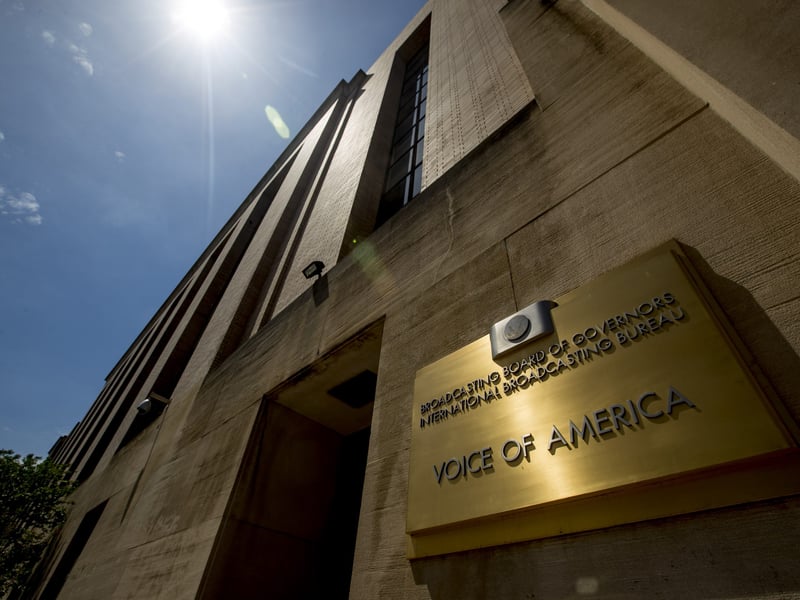
WASHINGTON (CN) — A federal judge on Friday blocked the Trump administration’s effort to cancel collective bargaining agreements for U.S. Agency for Global Media and Voice of America employees, slamming the move as clear retaliation for the workers’ efforts to halt Trump’s dismantling of the news outlet.
Senior U.S. District Judge Paul Friedman found President Donald Trump’s Aug. 28 executive order, “Further Exclusions from the Federal Labor-Management Relations Program,” wrongfully tried to classify the independent media agencies as having a “primary national security function” to strip their employees of union representation.
Other agencies targeted by the order included NASA, the National Weather Service, the International Trade Commission, the National Environmental Satellite, Data and Information Service and the Office of the Commissioner for Patents.
The Bill Clinton appointee issued his ruling from the bench, noting he has ruled similarly in several near-identical cases challenging Trump’s March 27 executive orderthat aimed to exclude approximately two-thirds of the federal workforce from their collective bargaining agreements.
Friedman added the chief executive is not entitled to the “presumption of regularity” — a legal doctrine that affords the executive branch a certain amount of deference based on the assumption officials follow the law — due to his pattern of retaliating against his perceived enemies.
“This presumption is based on the assumption that the president will obey their official duties, but this has not been what’s happened since Jan. 20. It’s just not,” Friedman said.
The suit was brought by the American Federal Government Employees Union, the American Federation of State, County and Municipal Employees, the Voice of America Employees Union and the U.S. Agency for Global Media’s employee union on Sept. 19.
Friday’s ruling is the latest in an eight-month campaign by the Trump administration to dismantle the Voice of America, which Trump has slammed as the “Voice of Radical America,” starting with a March 14 executive order requiring its “nonstatutory components and functions” be eliminated to the “maximum extent.”
A coalition of VOA journalists and editors, led by White House Bureau Chief Patsy Widakuswara, challenged the March order, leading Senior U.S. District Judge Royce Lamberth to issue an injunction blocking the outlet’s shuttering, which he noted “silenced VOA for the first time ever.”
John Pellettieri of Bredhoff Kaiser and representing the unions, argued Friday that the administration’s conduct following the March 14 executive order — including efforts to circumvent Lamberth’s order that led to a show cause order and the deposition of acting Voice of America CEO Kari Lake — along with Trump’s pattern of retaliation necessitated a preliminary injunction.
Without one, Pellettieri said, the employees would lose their union representation and could potentially face looming reduction-in-force orders on their own.
He noted that on Aug. 29, the day after Trump’s executive order, Lake emailed U.S. Agency for Global Media employees stating that their collective bargaining agreements were canceled, and included a file explicitly referencing further reduction-in-force orders.
Lamberth, a Ronald Reagan appointee, has also stayed the reduction-in-force orders, blasting Lake’s “concerning disrespect” for court orders and suggesting that contempt proceedings may be on the table.
Pellettieri pointed to the recent government shutdown and the fact that only seven of the U.S. Agency for Global Media’s 500 employees remained on the job, while the remainder were furloughed, as proof the government’s national security claims were inconsistent.
Only certain members of the Office of Cuba Broadcasting remained on the job due to certain national security interests.
The government’s claims that the global media agency has a primary national security function “just cannot be squared with the idea the agency should be closed,” Pellettieri said, adding the seven non-furloughed employees are further proof any such function is minimal.
Tyler Becker from the Office of the Assistant Attorney General argued that the only question Friedman must answer is whether Trump in fact targeted the global media agency in retaliation for the unions’ resistance, or if he would have issued the executive order anyway.
Becker further suggested the unions cannot claim the August executive order would irreparably harm them, as the reduction-in-force orders remained suspended by Lamberth’s order and thus any harm is speculative.
Friedman rejected that theory, saying the local unions face an “existential threat” and would no longer exist if the global media agency is fully dismantled and its employees all terminated.
The D.C. Circuit is set to hear arguments in three consolidated cases challenging Trump’s March executive order on Dec. 15.
 Follow @Ryan_Knappy
Subscribe to our free newsletters
Our weekly newsletter Closing Arguments offers the latest about ongoing trials, major litigation and rulings in courthouses around the U.S. and the world, while the monthly Under the Lights dishes the legal dirt from Hollywood, sports, Big Tech and the arts.