
 Search Articles


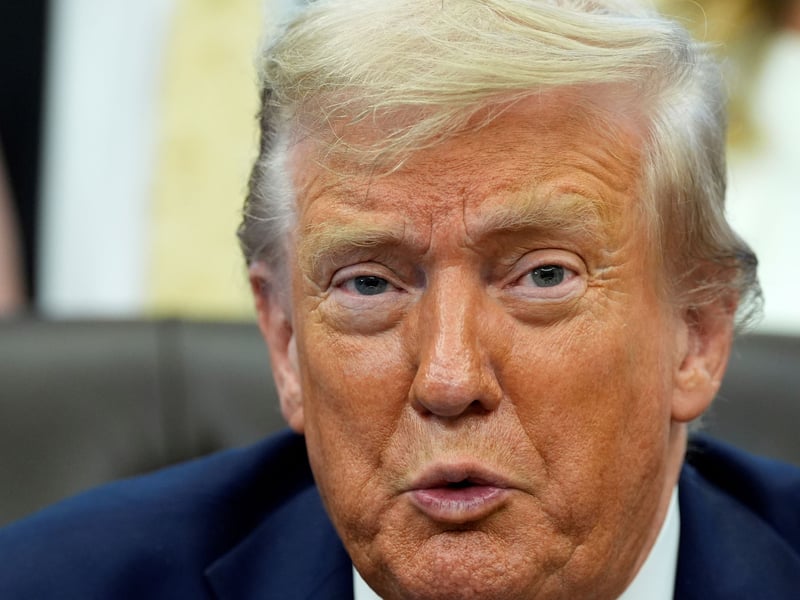
WASHINGTON (CN) — President Donald Trump launched a direct attack on a nearly century-old ruling on Thursday, asking the Supreme Court to let him fire a Federal Trade Commissioner despite longstanding precedent.
Trump argued that allowing Democratic FTC Commissioner Rebecca Slaughter to remain in her seat interfered with his executive authority.
“Article II precludes a court from ordering the reinstatement of an executive officer removed by the president,” U.S. Solicitor General John Sauer wrote in an emergency appeal. “The president’s removal power is ‘‘conclusive and preclusive,’’ which means that it ‘may not be regulated by Congress or reviewed by the courts.’”
If granted, the appeal would be the nail in the coffin of Humphrey’s Executor v. United States — a landmark 1935 Supreme Court ruling limiting presidential authority over independent regulatory commissions. The conservative supermajority has severely curtailed the 90-year precedent in recent months, ceding to Trump’s repeated requests to dismiss ideological foes. This latest emergency appeal — the 23rd of Trump’s second term — could effectively overturn the ruling without the high court’s thorough review.
For-cause removal protections shield independent board members from political interference. Members are appointed by the president and confirmed by the Senate, but Humphrey’s Executor determined they can only be fired for misconduct — not because their decisions aren’t favorable to the current administration.
A panel on the D.C. Circuit refused to remove the commissioner, relying on Humphrey’s . Trump characterized the move as “subverting the hierarchy of the federal court system created by the Constitution and Congress,” citing the court’s recent shadow docket rulings.
“[The lower courts] have made clear that, regardless of recent developments on [this] court’s emergency docket,’ they will adhere to their expansive and incorrect interpretation of Humphrey’s Executor ,” Sauer wrote. “And they have explained that they will persist in that adherence ‘unless and until’ this court grants certiorari and overrules that decision.”
Trump suggested that the justices skip a pending merits review by the appeals court, pushing the high court to take on the review itself.
“Uncertainty about the continued status of Humphrey’s Executor and the constitutionality of statutory removal protections is disrupting the work of federal agencies,” Sauer wrote. “And the ‘downsides of delay in resolving the status of [Humphrey’s Executor ] outweigh the benefits of further lower court consideration.’”
The conservative supermajority on the Supreme Court has already allowed Trump to remove Democratic commissioners from the Consumer Product Safety Commission, National Labor Relations Board and the Merit Systems Protection Board.
Slaughter and fellow FTC Commissioner Alvaro M. Bedoya similarly sued the administration for unlawful termination after they were fired by Trump in March. Bedoya ultimately resigned in June to support his family, as he wasn’t allowed to take another job while fighting his dismissal due to the FTC’s ethics policy on accepting outside money.
Trump himself nominated Slaughter to serve as a Democratic commissioner in 2018. As she was nominated again last year by former President Joe Biden, her appointment is not set to expire until September 2029.
Bedoya was nominated by Biden, with over a year remaining of his tenure that was expected to end in September 2026.
The FTC was created by Congress more than a century ago as a bipartisan federal agency that is responsible for combatting unfair, deceptive and anticompetitive business practices to protect consumers.
The appeals court determined that the Republican majority on the commission would prevent any harm caused by allowing the commissioners to remain in their positions until the legal battle is settled. Trump disagreed.
“The president removed respondent because he determined that her ‘continued service on the FTC is inconsistent with [his] administration’s priorities,” Sauer wrote. “Courts have no power to second-guess that presidential judgment.”
Despite many lower court losses, Trump has overwhelmingly prevailed at the high court in recent months.
 Follow @KelseyReichmann
 Follow @kelseyreichmann.bsky.social
Subscribe to our free newsletters
Our weekly newsletter Closing Arguments offers the latest about ongoing trials, major litigation and rulings in courthouses around the U.S. and the world, while the monthly Under the Lights dishes the legal dirt from Hollywood, sports, Big Tech and the arts.