
 Search Articles


WASHINGTON (CN) — President Donald Trump asked the Supreme Court on Thursday to resume indiscriminate immigration stops and arrests that swept through Hispanic communities in California.
A federal judge halted the administration’s “roving” raids in July, finding that agents likely used racial profiling to arrest immigrants suspected of being in the U.S. illegally and unlawfully detained them without access to an attorney.
Trump pushed the justices to restore these raids, arguing that the widespread illegal presence of migrants in areas like Los Angeles called for such considerations.
“Needless to say, no one thinks that speaking Spanish or working in construction always creates reasonable suspicion,” U.S. Solicitor General John Sauer wrote in Trump’s petition. “Nor does anyone suggest those are the only factors federal agents ever consider. But in many situations, such factors — alone or in combination — can heighten the likelihood that someone is unlawfully present in the United States."
The administration claims that California’s Central District harbors 2 million undocumented migrants, giving agents a one in 10 chance of arresting a potential deportee among the region’s 20 million residents.
Trump called for an end to this “attempted judicial usurpation of immigration enforcement functions.”
Five Southern California residents and three advocacy groups challenged the administration’s stop-and-arrest practices last month. The groups, including United Farm Workers, say that agents stopped individuals with brown skin, forcing them to answer questions or risk arrest.
“If they hesitate, attempt to leave, or do not answer the questions to the satisfaction of the agents, they are detained, sometimes tackled, handcuffed, and/or taken into custody,” the plaintiffs say. “In these interactions, agents typically have no prior information about the individual and no warrant of any kind … Also contrary to federal law, the agents do not identify themselves or explain why the individual is being arrested."
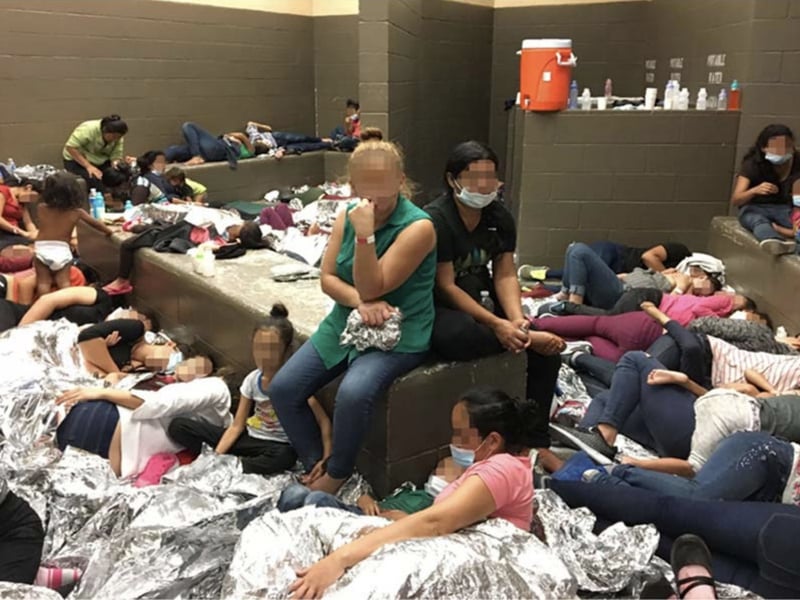
Some people are held in an Immigration and Customs Enforcement basement in downtown Los Angeles known as B-18 for days at a time.
“In these dungeon-like facilities, conditions are deplorable and unconstitutional. The government has also unlawfully deprived those arrested of access to counsel. Under such conditions, some of those arrested are pressured into accepting voluntary departure,” the plaintiffs say.
Among the five individual Latino plaintiffs, three say in the complaint that they are day laborers who are still detained in B-18. Two other plaintiffs say they have been frequently stopped and questioned by ICE officers. The individual plaintiffs and United Farm Workers are joined by the Los Angeles Worker Center Network, the Coalition for Humane Immigrant Rights, and the Immigrant Defenders Law Center.
The plaintiffs cite media reports of a 3,000 arrestees-per-day quota imposed by Homeland Security on its agents. According to those reports, agents were told not to conduct long-term investigations, but instead to simply round up day laborers looking for work at Home Depots, or even people hanging outside convenience stores.
Judge Maame E. Frimpong issued an emergency order blocking indiscriminate raids. The Joe Biden appointee found that there was a mountain of evidence supporting the plaintiffs’ claims.
“As the stop/arrest plaintiffs point out, compliance with the Fourth Amendment is nothing new, contrary to defendants’ claims,” Frimpong wrote. “Complying with the law does not impose harm.”
The Ninth Circuit upheld the temporary restraining order, finding agents were subjecting Angelenos to detentive stops based on group profiling, not individualized suspicion.
Trump said the plaintiffs’ past injuries did not justify a restraining order barring agents from using factors such as accents or place of employment to target all undocumented immigrants in California. The administration asked the Supreme Court to narrow the order to only the named plaintiffs.
Frimpong previously rejected this suggestion, finding the plaintiffs could get swept up in another raid.
“Particularly given how these enforcement actions appear to have been conducted, it would be a fantasy to expect that law enforcement could and would inquire whether a given individual was among the named stop/arrest plaintiffs or the (putative) class before proceeding with a seizure,” Frimpong wrote.
The order chilled immigration enforcement, the administration said, by threatening officers with contempt for doing their job.
“Uncertainty over how the court might later view an agent’s reliance on a mix of factors will ‘likely cause hesitation and delay in the field, which in turn increases the risk of assaults on officers, escalations during volatile encounters, and injuries to both officers and the public, particularly in the already high-risk and unpredictable environment of Los Angeles,’” Sauer wrote.
Trump’s immigration crackdown sparked mass protests in Los Angeles in the opening months of his second term. The president federalized California’s National Guard to quell the protests, against the wishes of Governor Gavin Newsom and Los Angeles Mayor Karen Bass.
Over 5,000 National Guard members and Marines were deployed to the city in June. Nearly two months later, only 250 guard members remain in Los Angeles to protect federal agents and buildings.
 Follow @KelseyReichmann
 Follow @kelseyreichmann.bsky.social
Subscribe to our free newsletters
Our weekly newsletter Closing Arguments offers the latest about ongoing trials, major litigation and rulings in courthouses around the U.S. and the world, while the monthly Under the Lights dishes the legal dirt from Hollywood, sports, Big Tech and the arts.