
 Search Articles


WASHINGTON (CN) — A Trump-appointed federal judge cleared the way for Attorney General Merrick Garland to release Jack Smith’s final report on his dismissed federal case against the president-elect over subversion of the 2020 election.
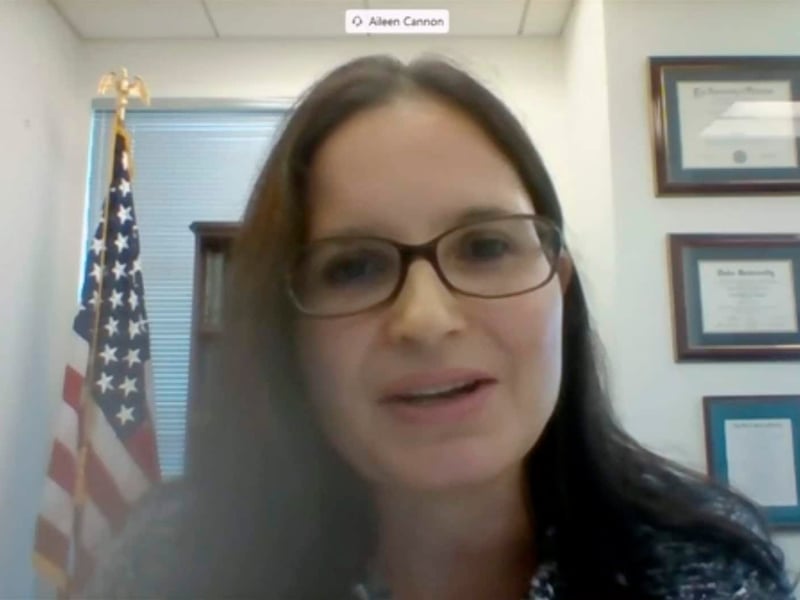
U.S. District Judge Aileen Cannon’s decision allows Garland to release the report as early as Tuesday, and comes a week after Trump and his lawyers demanded Garland block its release over concerns it would “illegally interfere with the presidential transition.”
With just one week until Trump’s inauguration, Smith’s report will be the final opportunity for the public to fully understand the lengths the president-elect went to maintain his grip on power after his electoral defeat to President Joe Biden in 2020.
Smith, who submitted both volumes of the report to Garland last week, resigned from his position as special counsel on Friday. Trump had repeatedly said he would fire Smith immediately upon taking office and has vowed to investigate him for “weaponizing” the justice system.
Cannon’s decision Monday denied an emergency motion by Trump aide Walt Nauta and former Mar-a-Lago property manager Carlos De Oliveira — Trump’s co-defendants in his Florida classified documents case — to block the Washington election subversion volume, referred to as Volume One.
Monday’s ruling comes four days after the 11th Circuit similarly ruled against Trump’s effort to block both volumes of Smith’s report.
She found allowing the public release of Volume One would have no prejudicial impact on Nauta or De Oliveira, siding with the Justice Department’s assertion that Volume One made no reference either defendant outside of two mentions of the classified documents case.
Cannon also rejected Nauta and De Oliveira’s argument that, based on her July ruling that Smith was unconstitutionally appointed, either case and anything related could not stand.
That decision is currently on appeal to the 11th Circuit, which Cannon addressed in her ruling by noting that the argument is only relevant to the classified documents case, and she cannot enforce an order regarding the release of Volume One.
Cannon scheduled a Jan. 17 hearing to determine whether Volume Two of the report, the culmination of Smith’s investigation into Trump’s mishandling of classified documents at his Mar-a-Lago estate after leaving the White House, can be released.
In a court filing, Garland indicated that he would only release Smith’s final report on the Washington election subversion case to avoid any prejudice against Nauta and De Oliveira in their pending Florida cases, after having reviewed both volumes of the report earlier this week.
Garland said in the brief that he would make the Florida report only available for review by the House and Senate Judiciary Committee leadership.
“The attorney general intends to release Volume One to Congress and the public,” Garland wrote, saying its release would further the “public interest in informing a co-equal branch and the public regarding this significant matter.”
Garland added that his decision to keep the release of the Florida classified documents report limited to the Judiciary committees was at the recommendation of Smith.
The requests upend the common practice of allowing special counsels to issue a final report detailing their findings to the public, regardless of whether the probe resulted in criminal charges or conviction — such as special counsel Robert Hur’s final report on President Joe Biden’s mishandling of classified documents.
The effort has also pit the current attorney general against Pam Bondi and Todd Blanche, Trump’s picks for attorney general and deputy attorney general, respectively. Blanche, who defended Trump throughout his federal criminal cases, demanded Garland leave the decision to release the reports up to Bondi.
Many of Smith’s findings have been made public over the course of the investigation as part of an immunity brief and subsequent dossier released in October, but the final report would be his last chance to outline how Trump tried to maintain his grip on power in 2020.
Cannon’s ruling is only the most recent reminder of Trump’s long-running legal woes, following New York Supreme Court Justice Juan Merchan’s decision Friday to sentence Trump to unconditional discharge on 34 counts of falsifying business records.
The sentence carries no punishment with it but preserves the jury’s guilty verdict, solidifying Trump’s status as convicted felon just 10 days before taking office as the nation’s chief executive.
 Follow @Ryan_Knappy
Subscribe to our free newsletters
Our weekly newsletter Closing Arguments offers the latest about ongoing trials, major litigation and rulings in courthouses around the U.S. and the world, while the monthly Under the Lights dishes the legal dirt from Hollywood, sports, Big Tech and the arts.