
 Search Articles


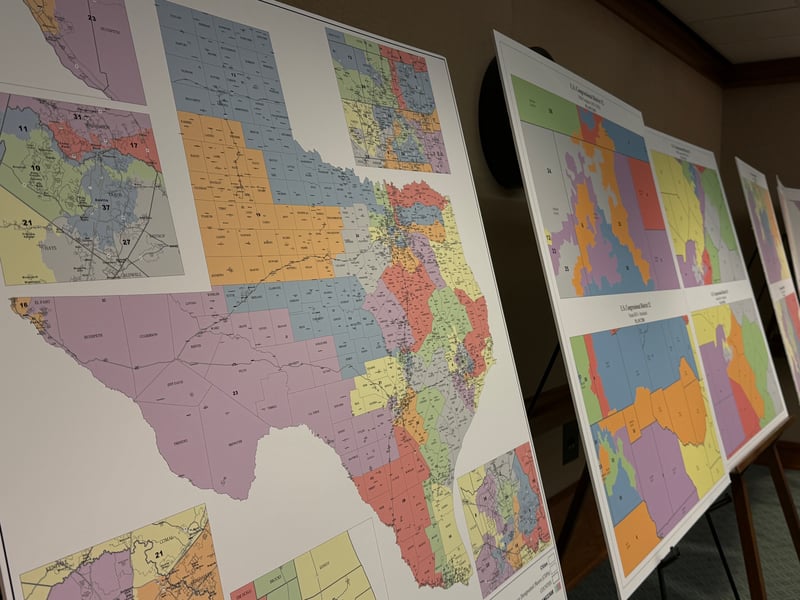
EL PASO, Texas (CN) — A panel of three federal judges blocked Texas’s new congressional map from being used in the 2026 midterms, ruling 2-1 on Tuesday that a coalition of civil rights groups is likely to succeed in claiming the new map constitutes an unconstitutional racial gerrymander.
The panel ordered the state to instead use a prior map from 2021 for next year’s midterms.
“The public perception of this case is that it’s about politics,” U.S. District Judge Jeffrey Brown, a Donald Trump appointee, wrote for the majority. “To be sure, politics played a role in drawing the 2025 map. But it was much more than just politics. Substantial evidence shows that Texas racially gerrymandered the 2025 map.”
Senior U.S. District Judge David Guaderrama, a Barack Obama appointee, joined Brown in the majority. U.S. Circuit Judge Jerry Smith, a Ronald Reagan appointee, dissented. The ruling followed a nine-day hearing in El Paso last month.
In his opinion, Brown recounted how earlier this year President Donald Trump publicly urged Texas to redraw its congressional districts to give Republicans five more seats in the U.S. House of Representatives. Following this request, Texas lawmakers met in a special session and adopted a new map that’s expected to result in the five additional Republican seats Trump sought.
The U.S. Supreme Court has ruled federal courts can’t consider partisan gerrymandering claims, but Brown noted in his opinion that Trump’s Justice Department sent a letter to Texas Governor Greg Abbott and Texas Attorney General Ken Paxton in July demanding the state redraw its congressional map based on districts’ racial makeup. Two days later, Abbott added redistricting to the special session’s agenda, citing the DOJ’s letter.
“Notably, the DOJ letter targeted only majority-non-white districts,” Brown wrote. “Any mention of majority white Democrat districts — which DOJ presumably would have also targeted if its aims were partisan rather than racial — was conspicuously absent.”
In its letter, the DOJ claimed certain Texas congressional districts were unconstitutional because they were “coalition districts” — districts where no single racial group formed a majority. The Justice Department said this violated the 14th Amendment and the Voting Rights Act, but Brown said the DOJ’s reasoning was based on an incorrect interpretation of the Fifth Circuit’s 2024 ruling in Petteway v. Galveston County .
Citing statements by Abbott and Texas legislators, Brown found that they adopted the same racial motives, which he said provides evidence of a legislative intent to racially gerrymander. The judge also found circumstantial evidence of racial gerrymandering, noting that, in line with the DOJ’s demands, Texas’s new map converted seven coalition districts into single-race-majority districts.
Brown found that Republicans engaged in race-based redistricting in order to provide cover for their partisan goals, believing that redistricting to eliminate coalition districts would be easier to sell than a “nakedly partisan map.”
“It wasn’t enough for the map to merely improve Republican performance; it also needed to convert as many coalition districts to single-race-majority districts as possible,” Brown wrote. “The bill’s main proponents purposefully manipulated the districts’ racial numbers to make the map more palatable. That’s racial gerrymandering.”
Democratic National Committee Chair Ken Martin celebrated the ruling in a statement, calling it “a win for Texas voters.”
“These maps were only introduced in the first place because Donald Trump and his Texas Republican allies are afraid of facing voters after the passage of their Big Ugly Bill,” Martin said. “They expected Democrats to roll over, but instead, Democrats in Texas and across the country rose up and fought back.”
However, Paxton vowed in a statement that he will appeal the ruling to the Supreme Court.
“The radical left is once again trying to undermine the will of the people. The Big Beautiful Map was entirely legal and passed for partisan purposes to better represent the political affiliations of Texas,” Paxton wrote.
“For years, Democrats have engaged in partisan redistricting intended to eliminate Republican representation. Democratic states across the country, from California to Illinois to New York, have systematically reduced representation of Republican voters in their congressional delegations. But when Republicans respond in kind, Democrats rely on false accusations of racism to secure a partisan advantage."
“I fully expect the court to uphold Texas’s sovereign right to engage in partisan redistricting,” he added.
Subscribe to our free newsletters
Our weekly newsletter Closing Arguments offers the latest about ongoing trials, major litigation and rulings in courthouses around the U.S. and the world, while the monthly Under the Lights dishes the legal dirt from Hollywood, sports, Big Tech and the arts.