
 Search Articles


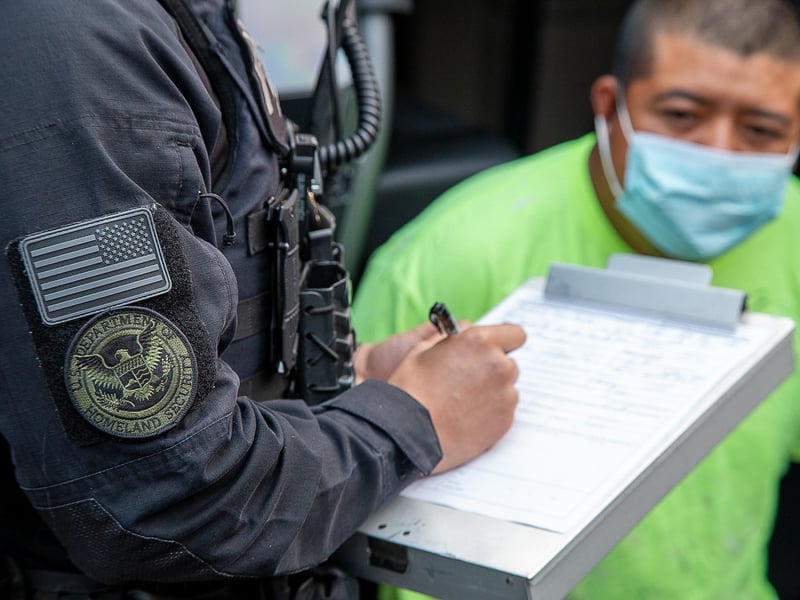
BROOKLYN (CN) — A federal judge is threatening the Department of Homeland Security with contempt after the agency refused to provide photographs of the “putrid and cramped” Long Island holding room that unlawfully held a noncitizen for several nights.
In a scathing 24-page ruling, U.S. District Judge Gary Brown — a Donald Trump appointee — suggested Immigration and Customs Enforcement has been “recklessly” expanding the use of these short-term detention facilities amid its nationwide push for stricter immigration enforcement.
“The evidence presented to this court, which has been largely unrebutted, demonstrates that ICE has been deploying its ‘holding rooms’ in a manner that shocks the conscience,” Brown wrote in a Thursday order.
The underlying case stems from a habeas petition brought by Erron Anthony Clarke, a Jamaican man who entered the U.S. legally on an H-2B visa in 2018. Clarke wound up overstaying the visa and, in 2023, married a U.S. citizen. Earlier this year, he applied for permanent residency on that basis.
Clarke has no record of violence, drug use or criminal history, according to the judge.
But per Brown’s ruling, Clarke was dubiously detained by ICE during this process on Dec. 5. He became one of nine men locked in a holding room — which Brown described as a small cell containing an open toilet “designed to briefly detain a single individual” — within the federal courthouse on Central Islip.
Brown found that Clarke was held in the overcrowded cell for several days, far longer than even ICE’s own internal standards allow for facilities like this.
“ICE held them, day after day, without access to bunks, bedding, soap, showers, toothbrushes or clean clothes,” the judge wrote. “The space is unheated or poorly heated at night, while the outside temperature dropped to as low as 21 degrees … To the extent they could sleep, they did so, crammed on the filthy floor, while the lights blared 24 hours a day.”
Finding that Clarke’s detention on its face violated due process, Brown ordered him released on Dec. 11. But he also found that the details of Clarke’s detention exposed something bigger, likening it to other recent cases that deal with “the revelation of ICE’s horrendous detention practices.”
“This case implicates something more,” Brown wrote. “There is evidence that the conditions of the detention are substandard, abhorrent and likely unlawful.”
After ordering Clarke’s release, Brown demanded answers from ICE and Homeland Security. He requested a precise timeline of Clarke’s whereabouts during his detention, and ordered photographs to be taken of his holding room cell in Central Islip.
The government’s answers were insufficient, the judge said.
Homeland Security flatly refused to show him photos, and Brown said he was given timeline information that was “evasive and demonstrably false.”
In one instance, the government claimed to have temporarily moved Clarke from one facility to another in eight minutes, despite them being separated by a roughly 35-minute drive, according to Brown.
“These misstatements of fact serve to undermine the information presented and the reliability of the records maintained by ICE,” Brown wrote.
Brown gave the government until Dec. 30 to argue why he should not enter an order of contempt. A spokesperson for the Department of Homeland Security didn’t immediately request for comment.
Formerly a federal magistrate judge in Brooklyn, Brown was appointed to the bench in 2019 during Trump’s first presidency via a bipartisan package of judicial nominees.
His ruling is the latest example of a short-term ICE facility inviting judicial scrutiny as immigration detentions skyrocket around the country. Earlier this year, a federal judge in Manhattan put a similar makeshift jail, 26 Federal Plaza, on blast for similar accusations of overcrowding, cleanliness concerns and illegal multi-day stays.
Homeland Security faces potential sanctions in that case, too, after the agency supposedly ignored calls from the judge to clean up the controversial facility.
 Follow @Uebey
 Follow @uebey.bsky.social
Subscribe to our free newsletters
Our weekly newsletter Closing Arguments offers the latest about ongoing trials, major litigation and rulings in courthouses around the U.S. and the world, while the monthly Under the Lights dishes the legal dirt from Hollywood, sports, Big Tech and the arts.