
 Search Articles


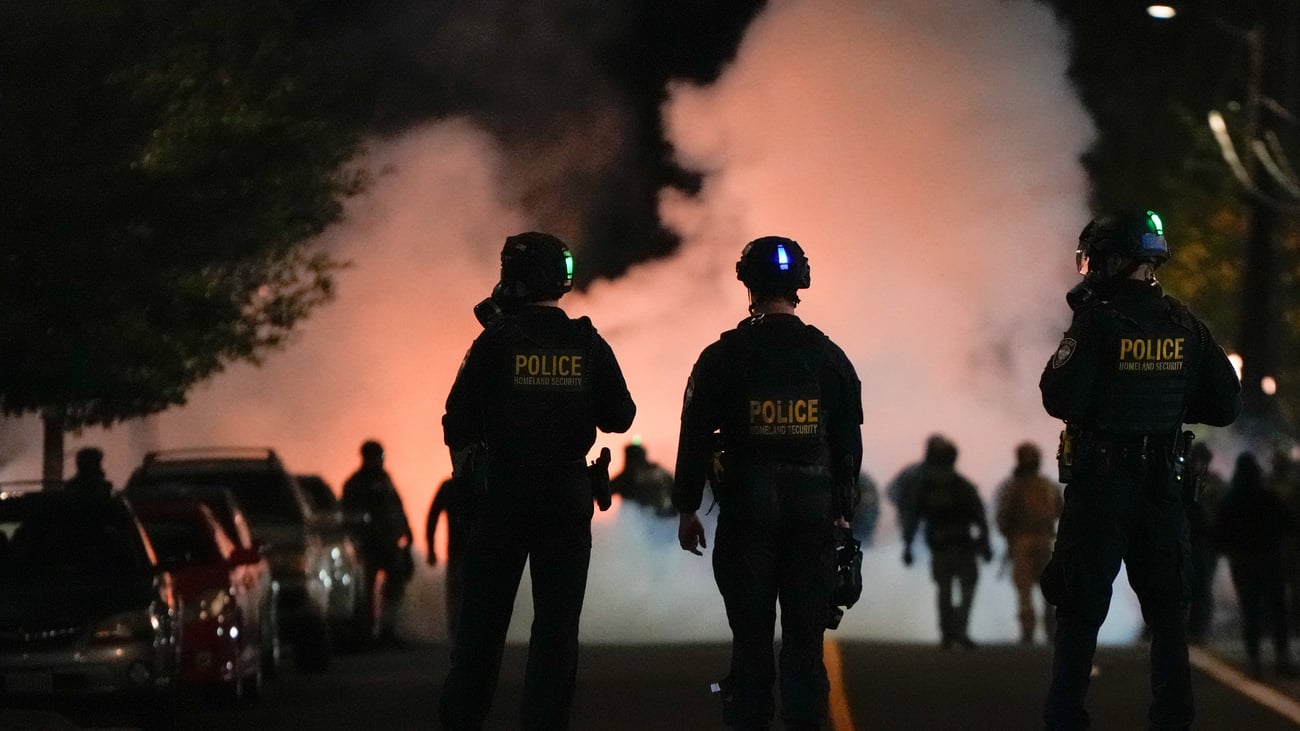
(CN) — The Trump administration on Tuesday told the Ninth Circuit two Oregon federal judges wrongly restricted federal agents’ use of chemical munitions outside of the Immigration and Customs Enforcement facility in Portland.
“The District Court’s very premise that the force used was excessive was predicated on what appears to be just a gravely erroneous understanding of the restrictions that the Constitution places on the use of crowd control devices,” argued Justice Department attorney Michael Shih.
The two cases before a three-member panel of the Ninth Circuit, composed of two Donald Trump appointees and a Joe Biden appointee, concern the rights of protesters and bystanders near the ICE facility. The government is requesting the appeals court pause both orders while it appeals.
A group of protesters and journalists sued Trump, the Department of Homeland Security and its former Secretary Kristi Noem late last year, arguing federal officers deployed tear gas, pepper balls and other munitions outside of the ICE facility in retaliation for the exercise of First Amendment rights.
U.S. District Judge Michael Simon, a Barack Obama appointee, issued a temporary restraining order in early February blocking federal immigration officers from deploying chemical munitions or projectiles.
The residents of a low-income housing complex across the street from the ICE building also sued the federal government late last year, accusing federal agents of intentionally and repeatedly deploying chemical munitions near the apartment complex, violating their right to bodily integrity by exposing them to toxic airborne substances.
Following an evidentiary hearing, U.S. District Judge Amy Baggio, a Biden appointee, sided with the residents in early March and issued a preliminary injunction blocking federal agents from deploying crowd control devices in a way that would send the chemicals into the nearby low-income housing complex.
Three days later, Simon issued a preliminary injunction blocking agents from using chemical or projectile munitions unless they were legally justified in using deadly force against the target.
The federal government appealed both orders and requested an emergency stay pending appeal, and the three-member Ninth Circuit panel granted a temporary stay in late March.
Regarding the case brought by protesters and journalists, Shih argued the plaintiffs couldn’t prove the federal agents were acting in retaliation.
“There are many reasons why force might be excessive under the First Amendment that have nothing whatsoever to do with subjective intent to retaliate,” Shih said.
U.S. Circuit Judge Eric Tung, a Trump appointee, noted that instances of excessive force are at least suggestive of retaliatory intent.
“It’s very difficult for plaintiffs to prove directly the state of mind of any particular officer, so they rely on circumstantial evidence. And if you have repeated instances of excessive force, isn’t that at least suggestive?” Tung asked.
The federal government argued the lower court ignored declarations from federal officers describing the particular situations officers faced that led to excessive force. Shih also argued that even if the plaintiffs were entitled to some form of relief, the court went too far.
“The scope of the injunction applies basically to anybody in the world who decides that they want to show up at the Portland ICE facility to protest,” Shih said.
Shih also pointed out that the lead plaintiff had attended at least 150 protests but only had excessive force used against him four times.
But U.S. Circuit Judge Ana de Alba, a Biden appointee, noted the evidence in the record showed a pattern.
“I also watched the videos, and I found them to be quite disturbing,” de Alba said. “Not all of them, of course, but a big majority of it … You had a protester shot in the eye, I just don’t know how we’re justifying this.”
The protesters and journalists argued the Department of Homeland Security has a policy of allowing and encouraging retaliatory, excessive force.
“This is a pattern of near-daily occurrences of protestors at the Portland ICE Facility and the continued use of the same type of excessive force that is being praised and not reprimanded,” said Kimberly Hutchison, attorney with Singleton Schreiber representing the protesters and journalists.
U.S. Circuit Judge Kenneth Lee, a Trump appointee, noted the injunction would bar federal agents from using crowd control devices if hundreds of people started vandalizing the building.
“I don’t see how that’s covered under the First Amendment; there’s no First Amendment right to commit vandalism or impede law enforcement. It seems the injunction was just way too broad.”
But Hutchison noted the officers are free to use other tools and less lethal weapons and can still deploy munitions when there’s a physical safety risk.
“ The problem here is that there was testimony undisputed in the District Court that these officers are not being trained on public order policing,” Hutchison said.
Turning to the case brought by the residents of the neighboring apartment complex, the federal government argued the lower court’s order would “effectively prohibit police officers from ever using chemical irritants in an urban area because there’s a chance that the wind could carry the aerosolized chemicals and affect people downwind,” said Justice Department attorney Brenna Scully.
The lower court found the federal defendants — including ICE and the Department of Homeland Security — disregarded the known or obvious consequences of their actions. The federal government argued the court improperly engaged in judicial policymaking by recognizing a novel right to bodily integrity.
“ This is a right that no court has ever recognized,” Scully said.
De Alba questioned why the government needed relief from the order.
“What sort of dangerous conditions did the folks face as a result of having this injunction in place those 10 days?” de Alba asked.
The government had no evidence on hand but argued the intensity of protests that may occur outside of the facility cannot be predicted.
“Chemical irritants are a critical defensive law enforcement tool and limiting the government’s ability to use them based on facts and circumstances facing officers irreparably harms the government,” Scully said.
But the residents disagreed, noting the government operated under restrictions on chemical munitions at the ICE facility for over eight weeks after Simon issued a temporary restraining order in the case brought by protesters and journalists.
“The government’s harm is simply speculative; the plaintiff’s harm here is not. They’ve suffered and will continue to suffer grievous injuries if the government continues its conduct,” said Stephen Wirth with the Jacobson Lawyers Group.
The residents of the apartment complex include young families, domestic violence survivors, veterans, retirees and people with disabilities, many of whom reported repeated doctor visits for new or worsening conditions such as chest pain, respiratory distress and panic attacks.
Similar to the other case, the residents reiterated that the preliminary injunction still allows officers to use chemical munitions when necessary to protect against threats to life.
“If the crowd presented a risk of danger to life, the government would be free to use tear gas in those circumstances; otherwise, the District Court was balancing the harms to our clients who face a risk to their own lives from these deployments,” Wirth said.
The Ninth Circuit panel did not indicate when it would rule.
Subscribe to our free newsletters
Our weekly newsletter Closing Arguments offers the latest about ongoing trials, major litigation and rulings in courthouses around the U.S. and the world, while the monthly Under the Lights dishes the legal dirt from Hollywood, sports, Big Tech and the arts.
Additional Reads

 Feds face suit over bid to gut Presidential Records Act April 7, 2026