
 Search Articles


PORTLAND, Ore. (CN) — Portland sparred with the Trump administration in federal court on Wednesday over whether the president could federalize and deploy the Oregon National Guard — but moments before the federal trial began, the Justice Department admitted that troops had been onsite after a judge’s order barred their deployment.
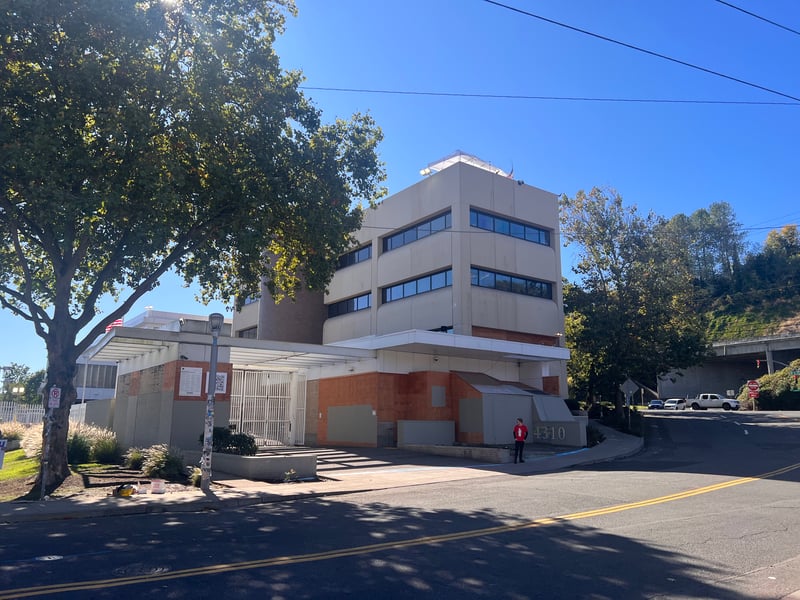
Portland and Oregon sued the Trump administration shortly after President Donald Trump declared his intent to send the troops to “protect war ravaged Portland” and its Immigration and Customs Enforcement facility, which had been the site of ongoing [protests](http://attended by protesters in inflatable costumes) since June.
Before opening statements in the three-day trial over the deployment, Justice Department Attorney Jean Lin told U.S. District Judge Karin Immergut that there was a window after Immergut had blocked the deployment of the National Guard that the troops had been on the ground at the Portland ICE facility late on Oct. 4.
The Trump-appointed judge considered holding the Trump administration in contempt for violating her temporary restraining order, which was issued earlier on Oct. 4 and barred the federalization and deployment of the Oregon National Guard. Lin said the troops completed their shift after midnight.
“We’ll discuss later whether that’s contempt and in direct violation of the temporary restraining order,” Immergut responded.
Following the disclosure, opening arguments began with Portland and Oregon fighting the Trump administration’s characterization of the activity at the ICE facility.
“Portland is not ‘war ravaged,’ there is no rebellion and the law continues to be enforced every day,” said Caroline Turco with the Portland City Attorney’s Office
The city described the situation at the ICE facility as a “manufactured crisis” rather than a dire situation in need of military intervention.
“Are protests in Portland so violent it justifies the National Guard?” Turco asked. “Plaintiffs submit the answer is no.”
Scott Kennedy with the Oregon Department of Justice called the case a “test of the outer bounds of presidential authority.” He said that there have been “sporadic, but inexcusable crimes” at the ICE facility, but said it has largely been a site for peaceful protests. Though the Portland police declared a riot at the ICE facility on June 14, the city and state argued that it was a crescendo that represented a pivot point.
But Trump’s Justice Department attorneys painted a different picture, one where violent agitators threatened the safety of federal officers.
“Violence and threatened violence is something that goes to federal interest,” said Eric Hamilton with the Justice Department.
That violence caused the ICE facility to close for three weeks during the summer, Hamilton said. He argued that Trump offered to send troops and funding to Oregon Governor Tina Kotek for her to control the operation, but that she “unfortunately refused that proposal,” requiring Trump to take action.
And the notion that bringing in the National Guard will inflame tensions on the scene is simply speculation, Hamilton argued.
“It will have the opposite effect,” Hamilton said.
The plaintiffs — including California, which joined the lawsuit after Trump announced he would send California National Guard troops to Portland after Immergut blocked the deployment of the Oregon National Guard — brought local law enforcement officials to testify to the “mild” and “low energy” nature of the bulk of the protests.
Compared to the unrest that gripped the city during the summer of 2020, when federal and local law officials faced off against nightly protests targeting the federal courthouse and local jail downtown, the situation at the ICE facility is far milder.
“2020 was almost drastically different than I’ve seen personally at ICE,” said Cameron Bailey, captain of the Oregon State Police’s criminal investigations division.
The state passed two police reform laws following the protest period, dictating how and when law enforcement can use munitions in crowds and limiting the state from using a proxy agency to skirt the munition rule. It stands in contrast to the approach taken by federal officers.
“Based on my personal observations, there are federal officers using crowd control munitions in a way that would violate [the law],” said Franz Schoening, a commander for the Portland Police Bureau.
For instance, the federal officers’ use of tear gas on a large crowd of older community members was “startling” and a departure from best practice, Schoening said.
Portland Police Bureau officers had to leave the area after they, too, were affected by the gas. Later in October, Schoening said an officer was hit in the shoulder by a projectile while standing 100 feet away from the facility.
To the federal government, the officers’ testimony highlights the need for federal intervention and illustrates how little city and state officers aided the Federal Protective Service.
Part of that comes down to Oregon’s sanctuary city laws, which prohibit state employees from assisting with immigration-related enforcement actions, such as dispersing crowds of protesters blocking vehicles from entering or exiting the ICE facility.
The city and states argued that local law enforcement is more equipped to handle the crowds and trained to deescalate tense crowds.
“There are ways you can intervene that make it worse, and there are ways that make it better,” Schoening said.
Federal officers enflamed the protesters at the federal courthouse in 2020, testified Craig Dobson, assistant chief with the Portland Police Bureau.
And Brian Hughes, critical incident commander with the Portland Police Bureau, told the court that daily email reports from police sergeants documented small crowds at the facility that didn’t require Portland police intervention.
Justice Department attorneys needled Hughes on why the Portland police didn’t investigate when several federal officers’ names and private information were leaked online, or why Portland officers weren’t at the site every day.
“The place is full of federal police,” Hughes later said about why Portland officers aren’t staffed there around the clock.
The trial started the morning after the Ninth Circuit announced it would rehear the government’s appeal of one of Immergut’s two temporary restraining orders and is expected to conclude on Friday.
Subscribe to our free newsletters
Our weekly newsletter Closing Arguments offers the latest about ongoing trials, major litigation and rulings in courthouses around the U.S. and the world, while the monthly Under the Lights dishes the legal dirt from Hollywood, sports, Big Tech and the arts.