
 Search Articles


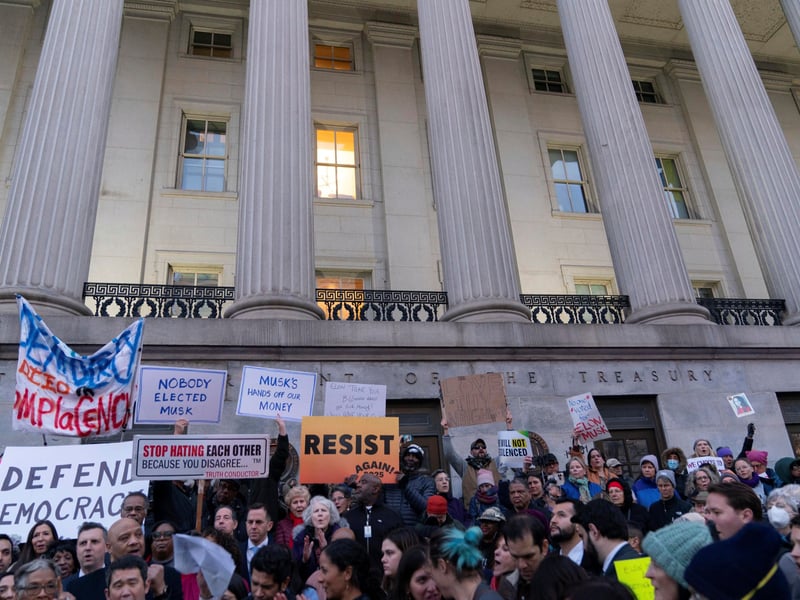
WASHINGTON (CN) — A group of federal employees filed a class action on Tuesday against the Trump administration’s disclosure of sensitive personal information to Elon Musk and members of his so-called Department of Government Efficiency, calling it the “largest data breach and the largest IT security breach in our country’s history.”
The employees work at the Department of the Navy, the Bureau of Prisons, the U.S. Army Corp of Engineers, the Department of Agriculture and the U.S. Agency for International Development, and each said they only learned about the disclosures via media reporting.
Since President Donald Trump’s inauguration three weeks ago, he has targeted several federal agencies in a proclaimed effort to tamp down on government waste, empowering billionaire Musk as a “special government employee” to gain unfettered access at the USAID, the Treasury Department, the Department of Labor and the Consumer Financial Protection Bureau.
The federal employees in Tuesday’s class action characterized the DOGE agents as hackers gaining unauthorized access to their information — including their names, addresses, Social Security numbers, passport numbers, medical records, and financial information.
“These unlawful disclosures already have — and will continue to have — deleterious effects on federal workers that have caused them harm, including but not limited to actual damages, ongoing vulnerability to further hacking, cyber-attacks, fraudulent activity, actual theft and ongoing mental distress,” the employees said.
Since Jan. 20, Musk and his DOGE agents — most of whom are between the ages 19 and 25 and were employees of Musk’s at some point — have been able to gain access to sensitive systems at the Treasury Department, the Labor Department and the Consumer Financial Protection Bureau.
The information include systems housed at the Bureau of the Fiscal Service that control the flow of over $6 trillion each year via Social Security and Medicare benefits, salaries for federal personnel, tax refunds and thousands of other functions.
Agents were also able to gain access to sensitive worker data and trade secret information at the Labor Department and to all computer systems at the consumer protection agency, which has heavily regulated Silicon Valley companies such as the Musk-owned X, formerly Twitter.
The federal employees highlighted several such agents who have gained unfettered access to a wide-swath of sensitive information, such as Marko Elez, a 25-year-old engineer who previously worked for SpaceX and X.
Elez — who has since stepped down from DOGE after several racist X posts were uncovered, including one calling for a “eugenic immigration policy” — was not a government employee nor had any security clearance or training that would warrant such access.
Elez was one of two DOGE agents placed at the Treasury Department last week, with Tom Krause, former chief executive of the Cloud Software Group Inc.
Another DOGE agent, Edward Coristine, graduated high school in 2022, was an intern at Musk’s Nueralink project and uses the nickname “bigballs” on LinkedIn, was granted access to employee information at the Office of Personnel Management, with five other DOGE agents with limited experience.
Several unions representing federal employees have similarly challenged the unprecedented access in the U.S. District Court for the District of Columbia, where Tuesday’s class action was filed. They have expressed concerns of what Musk and his team of non-governmental agents would do with the information containing thousands of government employees and tens of millions of Americans.
The Trump administration also faces another lawsuit Tuesday regarding its efforts to dismantle the U.S. Agency for International Development and halt all foreign assistance and grants issued by the agency.
A group of federal contractors, grantees and partners filed suit in Washington and requested a federal judge to block the “unlawful and unconstitutional exercise of executive power” that they say would shut down businesses, increase child hunger and the spread of disease worldwide.
“Far from combating waste, fraud and abuse in U.S. foreign-assistance programs, defendants’ actions have exacerbated it,” the coalition of contractors said.
The coalition asked U.S. District Judge Loren AliKhan to vacate the Trump administration’s memos directing the freeze of all USAID funds and enjoin any further actions meant to dismantle the agency.
On Jan. 20, Trump moved to freeze all funds from the USAID and all other federal agencies, causing the aid agency and the State Department to halt funding even to existing partners, while simultaneously shuttering USAID’s operations altogether, the coalition said.
The coalition said that, despite AliKhan’s order barring the federal funding freeze on Feb. 3, the Trump administration has continued issuing stop-work orders in furtherance with the Office of Management and Budget’s Jan. 27 memo.
That move comes as USAID employees in a parallel lawsuit warned that the administration had continued moving to shut down the agency, such as the physical removal of signage on the agency’s headquarters, the termination en masse of contracts and awards and another bar on employees entering the headquarters Monday morning.
 Follow @Ryan_Knappy
Subscribe to our free newsletters
Our weekly newsletter Closing Arguments offers the latest about ongoing trials, major litigation and rulings in courthouses around the U.S. and the world, while the monthly Under the Lights dishes the legal dirt from Hollywood, sports, Big Tech and the arts.