
 Search Articles


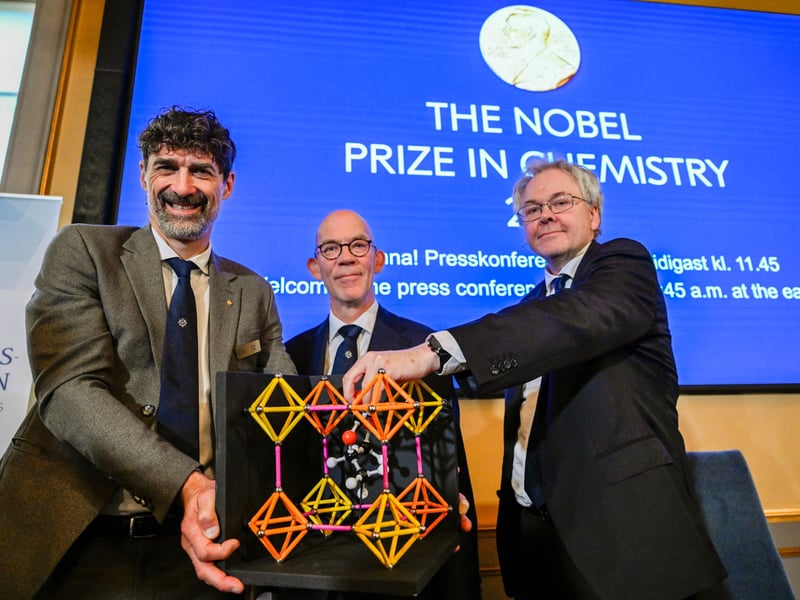
STOCKHOLM (AFP) — Three scientists won the Nobel Prize for Chemistry Wednesday for their work developing metal–organic frameworks, whose multiple uses include capturing carbon dioxide and harvesting water from desert air.
Japan’s Susumu Kitagawa, U.K.-born Richard Robson and American-Jordanian Omar Yaghi were honored for their groundbreaking discoveries dating from the late 1980s to the early 2000s.
The jury noted that thanks to the trio’s discoveries, chemists had been able to build tens of thousands of different such frameworks.
“Some of these may contribute to solving some of humankind’s greatest challenges,” it added.
It listed applications such as “separating PFAS from water, breaking down traces of pharmaceuticals in the environment, capturing carbon dioxide or harvesting water from desert air.”
To explain the scale of their achievement, Hans Ellegren, secretary general of the Royal Swedish Academy of Sciences, told reporters: “Imagine that the tools of chemistry could be used to create entirely new materials with unheard of properties.”
‘Spacious crystal’
In 1989, Robson, 88, tested utilizing the properties of atoms in a new way using copper ions.
“When they were combined, they bonded to form a well-ordered, spacious crystal,” the jury said. “It was like a diamond filled with innumerable cavities.”
Robson, a professor at the University of Melbourne, realized the potential of his discovery but the molecular construction was unstable.
It was Kitagawa, a professor at Kyoto University, and Yaghi, a professor at the University of California, Berkeley, who provided a “firm foundation” for the building method.
Between 1992 and 2003, working separately, they made a series of revolutionary discoveries.
Kitagawa “showed that gases can flow in and out of the constructions and predicted that MOFs could be made flexible,” said the jury.
Yaghi created “a very stable MOF” and showed that it could be modified using rational design, giving it new and desirable properties," it added.
Yaghi’s humble beginnings
“I’m deeply honored and delighted that my long-standing research has been recognized,” Kitagawa said as he was interviewed by phone during the prize announcement news conference.
In an interview with the Nobel Foundation, Yaghi said he was “astonished, delighted, overwhelmed” at the news he had won the award.
He was in an airport switching flights when the Academy called him to announce the news.
Born into a family of refugees in Amman, Jordan, Yaghi did not start out in ideal conditions to pursue an academic career.
“I grew up in a very humble home. And, you know, we were a dozen of us in one small room, sharing it with the cattle that we used to raise,” he said.
He said he thought his father had only finished sixth grade and that his mother could neither read nor write.
For Yaghi, school provided a refuge, the Royal Swedish Academy of Sciences said in its statement.
He had first discovered molecular structures in a book when he was 10 and had snuck into the usually locked school library, it added.
He moved to the U.S. to study at the age of 15.
“So it’s quite a journey,” he mused — and science had allowed him to make it, he added.
“Science is the greatest equalizing force in the world,” Yaghi said.
A diploma, a medal and a check
The chemistry prize follows the physics prize, which on Tuesday honored Briton John Clarke, Frenchman Michel Devoret and American John Martinis for work putting quantum mechanics into action. Their research enabled the development of all kinds of digital technology.
On Monday, the Nobel Prize for Medicine went to Mary Brunkow and Fred Ramsdell, of the United States, and Japan’s Shimon Sakaguchi, for research into the human immune system.
The Nobel Prize in literature will be announced on Thursday, followed by the Nobel Peace Prize on Friday.
The economics memorial prize wraps up the 2025 Nobel season on Oct. 13.
The Nobel consists of a diploma, a gold medal and a $1.2-million check, to be shared if there is more than one winner in a discipline.
—
By JOHANNES LEDEL Agence France-Presse
Subscribe to our free newsletters
Our weekly newsletter Closing Arguments offers the latest about ongoing trials, major litigation and rulings in courthouses around the U.S. and the world, while the monthly Under the Lights dishes the legal dirt from Hollywood, sports, Big Tech and the arts.