
 Search Articles


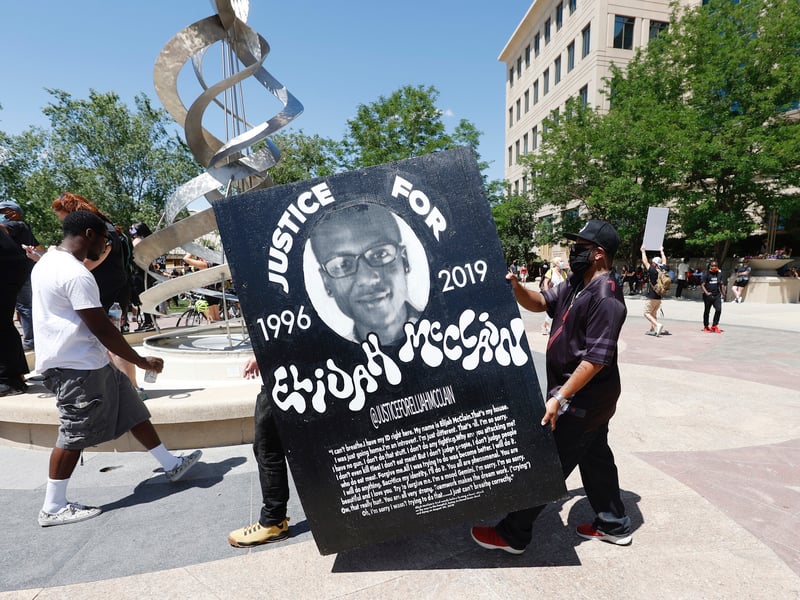
BRIGHTON, Colo. (CN) — The trial began on Wednesday for two Aurora first responders who face manslaughter charges after administering a fatal dose of ketamine to 23-year-old Elijah McClain on Aug. 24, 2019, after he was stopped by police on his way home from purchasing iced tea.
McClain was walking to his home in the Denver suburb of Aurora, after buying three cans of Arizona tea, when a passing teenager reported him as suspicious to 911 for wearing a ski mask and dancing down the sidewalk. Three police officers arrived within minutes.
When McClain didn’t immediately follow orders to “stop” and “relax,” the officers handcuffed him, took him to the ground and engaged him in two constructive carotid holds, which made him vomit. Also known as a “chokehold,” or “sleeper hold,” the maneuver cuts off blood flow to the brain, causing a person to black out.
Police are required to call emergency medical responders after using such a hold. That’s what brought Aurora Fire Rescue lieutenant Jeremy Cooper and chief medic Peter Cichuniec to the scene. Based on what officers told him — that McClain was out of control and on drugs — Cooper concluded McClain was suffering from excited delirium and called for 500 mg of the sedative ketamine, which Cichuniec administered.
McClain never regained consciousness and died three days later in a hospital. Investigators later confirmed McClain was unarmed and was not on drugs.
While excited delirium appeared in Aurora training manuals at the time of McClain’s death, the controversial condition connected to uses of excessive force by police, was recently disavowed by the American College of Emergency Physicians.
During her opening statement Wednesday, Colorado Solicitor General Shannon Stevenson stressed that Cooper and Cichuniec had treated McClain with complete disregard while he was under their care as a patient.
“They gave him that sedative without speaking to him or laying a hand on him,” Stevenson said. “The sedative had no medical purpose; it was used as a chemical restraint.”
Prosecutors say neither Cooper nor Cichuniec needed permission to offer McClain medical treatment as law enforcement held him to the ground. Defense attorneys countered that emergency responders were blocked from treating McClain until law enforcement ceded custody.
“The second the cuffs come off, you see the difference,” said defense attorney Shana Beggan, who practices with the firm Alonzi Pellow Beggan in Denver. Beggan argued Cooper couldn’t help McClain until an ambulance and gurney arrived.
Beggan told jurors she would use the same evidence as prosecutors to reveal her client’s perspective on what happened and cautioned the jury against relying on hindsight.
Referring to law enforcement’s body-worn camera footage, Beggan said, “We are literally going to watch an innocent man die, and that’s haunting, but we know things now the officers and medics did not know then.”
Internal investigations by the Aurora police and fire departments initially concluded no wrongdoing had occurred and the district attorney declined to press charges.
Following the 2020 George Floyd protests, Colorado activists began chanting McClain’s name at rallies. The state summoned a grand jury investigation and in September 2021 pressed charges Cooper and Cichuniec, as well as three police officers: Jason Roseblatt and Nathan Woodyard, who were recently acquitted, and Randy Roedema, who was found guilty of lesser charges.
Seventeenth Judicial District Judge Mark Warner is presiding over the trial, which is scheduled to run through Christmas.
 Follow @bright_lamp
Subscribe to our free newsletters
Our weekly newsletter Closing Arguments offers the latest about ongoing trials, major litigation and rulings in courthouses around the U.S. and the world, while the monthly Under the Lights dishes the legal dirt from Hollywood, sports, Big Tech and the arts.