
 Search Articles


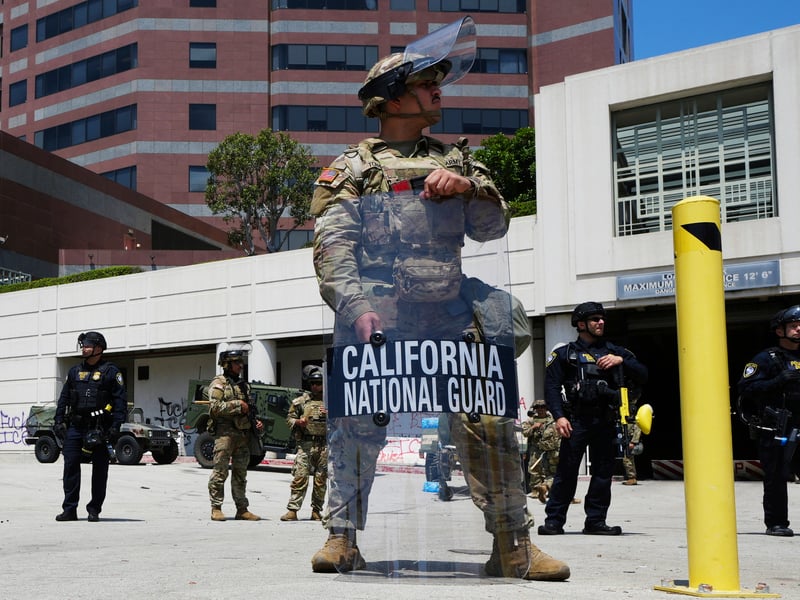
SAN FRANCISCO (CN) — California once again challenged President Donald Trump in court on Monday in a bench trial where a judge must decide if the White House violated federal law earlier this summer by sending federal troops to Los Angeles during its immigration protests.
U.S. District Judge Charles R. Breyer said that the trial, which will last through Wednesday, will determine if the president violated the Posse Comitatus Act, a federal law that blocks federal troops from participating in regular civilian law enforcement except when authorized by the Constitution or an act of Congress.
“The trial that is going to commence this morning is about a single factual issue, to which a number of legal challenges have been asserted,” the Bill Clinton appointee said.
“That factual issue is as follows: Did the military, in this case, the Marines and National Guard, violate the Posse Comitatus Act?”
The judge heard from high-ranking military and immigration officials on a variety of evidence, including photos and videos of the protests.
However, California found its arguments unexpectedly boosted when Trump announced just hours earlier that he would also mobilize the National Guard in Washington, D.C. and take control of the city’s police department.
“In Los Angeles, we did the same thing, working with the California National Guard, working with ICE officers,” U.S. Defense Secretary Pete Hegseth said on Monday.
Many of the federal officials in the courtroom Monday hadn’t yet heard the announcement, strengthening California’s position that without a court order blocking Trump’s future control of the state National Guard, the White House would likely take control again.
The Justice Department objected to showing the officials a video of the announcement, arguing that it wasn’t on the exhibits list and that they were not properly informed of the development.
“How could you be informed when it happened this morning?” Breyer asked federal attorneys.
The judge ultimately allowed the video to be played, finding it relevant to the trial.
“Now you’re informed,” the judge said.
In the courtroom, California built a case that federal troops had been illegally participating in law enforcement actions using videos and photos of federalized National Guardsmen blocking traffic, which is prohibited by the law, and reports detailing the detainment of one local veteran by U.S. Marines, who was visiting a federal building on an errand.
Through witness testimony, California also laid out the limitations placed on troops by the law.
William Harrington — deputy chief of staff of Task Force 51, which was the U.S. Army group deployed to LA in June — testified that federal troops were not permitted to make arrests, nor conduct searches, seizures, security patrols, traffic control, crowd control, riot control or interrogations.
There are, however, exceptions made for the protection of federal property and personnel, which is what the army insists was its purpose.
Major General Scott Marshall Sherman, the commander of the U.S. Army force deployed to LA, identified several troops blocking traffic as members of Task Force 51, although he said that he couldn’t say what they were up to without proper context.
Referencing one operation that took place at MacArthur Park in the Westlake neighborhood of Los Angeles called “Operation Excalibur,” California presented documents showing that the command knew that conducting operations in the area would be of little strategic value.
According to an executive summary of the operation offered in court, higher-ups noted there were no “high-value targets” or threats to federal functions at the location, nor indications that failing to act would result in property damage or loss of life.
“Conclusion: Although inaction carries little immediate risk, it could weaken the public’s perception of federal responsiveness and reduce deterrence in other areas if the federal presence seems limited or absent,” the document states.
Sherman said that when he questioned the decision to approve “Operation Excalibur,” the leader of Customs and Border Protection operations in Los Angeles, Gregory Bovino, questioned his loyalty to his country.
Although the Justice Department objected to the relevancy of that testimony, Breyer overruled.
“If the person making the decision has 33 years of experience and is told by a civilian authority that he is disloyal to the United States of America, why isn’t that relevant to whatever decision is made?” Breyer questioned.
Ultimately, Sherman did not approve of the operation, but Hegseth later approved it.
Federal agents faced no resistance at the park, and the operation was over quickly. No arrests were made.
“It actually took more time to drive there than it did for agents to walk through the park,” Harrington said.
Although nearly all the troops in LA have been demobilized, Sherman testified that 300 California National Guard soldiers are still deployed in the city, where they continue to assist federal law enforcement.
Ernesto Santa Cruz Jr., the field office director for the Department of Homeland Security in LA, also testified that the presence of the National Guard was a huge deterrent for the public, allowing his agents to make their arrests unimpeded.
However, the director also quibbled with the judge over the precise definition of what he defined as an “immigration raid.”
“I don’t know anyone who actually conducts raids,” Santa Cruz Jr. said.
Before the trial day ended, the Justice Department moved for summary judgment, arguing that California hadn’t proved any violations of the Posse Comitatus Act. The judge took the matter under submission.
California Attorney General Rob Bonta issued a statement ahead of the trial.
“Today, 300 federalized California National Guard members remain tools in the president’s game, and the Trump Administration seeks to advance the argument that there should be no limits on what federal troops can do. But that is not what our law allows,” Bonta said.
Representatives for the Justice Department declined to comment on the proceedings.
Newsom sued Trump in federal court on June 9 — just days after the LA protests began and the National Guard was mobilized— arguing that Trump’s deployment of the troops violates the 10th Amendment and the Administrative Procedure Act by exceeding his constitutional authority.
Beginning in early June, the Trump administration ordered as many as 4,000 California National Guard troops and 700 Marines into LA after protests erupted over U.S. Immigration and Customs Enforcement raids of downtown businesses and Home Depot parking lots, where day laborers gather to find work.
Newsom says that federal law requires the governor’s consent before the president can mobilize a state’s National Guard for domestic law enforcement. Without immediate court intervention, he warned, the unauthorized use of troops would harm state sovereignty, inflame tensions and fuel unrest.
Breyer initially issued a temporary restraining order on June 12 restoring Newsom’s control of the National Guard, but a Ninth Circuit panel quickly blocked that order the same day with an emergency stay.
In its unanimous opinion, the panel took issue with the breadth of Breyer’s temporary restraining order.
“Even if defendants failed to comply with the statute’s procedural requirement, such failure would not justify the injunctive relief imposed by the district court,” the panel said.
“The proper remedy would be injunctive relief tailored to defendants’ failure to issue the order through the governor — not an injunction prohibiting the president from exercising his lawful authority to call up the National Guard," it added.
Although the panel ultimately disagreed with Trump’s argument that his deployment decision was “unreviewable,” it still determined that the president was within his authority to send in the state National Guard.
In a later court order, Breyer said that the Ninth Circuit’s recent decision will not prevent him from deciding if another preliminary injunction is warranted, as long as he doesn’t interfere with the higher court’s findings on appeal.
" The Ninth Circuit has left it to this court to determine whether defendants’ conduct exceeds their authority under the Posse Comitatus Act … and the court will do so," Breyer wrote.
This case was filed in the Northern District of California and heard at the Phillip Burton Federal Courthouse in San Francisco.
Subscribe to our free newsletters
Our weekly newsletter Closing Arguments offers the latest about ongoing trials, major litigation and rulings in courthouses around the U.S. and the world, while the monthly Under the Lights dishes the legal dirt from Hollywood, sports, Big Tech and the arts.