
 Search Articles


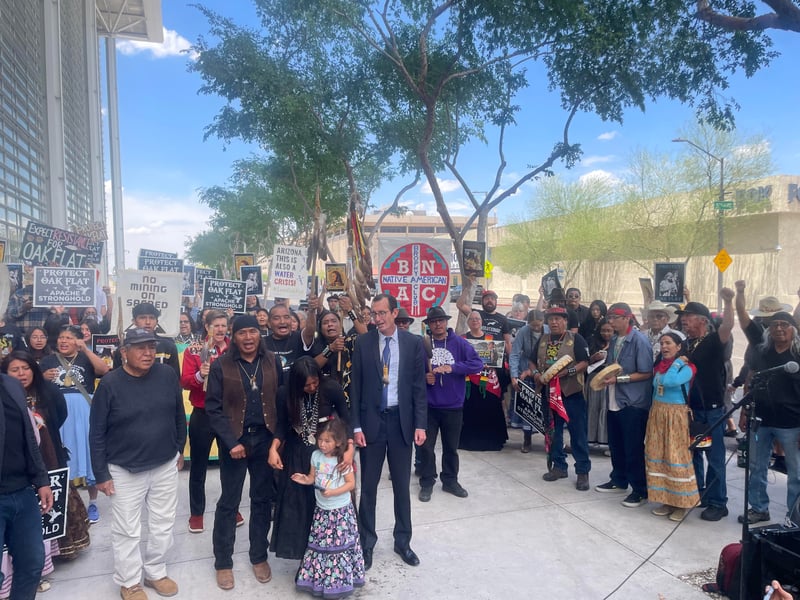
PHOENIX (CN) — After attempting to rush transfer of an Apache holy site into the hands of a private mining company to avoid judicial review, the federal government now says the land transfer is immune from such review and cannot be enjoined or delayed despite challenges to the document that triggers the exchange.
In a six-hour hearing in Phoenix Wednesday, Arizona’s San Carlos Apache Tribe and the Arizona Mining Reform Coalition pleaded yet again with a federal judge to halt the transfer of Oak Flat — a 2,400-acre site in the Tonto National Forest used for the most sacred of Apache religious ceremonies — to the private ownership of Resolution Copper, which plans to swallow the site in a 2-mile-wide, 7,000-feet-deep crater.
Despite U.S. District Judge Dominic Lanza granting 60 days for the plaintiffs to challenge the Forest Service’s final environmental impact statement (FEIS), the issuance of which initiates the land transfer, Department of Justice attorney Erica Norman said Wednesday that no challenge to the statement can prevent the transfer.
The attorney said the final environmental impact statement — an analysis of all potential environmental effects of any Forest Service action as required by the National Environmental Policy Act — isn’t subject to judicial review regarding the land transfer, meaning no issues the court finds with it can stop the privatization of Oak Flat.
Before a gallery of more than 75 Western Apaches and supporters, Norman said that only the yet-to-be-issued record of decision would be subject to judicial review. That document won’t be released until the 60-day challenge period has expired.
But once the land is privately owned, plaintiffs’ attorneys point out, nothing can be done to stop the mine.
Congress approved of the land transfer via an 11th hour amendment to a national defense bill in 2014. In it, Congress explicitly wrote that Oak Flat must be transferred to Resolution Copper within 60 days of the publication of the final environmental impact statement. Though the Forest Service published its statement in 2021, it later rescinded the document, planning to go back to the drawing board and promising litigants, including the San Carlos Apache Tribe and Arizona Mining Reform Coalition, that it would allow them time to challenge the new statement before the transfer was completed.
Earlier this year, the government tried to go back on the promise, telling Lanza, a Trump appointee, that it would transfer the land immediately after publication. In June, Lanza foiled that plan, ordering the government to wait the full 60 days while the plaintiffs filed new motions for a preliminary injunction.
Now, the Forest Service and Resolution Copper seem to have moved the goalpost.
“Congress never intended that judicial review of the FEIS would be a roadblock for the land exchange,” Norman said.
Instead, the defendants say that the transfer of Oak Flat is a “non-discretionary duty” under the 2014 statute and must happen by Aug. 19 regardless of challenges to the impact statement. Non-discretionary duties cannot be challenged under the National Environmental Policy Act.
While the plaintiffs can challenge aspects of the impact statement — they say the Forest Service failed to consult with the affected tribes, failed to consider expert opinion, didn’t properly evaluate groundwater modeling, effects on hydrology or waste management, improperly appraised the value of the copper beneath the ground and more — no judicial action could result in the cancellation of the transfer, Norman said. Challenges to the land use would simply be adjudicated after the fact, once the mine is already privately owned.
Lanza previously balked at going against Congress’ 2014 intent but seemed unconvinced that the impact statement has no authority over the land transfer at all. He asked whether the Forest Service could cancel the transfer if, for example, it found that the project would use too much water, suck the ground dry and burst the dams. Resolution Copper attorney Michael Houston doubled down, arguing the statute requires the transfer no matter what.
But plaintiff attorney Roger Flynn said stopping the mine is still within the Forest Service’s power. Attorney Bernardo Velasco, representing the tribe, argued that the statute doesn’t order the Forest Service to build the mine, but instead to complete the land transfer only after a comprehensive impact statement. Because the statement is less than comprehensive, the plaintiffs argue, Velasco said the land transfer has not yet been legally authorized.
Lanza called the conflict “as complicated a case as I’ve ever worked on,” commenting on the complexity of both sides’ arguments.
“Doesn’t that mean that plaintiffs have at least shown serious questions?” he asked.
He didn’t say by when he’d have a ruling on the plaintiffs’ preliminary injunction motion.
 Follow @JournalistJoeAZ
Subscribe to our free newsletters
Our weekly newsletter Closing Arguments offers the latest about ongoing trials, major litigation and rulings in courthouses around the U.S. and the world, while the monthly Under the Lights dishes the legal dirt from Hollywood, sports, Big Tech and the arts.