
 Search Articles


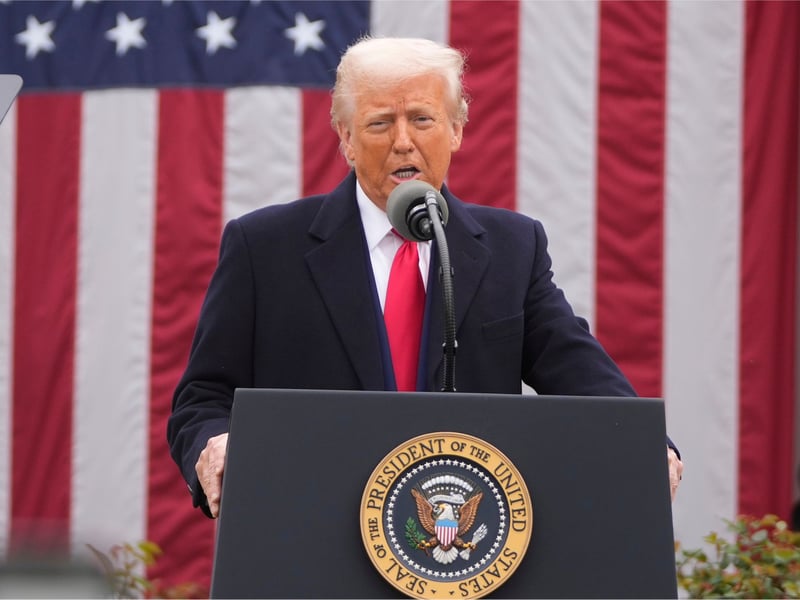
WASHINGTON (CN) — A family-owned toy company pressed the Supreme Court to take extraordinary action on Tuesday to halt President Donald Trump’s unilateral tariff war, warning that his actions were unconstitutional and harmful to American businesses.
Learning Resources, an Illinois-based business that creates and sells educational products, asked the justices to fast-track its challenge to Trump’s tariff authority before an appellate court weighs in on the case.
“It relates to the very nature of our government, and I don’t think this kind of issue can wait,” Rick Woldenberg, Learning Resources CEO, told Courthouse News. “This is not hypothetical. It’s in the newspaper every day. It has to stop.”
The Supreme Court rarely hears cases before an appeals court ruling — a process called certiorari before judgment. But Woldenberg urged the justices to make an exception, arguing businesses can’t afford the delay.
Although two courts have found Trump’s tariffs unlawful, those rulings are on hold. Each month of delay could cost businesses $50 billion, Woldenberg said, citing the administration’s estimate that the tariffs will generate $600 billion annually.
“The reality is it’s $100 billion plus of taxes that have been illegally declared that can be avoided or postponed by a more expeditious adjudication of the issues,” Woldenberg said. “I just think that that’s almost the definition of things that are urgent.”
Trump launched a global tariff war during a “Liberation Day” event, announcing a 10% base tariff on imports from 57 countries, with some rates spiking as high as 50%. The shifting tariffs — added, removed, and reimposed — have created economic uncertainty for businesses and consumers.
He justified the move by declaring a national emergency over trade deficits, invoking the International Emergency Economic Powers Act (IEEPA), a Nixon-era law granting presidents broad authority over economic matters during emergencies. Ironically, IEEPA was designed to curb earlier emergency powers under the Trading with the Enemy Act.
The White House did not answer questions about whether the justices should step into the legal battle before the D.C. Circuit, but the administration stood behind its use of IEEPA.
“The Trump administration is legally using the powers granted to the executive branch by the Constitution and Congress to address our country’s national emergencies of persistent goods trade deficits and drug trafficking,” White House Spokesman Kush Desai said in an email. “If the Supreme Court decides to hear this unfounded legal challenge, we look forward to ultimately prevailing.”
Learning Resources, a fourth-generation family business in northern Illinois that creates and sells educational toys and products, sued the administration in April, challenging Trump’s authority to impose tariffs under IEEPA.
Although other administrations have used IEEPA to enforce sanctions, Learning Resources said Trump’s tariffs are beyond the bounds of the statute.
“IEEPA does not give the President the vast power he has seized. IEEPA does not mention the word ‘tariff’ or ‘tax,’ and no other President in its nearly 50-year history has ever relied on it for tariffing power,” Learning Resources said in a brief filed at the Supreme Court on Tuesday.
Woldenberg said giving the president unilateral tariff authority flew in the face of fundamental democratic ideals concerning the separation of powers.
“[The founding fathers’] big issue back then was taxation without representation,” Woldenberg said. “They built the entire novel American form of government around the concept that taxation would be done by your neighbors, that you elected to Congress to run the government, government of the people, by the people, for the people.”
Under this administration, however, Woldenberg said that authority is being exercised by one individual: Trump.
“It’s a tax on an order that no U.S. government has imposed on its citizens in at least 100 years, and it’s being done in the dead of night,” Woldenberg said. “So that’s not right, and that’s not how our government’s supposed to function.”
U.S. District Judge Rudolph Contreras struck down certain tariffs that impacted Learning Resource and hand2mind, another educational toy business that joined the lawsuit. Both companies manufacture most of their products in China, Taiwan, Korea, Vietnam, Thailand and India.
The Barack Obama appointee’s ruling only applied to the specific plaintiffs.
A group of small businesses filed a separate appeal in the Court of International Trade, which also ruled that Trump overstepped his authority by declaring an “economic emergency.” Although both the court and Judge Contreras issued preliminary injunctions against the tariffs, those orders were paused by appellate courts.
Learning Resources argues the Supreme Court will inevitably need to resolve the issue, given the sweeping impact of the tariffs on businesses and consumers nationwide. Woldenberg noted that more than 500 employees rely on the company, which also supports local schools, services, and millions of children through its educational products.
Woldenberg said Trump’s tariffs posed an existential threat to his business and all the shareholders who depend on his company.
“When you really think about what the tear and the fabric of the universe would occur if our company were blotted out because of misguided and illegal tax policies, it can get very motivating — you have to do something about this,” Woldenberg said.
He continued, “There are a lot of people who need us, depend on us and have incorporated us into their lives, whether in a school or in their home. We’re a mission-driven business, and so we’ll fight to preserve that. We think what we do matters. We’re not a rounding error, and we’ll stand up and fight if that’s what is necessary to stay healthy.”
 Follow @KelseyReichmann
 Follow @kelseyreichmann.bsky.social
Subscribe to our free newsletters
Our weekly newsletter Closing Arguments offers the latest about ongoing trials, major litigation and rulings in courthouses around the U.S. and the world, while the monthly Under the Lights dishes the legal dirt from Hollywood, sports, Big Tech and the arts.