
 Search Articles


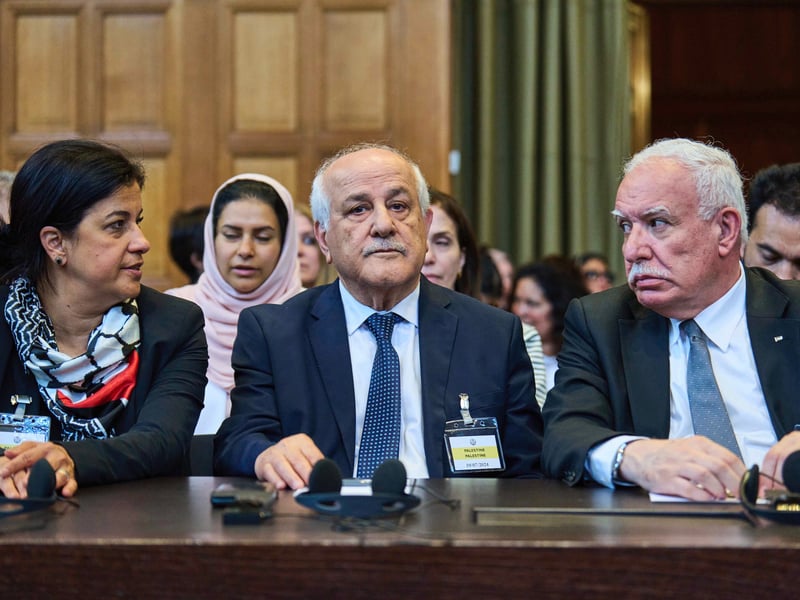
THE HAGUE, Netherlands (CN) — In a highly anticipated decision, the highest court of the United Nations said on Friday that Israel’s presence in the Palestinian territories is illegal and must end.
In a nonbinding advisory opinion, the International Court of Justice found a myriad of Israeli policies — including backing settlements and exploiting natural resources — violate international law and said all countries who assist Israel with its illegal activities are also in breach of their obligations.
“The State of Israel is under an obligation to bring to an end its unlawful presence in the Occupied Palestinian Territory as rapidly as possible,” presiding Judge Nawaf Salam said in reading out the 83-page ruling.
After years of pressure from human rights groups and Palestinian advocates, the United Nations General Assembly passed a resolution in December 2022 to ask its high court to weigh in on Israel’s legal obligations toward the Palestinian territories.
During two weeks of hearings earlier this year, 52 countries and three international organizations made presentations to the court over their interpretation of international law. The overwhelming majority of countries participating in the proceedings condemned Israeli behavior in the Palestinian territories.
While the International Court of Justice is known for often making decisions which are seen as very limited, this advisory opinion was extraordinarily broad. “It’s every layer of legality,” international law expert Juliette McIntyre told Courthouse News.
The 15-judge panel criticized Israel for continuing to expand settlement activity in breach of a 2004 opinion rendered by the court over the legality of the construction of a wall in East Jerusalem and called on the country to evacuate settlers.
Since Israel captured land in the 1967 Mideast war, it has built or supported settlements across the occupied territories. Some 700,000 Israelis are estimated to be living in them.
According to McIntyre, the part of the opinion that could have the most far-reaching consequences was the admonishment that all U.N. member states have an obligation to not assist Israel in the illegal occupation.
“There is no question as to the legality now,” she said.
Following the hearing the Palestinian delegation applauded the decision.
“The ICJ fulfilled its legal and moral duties with this historic ruling. All states must now uphold the clear obligations: No aid, no assistance, no complicity, no money, no arms, no trade, no nothing. No actions of any kind … to support Israel’s illegal occupation,” senior diplomat Riad Malki told reporters.
Aid organization Oxfam also applauded the extent of the decision. “This is an historic judgement that lays bare Israel’s criminal actions that have denied rights, marginalized and subjugated Palestinians for decades. Every aspect of the occupation is illegal – settlements and settlers, the denial of water, and the use of Palestinian natural resources,” Sally Abi Khalil, the British-based group’s Middle East director, said in a statement.
Israel condemned the decision: Prime Minister Benjamin Netanyahu called it “false” and denied the settlements were illegal. “The Jewish people are not conquerors in their own land — neither in our eternal capital Jerusalem nor in the land of our ancestors in Judea and Samaria,” he said in a statement.
While the Hague-based court mostly settles disputes between countries, certain U.N. bodies can ask the judges to weigh in on all sorts of legal questions, issuing what are known as advisory opinions. The opinion is a separate legal proceeding from the ongoing case between Israel and South Africa over charges of genocide.
The International Criminal Court also has an investigation open, and in a controversial move earlier this year, the court’s chief prosecutor requested arrest warrants for Israeli Prime Minister Benjamin Netanyahu, Minister of Defense Yoav Gallant and Hamas leader Yahya Sinwar and other senior officials.
The charges against the Israeli leaders center on the use of starvation as a war crime, pointing to the “arbitrary” closing of border crossings and cutting off water and electricity to the Gaza Strip following the Oct. 7, 2023, Hamas attacks.
The charges against Sinwar, the militant organization’s military chief Mohammed Deif and senior official Ismail Haniyeh stem from the cross-border raid last year that left more than 1,000 dead. Khan says the trio are guilty of extermination, murder, taking hostages and sexual assault for organizing the Oct. 7 attacks.
 Follow @mollyquell
Subscribe to our free newsletters
Our weekly newsletter Closing Arguments offers the latest about ongoing trials, major litigation and rulings in courthouses around the U.S. and the world, while the monthly Under the Lights dishes the legal dirt from Hollywood, sports, Big Tech and the arts.