
 Search Articles


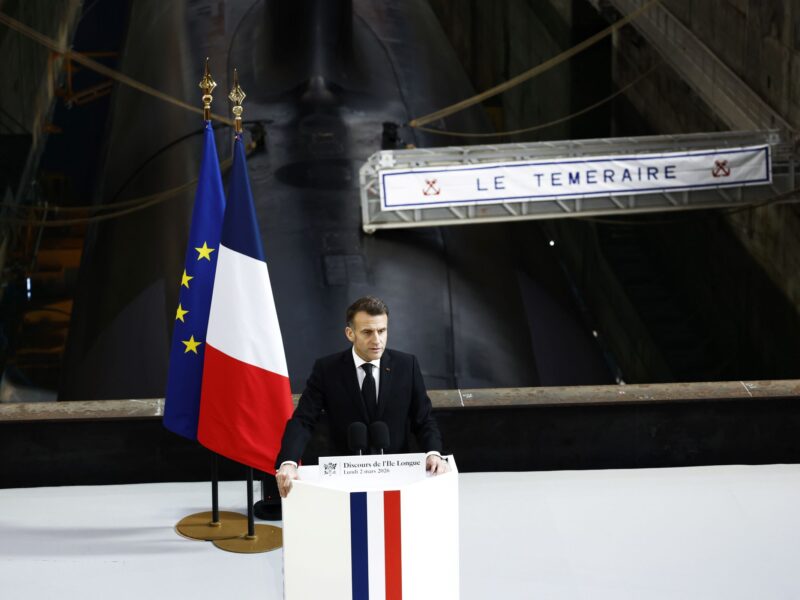
PARIS (CN) — France will increase its production of nuclear warheads, French President Emmanuel Macron announced Monday as part of a new “forward deterrence” nuclear strategy while Europe faces repercussions of the U.S.-Israeli led war on Iran.
“In this dangerous and unstable world … to be free, one must be feared — I am convinced of it,” Macron said at the Île Longue military base, home to the nation’s nuclear submarines. “The evolution of our competitors’ defenses, the emergence of regional powers, the possibility of coordination between adversaries, and the risks associated with proliferation … all of this, after a thorough review, has led me to this conclusion.”
Throughout the nearly 45-minute speech, Macron outlined key changes to France’s nuclear strategy to boost European defense. In addition to increasing its nuclear arsenal, it will no longer publicize how many weapons it has; it will work alongside a number of European allies on joint exercises; and it will consider stationing some of its nuclear assets in other countries, which would be a first.
“Today a new step of France’s deterrence can now be taken … We are entering the path of what I call forward deterrence,” he said. “It will finally provide for the temporary deployments of elements of our strategic air forces to allied countries.”
Macron said France will work with the U.K., Germany, Poland, the Netherlands, Belgium, Greece, Sweden and Denmark on this new framework. Germany, he said, would be a key partner in the effort.
“The German budget alone is expected to double from 2025 to 2029 where it could be 1.5 times that of France or the U.K., or even possibly as much as both added together,” Paul van Hooft, a research leader at RAND Europe, said. “Germany has also committed itself to spending roughly $40 billion on military space-based surveillance.”
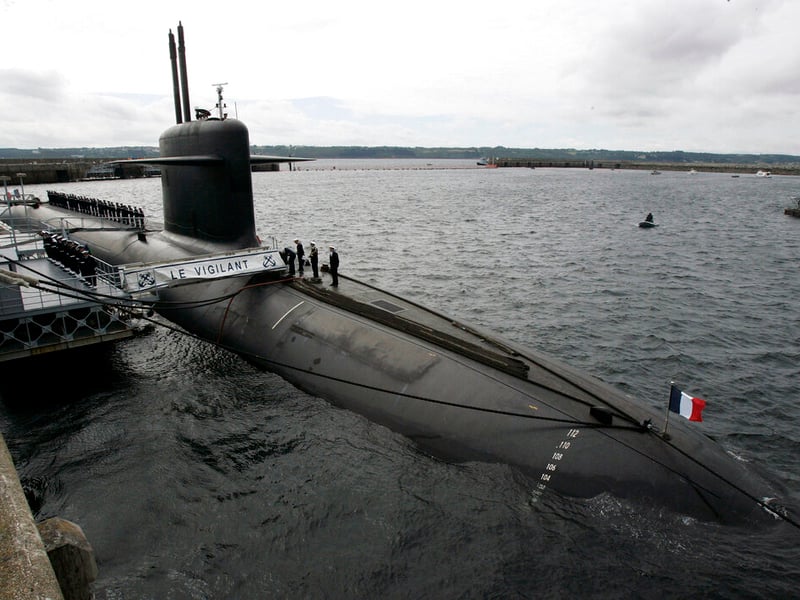
This marks a sharp turn away from France’s prior nuclear strategy, which largely followed a defensive logic. The nation did not enter into an arms race, and kept a minimum number of weapons — just under 300 nuclear warheads — to be threatening but not competitive. The United Kingdom is Europe’s only other nuclear power.
In contrast, the United States and Russia have thousands.
“The president’s speech actually marks a certain departure from his previous 2020 speech on nuclear deterrence, insofar as President Macron identifies — or at least draws lessons from — the past few years regarding both nuclear proliferation and the strategic and legal context,” Alain De Neve, a research fellow at the Royal Higher Institute of Defense in Brussels, said. “We are witnessing a speech that is truly intended to reinforce deterrence, reinforce credibility and ensure that there is no doubt about France’s determination in this policy of deterrence.”
In the first few minutes of his speech, Macron addressed how other countries — including China, Russia and the U.S. — are developing increasingly sophisticated systems to protect their territories. Threats, he added, can’t be considered “in isolation,” since new links have emerged between them.
“Added to this is theongoing war in the near and Middle East, which brings and will continue to bring its share of instability and potential conflagration to our borders, with an Iran whose nuclear and ballistic capabilities have not yet been destroyed,” he said. “As for our American allies, who are themselves modernizing their arsenal, they have played a key role in the defense of Europe since 1945 and will continue to do so — we are grateful to them for this.”
Since the beginning of Macron’s first term in 2017, he has advocated for a stronger, more independent Europe. However, U.S. President Donald Trump’s second administration has accelerated the urgency; in his speech, Macron mentioned the U.S.’s recent national security and defense strategy, which he said reflects a shift in American priorities.
“[The U.S. has been] calling for Europe to take more direct responsibility for its own security,” he said. “We must heed this invitation to take greater control of our own destiny.”
France and Germany have agreed to take the first concrete steps in the project this year, the Élysée Palace said in a statement shortly after Macron’s speech. Germany will participate in French nuclear exercises and the two will make joint visits to strategic sites.
“France and Germany have established a high-ranking nuclear steering group,” the two nations said in a joint statement in English, in an arrangement they said would “add to, not substitute for, NATO’s nuclear deterrence.”
The broader European effort will focus largely on surveillance.
“Early warning, meaning the capability, through a combination of satellites and radars, to detect and track missiles that could target us … control of our airspace with extended air defense and antimissile and antidrone protection,” Macron said. “And finally, deep-strike capabilities … By joining us in this mutual support, partner countries can help strengthen Europe’s capabilities in these three areas.”
However, Macron said France will remain the only country with the power to press the button.
“I want to make it clear right away — there will be no sharing of the ultimate decision, its planning or its implementation,” he said. “Under our Constitution, it belongs solely to the president of the Republic, who is accountable to the French people.”
 Follow @lilyradz
Subscribe to our free newsletters
Our weekly newsletter Closing Arguments offers the latest about ongoing trials, major litigation and rulings in courthouses around the U.S. and the world, while the monthly Under the Lights dishes the legal dirt from Hollywood, sports, Big Tech and the arts.