
 Search Articles


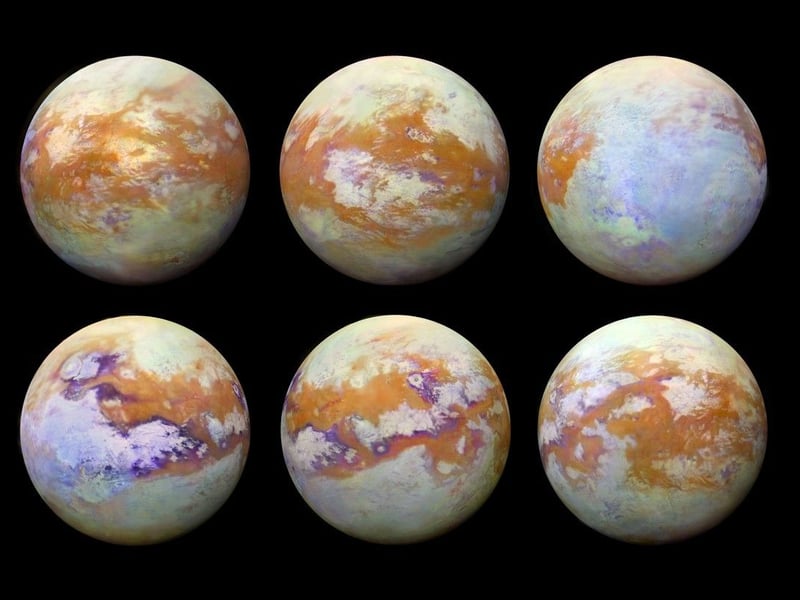
(CN) — For years, Saturn’s largest moon has been considered one of the most promising places in the solar system to look for life. A new analysis suggests Titan’s interior may be far stranger and slushier than scientists once thought.
The conclusion comes from a fresh look at data collected by NASA’s Cassini mission, which studied Saturn and its moons for nearly 20 years. Researchers say Titan likely does not have a vast, global ocean of liquid water beneath its icy shell.
Instead, a journey below the moon’s frozen surface would probably reveal more ice, mixed with slushy layers and pockets of meltwater near the rocky core. The findings, published Wednesday in Nature, challenge long-standing assumptions about Titan’s interior and could reshape how scientists search for life there.
Earlier interpretations of that data led scientists to propose a large subsurface ocean on Titan, based largely on how the moon flexes as it orbits Saturn. But when researchers tried to model Titan with a deep ocean, the numbers did not quite line up.
“Instead of an open ocean like we have here on Earth, we’re probably looking at something more like Arctic sea ice or aquifers, which has implications for what type of life we might find, but also the availability of nutrients, energy and so on,” said Baptiste Journaux, a University of Washington assistant professor of Earth and space sciences, in a press release.
Apart from Earth, Titan is the only known place in the solar system with stable liquid on its surface. Temperatures hover near minus 297 degrees Fahrenheit, cold enough that liquid methane and ethane form lakes and rain clouds. Water, meanwhile, is locked away as ice.
As Titan travels around Saturn in a slightly elongated orbit, the planet’s gravity pulls on the moon, stretching and compressing it. In 2008, researchers concluded that Titan must contain a large ocean beneath its crust to allow that degree of deformation.
“The degree of deformation depends on Titan’s interior structure. A deep ocean would permit the crust to flex more under Saturn’s gravitational pull, but if Titan were entirely frozen, it wouldn’t deform as much,” Journaux said. “The deformation we detected during the initial analysis of the Cassini mission data could have been compatible with a global ocean, but now we know that isn’t the full story.”
What the earlier work did not fully account for was timing. In the new study, researchers found that Titan’s shape changes lag about 15 hours behind Saturn’s strongest gravitational pull. That delay matters.
Like trying to stir honey instead of water, it takes more energy to deform a thick, viscous material. By measuring the lag, scientists were able to estimate how much energy Titan loses as it flexes. The amount of energy dissipated was far greater than expected if Titan contained a large, free-flowing ocean.
“Nobody was expecting very strong energy dissipation inside Titan. That was the smoking gun indicating that Titan’s interior is different from what was inferred from previous analyses,” said Flavio Petricca, a postdoctoral fellow at NASA’s Jet Propulsion Laboratory and lead author of the study, in the press release.
The model that best fits the data replaces a deep ocean with a thick, slushy layer. This mixture of ice and water is stiff enough to explain the delayed response but still pliable enough to allow Titan to deform under Saturn’s pull.
Petricca based his analysis on subtle shifts in the frequency of radio waves sent from the Cassini spacecraft during Titan flybys. Journaux helped interpret the results by applying laboratory measurements of how water and ice behave under extreme pressure.
“The watery layer on Titan is so thick, the pressure is so immense, that the physics of water changes. Water and ice behave in a different way than seawater here on Earth,” Journaux said.
However, the findings do not rule out life on Titan.
Researchers say smaller pockets of liquid water could actually improve the odds by concentrating nutrients and energy in limited spaces, rather than spreading them thin across a global ocean. Analyses suggest some of these freshwater pockets could reach temperatures as warm as 68 degrees Fahrenheit.
Questions about Titan’s interior are expected to be explored further in the coming years.
Journaux is on the team for NASA’s upcoming Dragonfly mission to Titan, scheduled for launch in 2028, which will study the moon’s chemistry and surface conditions in detail.
“The discovery of a slushy layer on Titan also has exciting implications for the search for life beyond our solar system,” said Ula Jones, a graduate student in Journaux’s lab, in the press release. “It expands the range of environments we might consider habitable.”
Subscribe to our free newsletters
Our weekly newsletter Closing Arguments offers the latest about ongoing trials, major litigation and rulings in courthouses around the U.S. and the world, while the monthly Under the Lights dishes the legal dirt from Hollywood, sports, Big Tech and the arts.