
 Search Articles


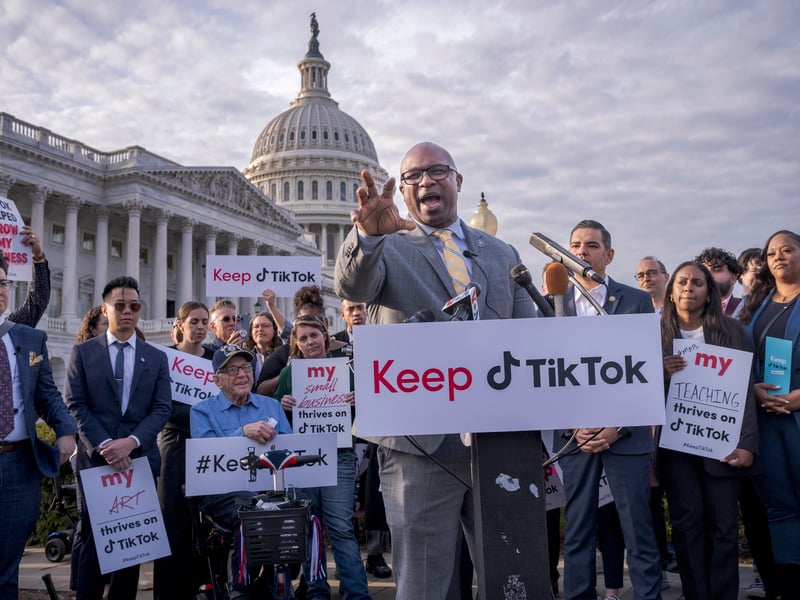
WASHINGTON (CN) — A high-profile First Amendment battle over the bipartisan effort to ban or rein in the social media giant TikTok will kick off at the D.C. Circuit on Sept. 16, even as experts and the public have doubts the ban is necessary — or legal.
The case pits the popular video-sharing platform against the bipartisan Protecting Americans from Foreign Adversary Controlled Applications Act, which seeks to ban the app or force it to divest from Chinese parent company ByteDance before Jan. 19, 2025 — a task TikTok argues is near impossible.
A three-judge panel made up of Chief U.S. Circuit Judge Sri Srinivasan and U.S. Circuit judges Neomi Rao and Douglas Ginsburg — appointed by Barack Obama, Donald Trump and Ronald Reagan, respectively — will decide whether the potential ban clears the high bar set by the First Amendment.
If the panel sides with the government, it could either result in a full ban of the app in the United States, or, if TikTok finds an U.S.=based buyer, could create an U.S.-only version disconnected from international users.
The key question involves whether the panel finds the potential ban is an effort to suppress certain speech on the app — TikTok’s argument — or a reasonable action to prevent content manipulation and data collection by China — the government’s argument.
Anupam Chander, professor of law and technology at Georgetown University, said in an interview that TikTok’s argument and likely citations of lawmakers’ explicit claims that the app has boosted pro-Palestinian content is problematic for the government.
Chander, who filed an amicus brief along with other First Amendment experts supporting TikTok’s position, said that while the government may argue otherwise, those claims “strike at the heart” of First Amendment protections against viewpoint discrimination.
He noted U.S. Representative Mike Gallagher, the chairman of the House Select Committee on Competition with the Chinese Communist Party and co-sponsor of the bill who has since resigned from Congress, made those claims in a November op-ed. Gallagher accused TikTok of “brainwashing our youth against the country and our allies” by promoting “pro-Hamas” content.
“If you’re trying to control speech in the U.S., you’re setting yourself up to fail,” Chander said.
The case stems from a lawsuit filed by TikTok at the D.C. Circuit to block the potential ban, which it describes as “obviously unconstitutional” and an “extraordinary speech restriction.”
Lawmakers slipped a sweeping foreign-aid package into the act that also included around $95 billion in aid for Ukraine, Israel and Taiwan. The act passed with a wide bipartisan margin as Congress argued the platform posed a national security threat and was signed into law by President Joe Biden on April 24.
In legal filings last month, Attorney General Merrick Garland, who was named as the defendant in the case, defended the act and rejected TikTok’s contention that national security concerns were merely speculative.
He pointed to several classified briefings and one classified hearing that Congress received and conducted prior to the bill’s passage, that outlined risks posed by TikTok’s continued operations in the U.S. under ByteDance.
Garland also pointed to lawmakers’ claims that TikTok’s data collection allows the Chinese government to undermine the security of the U.S. and highlighted the app’s algorithm, warning it allows China to “covertly control” the content Americans see in “ways detrimental to U.S. interests.”
Chander noted that the classified nature of Garland’s arguments — a third of his reply brief was redacted — makes it difficult to know how the panel will react and puts the petitioners in a unique position of “fighting with one eye closed.”
Monday’s arguments will also feature a second suit, brought by a group of eight TikTok creators who warned they would suffer financial and personal harm if the platform is banned, which was consolidated with TikTok’s suit.
According to recent polling by the Pew Research Center, 32% of Americans support a TikTok ban, down from 50% who supported the ban in March 2023.
While 61% of Americans who use the app oppose the ban, just 42% who don’t are in favor, another drop from 60% in March. Further, 50% of Americans said they doubt the app will ultimately be banned, with a near even split between Republicans, 52%, and Democrats, 50%.
Despite the unprecedented nature of the case, Chander said Supreme Court precedent from 1971 to the present has been to reject government claims of national security concerns as a reason to clamp down on rights.
Chander highlighted the Pentagon Papers case, or New York Times v. United States, in which the government sought to prevent the publication of secret Vietnam War documents and warned they would endanger soldiers’ lives. The Supreme Court rejected that claim and allowed the paper to publish the documents.
The example, Chander said, was a reminder to take any national security claims that may take away certain rights “with a grain of salt.”
In NetChoice , the high court paused content moderation limits Texas and Florida had sought to place on social media sites like Facebook and YouTube, in an effort to limit the companies’ content-moderation policies that aim to restrict hateful content or misinformation.
Justice Elena Kagan wrote in her opinion that social media companies’ content moderation polices amounted to editorial decisions, and that just as the First Amendment requires strict scrutiny for laws curtailing such decisions by newspapers, it should also require scrutiny for laws targeting the policies.
“There is a through line, the internet is a place with a wide variety of discourse, something that we want to protect, not suppress,” Chander said.
While not clearly related to the looming oral arguments, TikTok also announced on Monday a multiyear partnership with Monumental Sports & Entertainment, the parent company of the Washington Capitals, Washington Wizards and the Washington Mystics.
According to a press release, TikTok will serve as the “official partner” of the Capitals through 2027 and will include a TikTok logo patch on the hockey team’s road jerseys beginning Sept. 24 against the Boston Bruins. The company also said it will be the title sponsor for the teams 50th anniversary celebration, sponsoring events and initiatives throughout the season.
Jim Van Stone, the chief commercial officer for Monumental, expressed his excitement to “utilize TikTok” to connect with fans across all three major sports teams in the announcement.
“TikTok empowers our fans to share their passion for the Caps and all our teams in their own unique ways,” Van Stone said in the statement.
 Follow @Ryan_Knappy
Subscribe to our free newsletters
Our weekly newsletter Closing Arguments offers the latest about ongoing trials, major litigation and rulings in courthouses around the U.S. and the world, while the monthly Under the Lights dishes the legal dirt from Hollywood, sports, Big Tech and the arts.