
 Search Articles


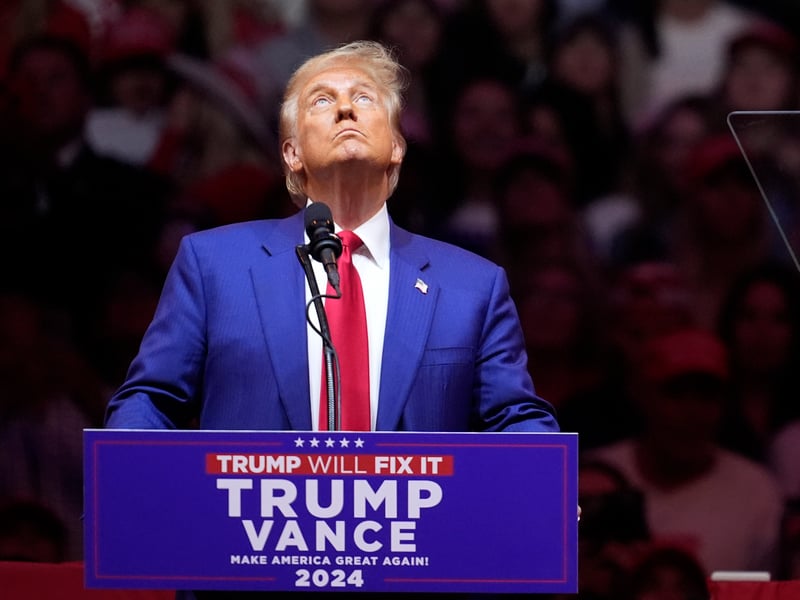
MANHATTAN (CN) — The U.S. Justice Department unsealed criminal charges Friday in a thwarted Iranian plot to kill President-elect Donald Trump.
According to the complaint filed in Manhattan federal court, an unnamed official in Iran’s paramilitary Revolutionary Guards instructed a contact in September to put together a plan to surveil and ultimately kill Trump ahead of the presidential election.
The government says the official told his contact, identified as Farjad Shakeri, to pause his plan until after the presidential election if he couldn’t get it done in time because he believed Trump would lose and it would be easier to assassinate him then.
As outlined in the complaint, the official told Shakeri that “money’s not an issue."
In an interview with the FBI, Shakeri claimed he did not intend to propose a plan within the official’s initial timeframe.
Shakeri, alongside co-conspirators Carlisle Rivera and Jonathan Loadholt, face charges of murder-for-hire, conspiracy to commit murder-for-hire and money laundering conspiracy.
“Actors directed by the government of Iran continue to target our citizens, including President-elect Trump, on U.S. soil and abroad,” U.S. Attorney for the Southern District of New York Damian Williams, said in a statement. “This has to stop.”
Federal officials say the plot is the latest display of ongoing efforts by Iran to target U.S. government officials.
Trump survived two assassination attempts during his presidential campaign. In July, he was shot in the ear by a gunman at a Butler, Pennsylvania rally and months later another individual showed up on the edge of Trump’s West Palm Beach, Florida golf course with a firearm.
According to prosecutors, Shakeri is an Afghan national who immigrated to the United States as a child. In 2008, he was deported after serving about 14 years in New York state prisons following a 1994 conviction for robbery.
While incarcerated, he created a network of criminal associates to supply the Islamic Revolutionary Guard Corps with operatives to conduct surveillance and assassinations of the group’s targets.
According to prosecutors, Shakeri also attempted to carry out a plot to kill Masih Alinejad, a New York-based Iranian journalist and political activist who has been critical of the Iranian government. As part of his plan, he promised to pay Rivera and Loadholt $100,000 to surveil and kill Alinejad.
“We have also charged and arrested two individuals who we allege were recruited as part of that network to silence and kill, on U.S. soil, an American journalist who has been a prominent critic of the regime,” U.S. Attorney General Merrick Garland said in a statement.
In one instance, Shakeri paid his co-conspirators about $1,000 to surveil Alinejad at a public speaking event at Fairfield University in Connecticut this past February.
The government also outlines various WhatsApp messages in which Rivera coordinated with his co-conspirators to monitor the journalist’s Brooklyn residence.
“This bitch is hard to catch, bro,” Rivera said in one voice note to Shakeri. “And because she’s hard to catch, there ain’t going to be no simple pull up, unless there’s the luck of the draw.”
In another message, Shakeri discussed a $100,000 payment with Rivera to “finish the work,” which federal agents say was about his order to kill Alinejad.
Federal prosecutors unsealed separate criminal charges in October against Islamic Revolutionary Guard Corps Brig. Gen. Ruhollah Bazghandi in connection with a murder plot to kill Alinejad, who has been especially critical of Iran’s repression of women.
 Follow @NikaSchoonover
Subscribe to our free newsletters
Our weekly newsletter Closing Arguments offers the latest about ongoing trials, major litigation and rulings in courthouses around the U.S. and the world, while the monthly Under the Lights dishes the legal dirt from Hollywood, sports, Big Tech and the arts.