
 Search Articles


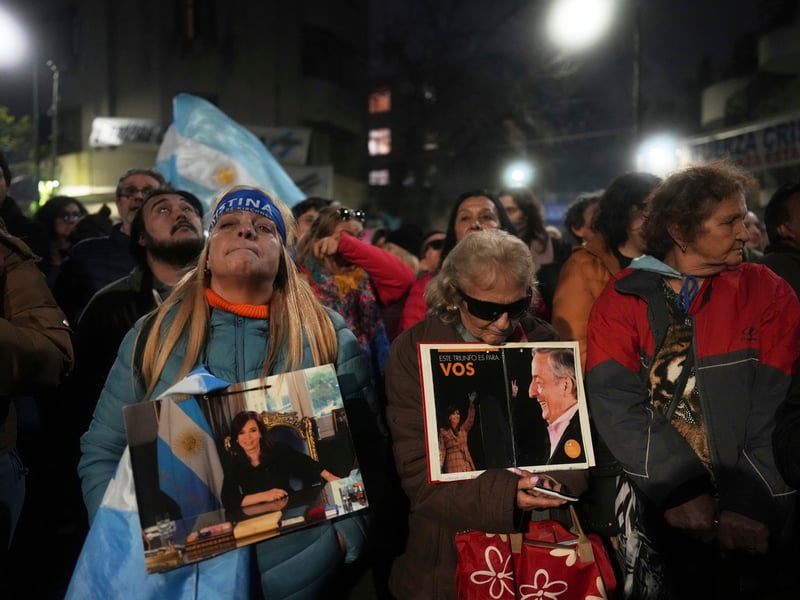
BUENOS AIRES (CN) — An estimated 160,000 people took to the streets of Buenos Aires on Wednesday to rally against the Supreme Court’s decision that led to the imprisonment of Cristina Fernández de Kirchner, Argentina’s former president and the primary opposition figure to the incumbent President Javier Milei.
Other rallies were held in cities across the country. The march was initially planned to start in Fernández de Kirchner’s flat and accompany to turn herself in in courts, but the judge granted her house arrest a day ealier, changing the plans of her supporter organizations.
A week ago, the Supreme Court upheld her six-year prison sentence and imposed a lifelong ban from public office. Following a request from her defense team, Fernández de Kirchner began serving her sentence from her apartment in southern Buenos Aires on Tuesday. It was from there that she recorded an eight-minute audio message addressed to her supporters gathered in the streets.
“Hello, dear fellow patriots, how are you, in that historical and marvelous Plaza de Mayo?” she said. “Here I am, in San José 1111 [her home address].”
“Here, imprisoned — they can lock me up, but they can’t jail all of Argentina,” she added. “They’re the ones who are scared, not us.”
Her supporters listened in silence before erupting into cheers, her words resonating as a powerful and unifying force for the crowd. Mariana Gómez, a 32-year-old communications professor, was among those present.
“This is an inflection point,” she said. A longtime supporter of Fernández de Kirchner, though concerned about the ongoing infighting among Peronist representatives, she said this moment should be seen by politicians as a time for reorganizing “with the people’s needs at the center,” far from “political pettiness.”
However, she felt empowered to join the crowd in Plaza de Mayo. “Being here, this gathering, is a way to show what we were, what we built — and a chance to think about how to rebuild it. And Cristina [Fernández de Kirchner] will be present with all of us, from another place, of course,” she said.
Cristina Fernández de Kirchner, twice elected president, is the most prominent opponent of the Javier Milei administration. A center-left leader and head of the Peronist coalition that brings together labor unions, national industry leaders, and progressive movements, Fernández de Kirchner has been a pivotal and polarizing figure in Argentine politics for the past two decades.
According to Pulso Research, a political consultancy group, 32% of respondents view her as the main political opponent to Milei. However, 43% responded that there was no clear opposition or that they did not know who it was, highlighting the strength of Milei’s administration and his party, Liberty Advances.
The “Vialidad case,” under which Fernández de Kirchner was sentenced, reflected one of the most persistent criticisms leveled against her and her late husband Néstor Kirchner’s presidencies: allegations of corruption in public works contracts, in collaboration with local businesspeople who benefited from state projects during their administrations. The first lawsuit was filed in 2008 and, after several judicial stages — including acquittals and the reopening of cases — she was ultimately sentenced in late 2022 while still serving as Vice President under the Alberto Fernández administration.
At the time, she declared she would not run for public office, stating she wanted to remain without privileges and fight the conviction as an ordinary citizen.
Fernández de Kirchner criticized the judicial decision, labeling it politically motivated by some of her political antagonists, including right-wing former president Mauricio Macri, who has shown ties and proximity to some of the prosecutors and judges involved in the case.
Over the weekend, leaders of the Peronist movement held a press conference with foreign media to address the sentence and discuss next steps. There, her son and lawmaker Máximo Kirchner described the ruling as politically motivated and characterized it as an act of “proscription,” drawing a parallel with the banning of Juan Domingo Perón, the founder and spiritual leader of Peronism, from 1955 to 1973.
“We will invest our whole strength in trying to reverse this [the sentence],” said Teresa García, a Peronist lawmaker from the Buenos Aires province. “We will go to international courts and look at all of our options.”
The sentence set upon Fernández de Kirchner, she said, urged a renewal of the Peronist movement.
“Several constitutional guarantees have been violated along the process,” added Carlos Alberto Beraldi, Fernández de Kirchner’s lawyer. “But not just my client’s rights — also, the democratic system in Argentina, because it’s proscribing her from running in the upcoming elections.”
During her address to the masses on Wednesday, Fernández de Kirchner said that her sentence was due to fear of her political antagonists that they would lose elections. Only days before, she had announced that she would run for the Buenos Aires province legislature, a minor seat for someone who was president twice but a strong gesture to dispute power in the country’s biggest electoral jurisdiction.
However, Beraldi said that the international steps are yet to be determined by the former president, who is a lawyer herself and is looking at the best options, both legal and political. “She will make that decision,” he said, “she’s the victim of this persecution.”
Beraldi said that their strongest point is that the judges along the process were “systematically impartial” and that there are several proofs of the executive power holding inappropriate ties with judiciary officials. He said, too, that Fernández de Kirchner wasn’t granted her right to defense.
Incumbent and former presidents Evo Morales from Bolivia, Miguel Díaz-Canel from Cuba, Gustavo Petro from Colombia, Rafael Correa from Ecuador, Lula da Silva from Brazil, among others, expressed support toward Fernández de Kirchner publicly, and some, like Da Silva, spoke with her privately over the phone. He is expected to travel to Argentina for a Mercosur summit in early July and could pay the former president a visit in person.
On Thursday afternoon, the judge granted the former president the allowance to step out of her flat into her balcony in the first floor, a ban that had been imposed earlier in the week and that was deemed by the president as “ludicrous.”
Hundreds gather every day outside the flat where she is serving her sentence, waiting for her to come out and greet them. The blocks around her house arrest are covered in signs expressing words of support.
“She’s not Rapunzel in her tower,” reads one of the signs. “She’s the best president Argentina ever had.”
 Follow @luciacholakian
Subscribe to our free newsletters
Our weekly newsletter Closing Arguments offers the latest about ongoing trials, major litigation and rulings in courthouses around the U.S. and the world, while the monthly Under the Lights dishes the legal dirt from Hollywood, sports, Big Tech and the arts.