
 Search Articles


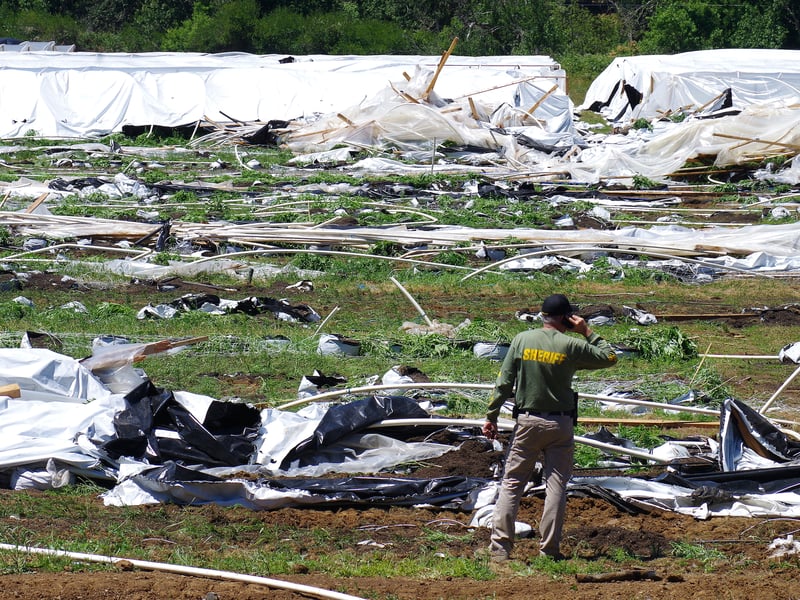
(CN) — Stephanie Shepard entered federal prison in 2010, convicted on a charge of conspiracy to distribute cannabis. It was a hefty charge, but a nonviolent one. And not one that Shepard expected to cost her a decade of her life.
“When it happened, it was shocking,” Shepard, now the director of advocacy for the cannabis reform nonprofit the Last Prisoner Project, said in a phone interview. “I thought you had to work very hard to become a federal prisoner.”
For her conviction, Shepard would spend the next nine years incarcerated. And she wasn’t alone. The FBI reported over 853,000 cannabis-related arrests in just 2010, including over 100,000 arrests for trafficking or selling and over 750,000 that included possession. Per the same data, over 15 million cannabis-related arrests were made in the U.S. between 1996 and 2015.
The numbers for people serving prison time for nonviolent cannabis offenses specifically are harder to pin down, but Shepard and other staff at the Last Prisoner Project said it was at least in the thousands.
“The intention was always incarceration,” the Last Prisoner Project’s policy manager Adrian Rocha told Courthouse News. “It was never about public safety.”
The history of America’s War on Drugs goes back to the early 1900s, with opium among the first substances proscribed by law. The country famously banned the production, transport and trade of alcohol in 1919 via the now-repealed 18th Amendment, leading to the Prohibition Era that lasted until 1933.
Other federal regulations on drugs and pharmaceuticals were enacted contemporaneously, along with early state-level regulations on cannabis specifically. The Boggs Act of 1952 mandated minimum mandatory sentences for drug convictions — including cannabis possession — and 20 years later, former president Richard Nixon gave his infamous June 1971 White House speech declaring drug abuse “America’s public enemy number one.”
“In order to fight and defeat this enemy, it is necessary to wage a new, all-out offensive,” Nixon said.
The Drug Enforcement Administration was established under Nixon’s watch in 1973, and rates of arrest for cannabis skyrocketed in the aftermath. FBI crime report data shows over 416,000 cannabis arrests were made in the U.S. in 1975, more than double the number just five years earlier.
The rate of cannabis arrests remained relatively stable for the next 20 years, even as cultural movements against drug use like Nancy Reagan’s “Just Say No” campaign and the Drug Abuse Resistance Education (D.A.R.E) program ramped up in the 1980s. Rates again soared following the passage of the 1994 Crime Bill during the Clinton administration — alongside a more general increase in rates of incarceration — and peaked in 2007 with close to 873,000 arrests.
These heightened arrest rates disproportionately affected, and still disproportionately affects, people of color — a 2020 study conducted by the American Civil Liberties Union found Black people were 3.6 times more likely to be arrested for cannabis possession as white people, despite similar rates of cannabis use.
“There’s a recognition that prohibition has ruined and derailed so many lives,” Rocha said.
Since the late 1990s, 38 states have moved to decriminalize, and eventually legalize, cannabis use for medicinal and/or recreational purposes. But even as people outside prison walls have gained the ability to use cannabis openly, the movement to free those still imprisoned for now-legal acts — and clear their records — has moved more slowly.
The federal government has moved slowest of all. It still considers weed a prohibited, Schedule 1 controlled substance and has made no moves toward the possibility of expungement for cannabis offenses.
The Biden administration has made several symbolic overtures to changing this — Biden endorsed the possibility of reclassifying cannabis from a Schedule 1 to the less-severe Schedule 3 substance this past May, and announced rounds of pardons for simple marijuana possession and use offenders in 2022 and 2023. But his record of more concrete actions is lacking. He’s so far granted only about 2% of the clemency petitions the White House received in 2022 and 2023. He also had a hand in drafting the 1994 crime bill.
“His record on the War on Drugs is pretty clear,” Rocha said.
Cannabis use, sale and possession also remains illegal in 12 mostly Republican-controlled states — in early 2021 the Idaho Senate even tried to pass a state constitutional amendment that would have barred legalization.
Shepard discussed, in light of that reality, how some states’ opposition to cannabis legalization and expungement may go beyond ideology into more cynical economic calculations: the value of prison labor, free from minimum wage protections. The ACLU and University of Chicago, in 2022, found that American prison workers produced about $2 billion in goods and over $9 billion in services per year, despite being paid on average between $0.13 to $1.30 an hour.
While behind bars, Shepard said she too was compelled to work, but that she chose to teach English instead of work in a prison shop “making shorts for the Army,” as she put it.
“I thought, what are these contracts worth? Because these people are making a dollar an hour,” Shepard said of her own time as prison laborer.
In 2023, the nonprofit prison reform think tank Prison Policy Initiative found that of the nearly 2 million people behind bars in the U.S., one in five are there on a drug-related offense. Other estimates range as high as 46%.
“When you have thousands of people doing free labor for you, it’s very hard to let go of that,” Shepard said.
Despite these hurdles, Rocha and Shepard both expressed hope that the pace of change was accelerating. In Illinois, for example, about 780,000 people’s cannabis offense records were expunged between July 2019 and January 2023. Rocha called California’s route to expungement “the gold standard,” citing how the state has addressed over 90% of eligible cannabis convictions since passing its 2016 cannabis legalization measure Proposition 64.
“That’s the progress that we want to see,” Rocha said, also noting the Illinois Supreme Court recently ruled that burnt cannabis smell alone was not enough to justify warrantless vehicle searches by police.
But expungement and legalization aren’t the only issues to reckon with. The legal U.S. cannabis market has exploded since the mid-2010s as more states have legalized medical and recreational use: by the end of 2024 total revenues could hit nearly $40 billion. But just as Black and brown people have been disproportionately impacted by cannabis law enforcement, they are also disproportionately absent from this booming industry.
Black owners accounted for less than 2% of the industry according to 2021 data from the cannabis industry outlet Leafly. The reality is especially stinging for Shepard, a Black woman whose decade behind bars stemmed from her participation in that same industry. She recounted how she watched from prison as wealthy white entrepreneurs boasted their success in the same business that saw her arrested.
“I would say this hypocrisy has to stop,” Shepard said, later adding, “When I saw cannabis getting legalized, I asked ‘what about me?’”
Entrepreneurs or workers, free or imprisoned, Shepard also emphasized how the generations of punitive laws against cannabis possession and trade had harmed whole communities, particularly communities of color. Her work with Last Prisoner Project, she said, was part of her attempt to right some of those injustices.
“When a community is affected, it affects our entire nation… I was reduced to this one charge. And that’s not how we’re going to move society forward,” she said.
 Follow @djbyrnes1
Subscribe to our free newsletters
Our weekly newsletter Closing Arguments offers the latest about ongoing trials, major litigation and rulings in courthouses around the U.S. and the world, while the monthly Under the Lights dishes the legal dirt from Hollywood, sports, Big Tech and the arts.