
 Search Articles


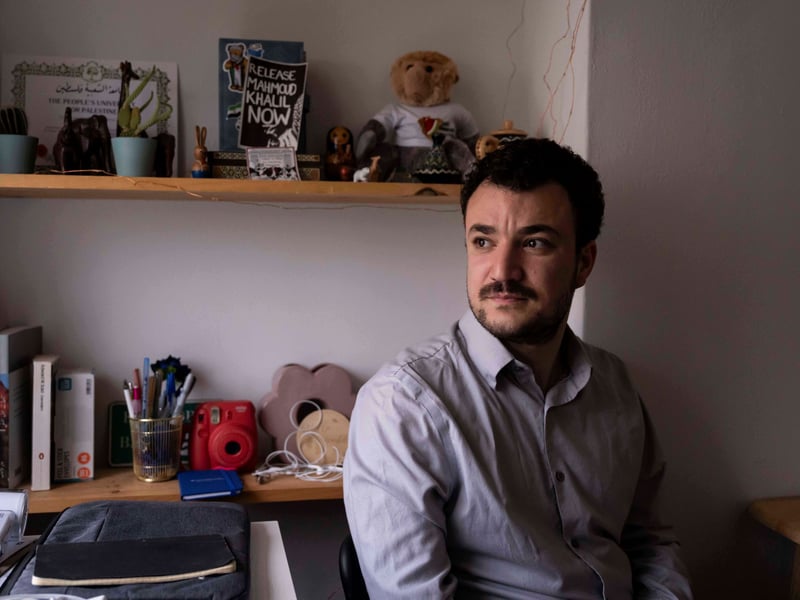
(CN) — A federal appeals court on Thursday ruled that Mahmoud Khalil, the former Columbia University graduate student jailed by the Trump administration for pro-Palestinian advocacy, never had the right to contest his immigration arrest in the New Jersey court that freed him.
In a 2-1 ruling, a panel of Third Circuit judges ordered the lower court to dismiss Khalil’s habeas corpus petition, which could open the 31-year-old up to be detained again and eventually deported by federal immigration authorities. It’s a massive blow to academics around the country whom the government is seeking to deport for criticisms of Israel, like Rumeysa Ozturk and Mohsen Mahdawi, who, like Khalil, are lawful residents advocating for Palestinian rights at their respective universities.
Khalil, a green card holder whose wife and son are U.S. citizens, was the first of those students to be arrested after he led highly covered protests at Columbia University in the spring of 2024. Khalil served as a lead negotiator on behalf of the demonstrators, engaging in talks with the school to urge them to divest from Israel.
He was detained at his Manhattan home last year by Immigration and Customs Enforcement agents and held for more than 100 days after the State Department deemed his advocacy harmful to U.S. foreign policy — a determination the government is using to try to deport Khalil on the back of a rarely used statute that allows for the removal of lawful permanent residents.
He was eventually released by U.S. District Judge Michael Farbiarz, a Joe Biden appointee in New Jersey, who ruled that Khalil is neither a flight risk nor a danger to the community, and should be freed from detention until a more permanent determination is made in his immigration case.
But Farbiarz never had the right to do that, the Third Circuit panel found on Thursday. It ruled that an immigration judge, not Farbiarz, would have been the proper authority to weigh his release.
“That scheme ensures that petitioners get just one bite at the apple — not zero or two,” the majority wrote in a 70-page decision. “But it also means that some petitioners, like Khalil, will have to wait to seek relief for allegedly unlawful government conduct.”
Khalil skipped the line, the judges ruled, by going to Farbiarz immediately after getting detained instead of first going through the immigration court process.
“The [Immigration and Nationality Act] bars him from attacking his detention and removal in a habeas petition,” the panel added. “We will therefore vacate and remand to the district court with instructions to dismiss the petition.”
U.S. Circuit Judge Stephanos Bibas, a Donald Trump appointee, and U.S. Circuit Judge Thomas Hardiman, a George W. Bush appointee, were in the majority that deemed the lower court’s intervention unlawful. U.S. Circuit Judge Arianna Freeman, a Joe Biden appointee, dissented, writing in the order that Farbiarz “had subject matter jurisdiction” to oversee Khalil’s habeas case.
“To halt the irreparable harm Khalil suffered during his detention, the district court entered an injunction and authorized Khalil’s release on bail,” Freeman wrote. “Today, we do not reach whether all requirements for the injunction and bail order were satisfied, but no one disputes the central basis for those orders: Khalil was being irreparably harmed while detained.”
The trio of appellate judges heard arguments from the parties in October, where they scoffed at the government’s argument that Khalil fought his detention in the wrong jurisdiction. Bibas noted that Khalil was taken by ICE in the middle of the night, and transferred to several different districts before his lawyers got a hold of him.
“They had to prepare for the worst, and they did their best,” Bibas exclaimed. “What else do they do unless we’re creating a black hole of no jurisdiction?”
The panel’s ruling on Thursday indeed found that Khalil filed his claim in the right location, only that the lower court itself was unable to take the action it did. Now, Khalil is one step closer to being deported. His immigration judge last September greenlit his removal on the government’s assertion that he poses a risk to U.S. foreign policy, but Khalil was protected from removal via Farbiarz’s order — now deemed unlawful by the Third Circuit.
“Today’s ruling is deeply disappointing, but it does not break our resolve,” Khalil said in a statement Thursday. “The door may have been opened for potential redetainment down the line, but it has not closed our commitment to Palestine and to justice and accountability. I will continue to fight, through every legal avenue and with every ounce of determination, until my rights, and the rights of others like me, are fully protected.”
The ruling won’t go into effect immediately. Khalil will have the opportunity for immediate review, meaning he can’t be detained again in the meantime.
 Follow @Uebey
 Follow @uebey.bsky.social
Subscribe to our free newsletters
Our weekly newsletter Closing Arguments offers the latest about ongoing trials, major litigation and rulings in courthouses around the U.S. and the world, while the monthly Under the Lights dishes the legal dirt from Hollywood, sports, Big Tech and the arts.