
 Search Articles


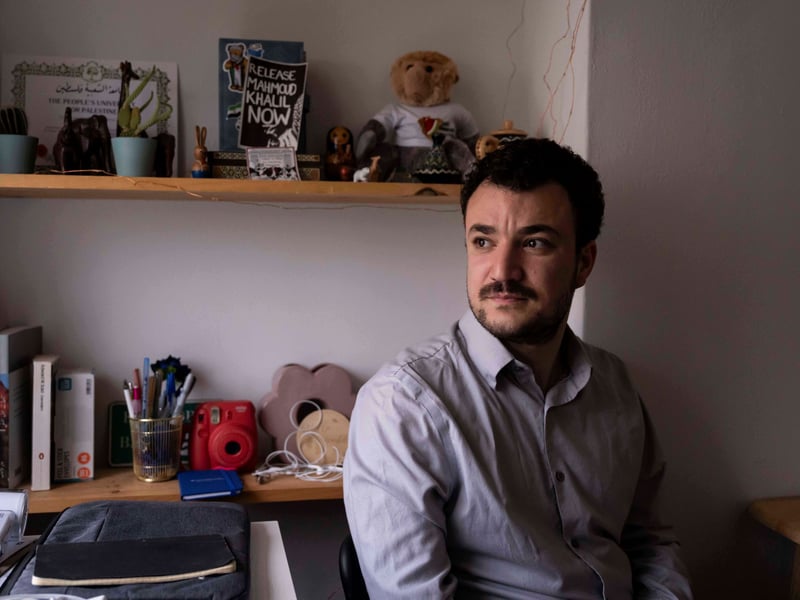
(CN) — A federal appeals court on Tuesday peppered the Justice Department with questions about its ongoing effort to put Palestinian activist Mahmoud Khalil back in immigration lockup.
The government tried to make the argument to the Third Circuit that Khalil’s habeas corpus petition, which eventually freed him from three months of detention, was filed in the wrong jurisdiction, deeming it invalid and making Khalil subject to detention once more.
But the panel of appellate judges quickly acknowledged that it was the government’s own delay in reporting Khalil’s location that led to confusion over where to file.
“It was filed in the wrong court because the government website indicated that he was in New York,” said U.S. Circuit Judge Thomas Hardiman, a George W. Bush appointee, referencing the federal database that lists where immigration detainees are being held.
Khalil, a Columbia University graduate student who led on-campus pro-Palestinian protests last spring, was arrested by Immigration and Customs Enforcement agents in the lobby of his Manhattan apartment in March. Despite being a lawful permanent resident with a green card, he was held for more than 100 days after the State Department deemed his advocacy harmful to U.S. foreign policy.
His attorneys quickly filed their habeas petition in New York, challenging the arrest as an unlawful affront to their client’s free speech. But in the span of less than two days, Khalil was moved to an ICE facility in New Jersey, then flown to another jail more than 1,000 miles away in Louisiana, where he spent the rest of his detention.
Habeas petitions are supposed to be filed in the jurisdiction where a detainee is being held. But in this case, the Third Circuit judges questioned what else Khalil’s legal team was supposed to do, considering the government failed to provide them with his up-to-date location.
“They didn’t know, the lawyers didn’t know,” said U.S. Circuit Judge Stephanos Bibas, a Donald Trump appointee. “They had to prepare for the worst, and they did their best. What else do they do unless we’re creating a black hole of no jurisdiction?”
Justice Department attorney Drew Ensign, who has been largely responsible for defending the government’s broader mass deportation agenda throughout the Trump administration, implied that Khalil’s team could have waited to file his petition until his location was known two days after his arrest.
Still, Bibas noted earlier in Tuesday’s arguments that the administration has created a situation in which “immigrants have been spirited out of the country in a matter of a day or two.”
Hardiman voiced concerns with setting a precedent where “jurisdiction just runs around the country where the petitioner has moved.”
“That can’t be the law,” the judge said.
The panel also acknowledged the First Amendment concerns that come with Khalil’s detention; he claims that the government sought to jail him to stop his pro-Palestinian advocacy.
Ensign argued that Khalil is raising those same First Amendment claims in his bid to stop his removal, too. Those claims will be subject to review by another appellate court, regardless of his detention, Ensign said.
“By the time he gets that review, his First Amendment rights will have been suppressed for some number of months,” said the panel’s third jurist, U.S. Circuit Judge Arianna Freeman, a Joe Biden appointee.
Robert Hodgson, an American Civil Liberties Union lawyer representing Khalil, agreed. He told the panel that this case is “a very straightforward First Amendment retaliation claim,” noting that detention is not required for the government to pursue Khalil’s deportation.
Hardiman, Bibas and Freeman didn’t immediately issue a ruling from the bench on Tuesday.
Khalil is still fighting his removal in an immigration court. In addition to the State Department’s assertion that Khalil’s advocacy poses a national security threat — which a federal judge deemed as a “likely unconstitutionally vague” reason to detain him — the government also claims that Khalil lied on his permanent residency application by failing to disclose that he interned for UNRWA, a United Nations relief agency that supports Palestinian refugees.
Khalil’s immigration judge greenlit his deportation on those grounds, though Khalil is currently protected from removal as his habeas corpus petition plays out in a federal court in New Jersey.
 Follow @Uebey
 Follow @uebey.bsky.social
Subscribe to our free newsletters
Our weekly newsletter Closing Arguments offers the latest about ongoing trials, major litigation and rulings in courthouses around the U.S. and the world, while the monthly Under the Lights dishes the legal dirt from Hollywood, sports, Big Tech and the arts.