
 Search Articles


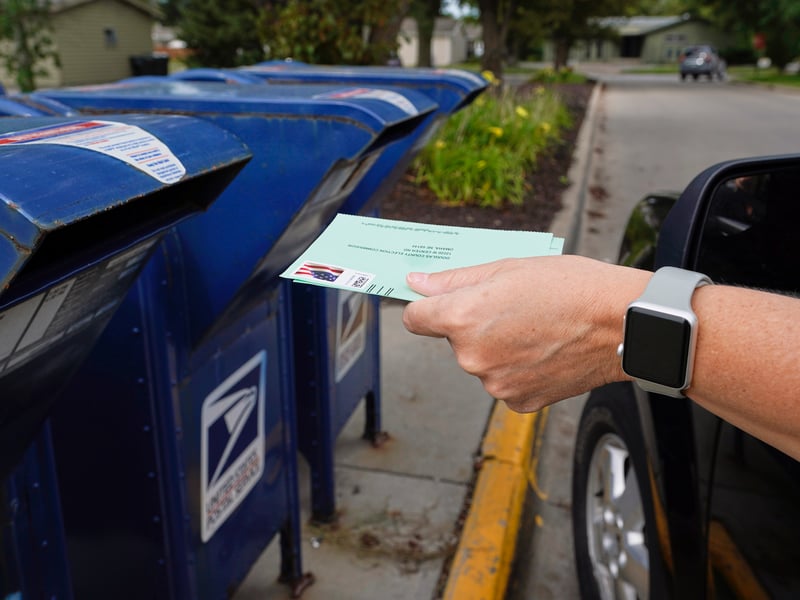
WASHINGTON (CN) — A Republican congressman heads to the Supreme Court next week in a challenge to mail-in ballots that could radiate through the midterm elections.
U.S. Representative Michael Bost claims that accepting mail-in ballots up to 14 days after an election is unlawful, but the Illinois lawmaker was thwarted before his lawsuit could take off. Two lower courts concluded that Bost and two prospective presidential electors didn’t have standing, meaning they couldn’t provide evidence that they were harmed by the policy.
The Supreme Court took up the case to decide whether Bost’s case should have moved forward. Legal experts warn that the justices’ ruling could lead to more election litigation.
“If [the justices] say that these people can challenge the way that states accept mail-in ballots, it’s going to supercharge, I think, misinformation and disinformation around electoral outcomes in the midterms, and it’s going to allow a flood of challenges by people who lose in what are otherwise standard electoral processes that have been in place for decades,” said Devon Ombres, senior director of courts and legal policy at the Center for American Progress.
Bost has served in Congress since 2015. Joined by Laura Pollastrini and Susan Sweeney, potential presidential electors in 2020, he sued the Illinois Board of Elections in May 2022, arguing that the state’s mail-in ballot deadline violated federal statutes setting the time, place and manner of federal elections.
Bost told the Supreme Court that counting mail-in ballots after Election Day harms his reelection prospects. The extended deadline is an electoral disadvantage, Bost argued, because more Democrats tend to vote by mail.
“As a result of the state law extending the deadline for receiving mail-in ballots by 14 days, petitioners must expend campaign resources to keep their campaigns running for two additional weeks, longer than campaigns in states that require mail-in ballots to be received by Election Day,” Bost wrote.
Bost said that such pocketbook injuries are enough to meet standing requirements.
“Because Illinois law effectively allows mail-in ballots to be mailed as late as Election Day, petitioners must extend their get-out-the-vote efforts targeted to likely mail-in voters to the last day,” Bost wrote. “All that costs money.”
The Illinois Board of Elections said that Bost’s argument would give all candidates standing to challenge any rule that governs their elections. That would allow political candidates to bypass the traditional standing requirements followed by every other litigant. The board said that courts have previously rejected arguments that treat political candidates differently than other plaintiffs, and the justices should do so again in Bost’s case.
“Under petitioners’ proposal, these candidates would be free to bring lawsuits to challenge any election rule on the books for purely ideological reasons — turning federal courts into fora for airing ‘generalized grievances’ about election law,” the board wrote. “And it would cause state and local governments to divert energy and resources away from administering elections and toward litigating ideological lawsuits.”
If the Supreme Court sides with Bost, it could lead to more election litigation, but not all legal experts see that as the likely outcome of the appeal.
“I think this is a case where [Bost] is not going to be found to have standing, and [the Supreme Court is] going to try to clarify when and how those types of cases can be brought,” Doug Spencer, a law professor at the University of Colorado, said. “But I don’t see that really as opening the door to more litigation as much as providing clarification.”
The Supreme Court’s 2025 term begins Monday. The justices will hear arguments in Bost v. Illinois State Board of Elections on Wednesday.
 Follow @KelseyReichmann
 Follow @kelseyreichmann.bsky.social
Subscribe to our free newsletters
Our weekly newsletter Closing Arguments offers the latest about ongoing trials, major litigation and rulings in courthouses around the U.S. and the world, while the monthly Under the Lights dishes the legal dirt from Hollywood, sports, Big Tech and the arts.