
 Search Articles


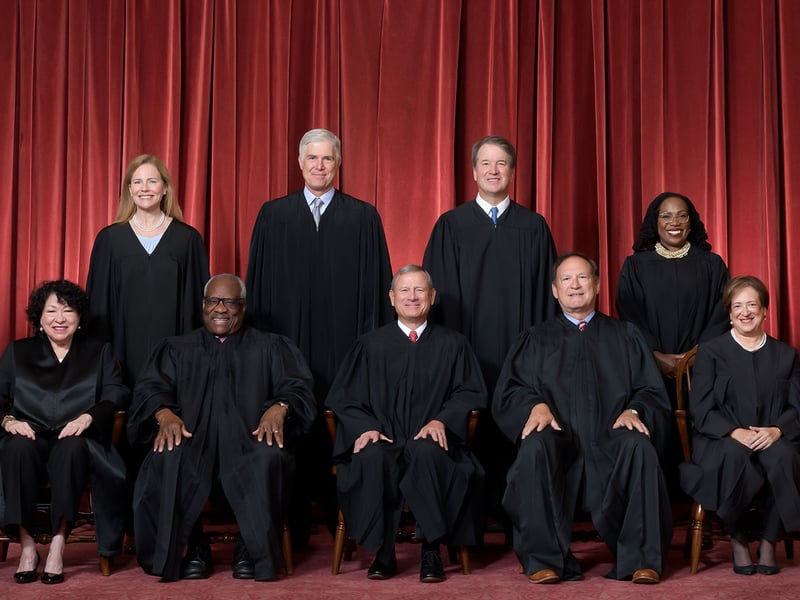
WASHINGTON (CN) — As he marks 20 years on the bench, Chief Justice John Roberts leads the Supreme Court into a new term that could fundamentally reshape the U.S. constitutional system.
During his confirmation hearings, Roberts famously promised to “call balls and strikes, not to pitch or bat.” But that promise of judicial humility has fallen short for some court watchers as the high court readies to issue major rulings on elections, free speech and executive authority.
“[Roberts] said, ‘I will walk into every case with an open mind and engage in judicial humility,’ and he has done the exact opposite for the last 20 years and headed one of the most activist courts in American history,” Devon Ombres, senior director of courts and legal policy at the Center for American Progress, said.
While the justices have pushed back against claims of judicial activism, the Supreme Court 2025 lineup presents a slew of opportunities for the Roberts court to overturn precedent and issue decisions that could ripple across the U.S. for the next 20 years.
Goodbye Voting Rights Act?
One of the standout cases on the Supreme Court’s 2025 term is a repeat from last year: Louisiana v. Callais . Hearing reargument in a case is rare for the Supreme Court and could signal that the justices intend to issue a consequential ruling. Other cases to be reargued include Brown v. Board , Roe v. Wade and Citizens United v. Federal Election Commission .
In June, the justices punted on whether Louisiana’s congressional maps complied with the Voting Rights Act, adding a secondary question to the already high-stakes case.
“Instead of just this narrow question — did Louisiana follow the Voting Rights Act — the court said we’d like to figure out if the Voting Rights Act itself is an appropriate exercise of congressional authority or whether Congress exceeded its authority 50 years ago by passing this act,” Doug Spencer, a law professor at the University of Colorado, said.
Congress drew on the Reconstruction Amendments to enact the Voting Rights Act in 1965. The 14th Amendment granted citizenship to all persons born in the U.S., and the 15th Amendment prohibited the denial of voting rights to any citizens based on race, color or previous condition of servitude.
The Voting Rights Act bars racial discrimination in voting, including the dilution of minority votes in redistricting. The question before the justices is whether creating a second majority-minority district to comply with the Voting Rights Act violates the 14th or 15th Amendments to the Constitution.
If the court ruled that creating such a district was unconstitutional, Section 2 of the Voting Rights Act — one of the last remaining sections of the law — could be unenforceable.
Civil rights groups recognize the Voting Rights Act as a crowning achievement of the Civil Rights Movement, but the Roberts court has significantly curtailed the law’s promises in the last decade. Now, legal experts warn that the justices might scrap the law altogether.
Upending the Voting Rights Act could significantly change redistricting across the country, reshaping how the electorate chooses its representatives. Spencer said Louisiana would probably lose both of its two majority Black districts if the justices found the law unconstitutional because both districts were drawn to comply with Section 2. Other states would follow suit.
“All of the states that have large populations of African Americans or Hispanics have drawn these districts,” Spencer said. “I’ve seen estimates that maybe 20–25% of these districts would be at risk of being overturned. There’d be no reason for them to keep the districts that they’ve been drawing over decades to comply with the Voting Rights.”
Citizens United part 2
Elections could also be reshaped by major changes to campaign finance law in another case, National Republican Senatorial Committee v. Federal Election Commission . The appeal seeks changes to federal limits on coordinated campaign expenditures, which restrict how much political parties can spend on campaign advertising in coordination with political candidates.
Congress enacted the Federal Election Campaign Act in 1972 to prevent quid pro quo corruption in the wake of the Watergate scandal. GOP candidates, however, claim limits on coordinated spending violate the First Amendment.
Some legal experts see the case as a continuation of Citizens United , the landmark 2010 decision that gave corporations unlimited spending power.
“It’s basically ending electoral protections and supercharging money in politics at the same time,” Ombres said. “So it’s two sides of the same coin in the way that they are altering the way that the American electoral system has functioned for the last two or three generations.”
However, other legal experts don’t have the same concerns about political parties spending money on candidates as they do about corporate interest groups.
“A super PAC run by Elon Musk, who spends a third of a billion dollars to help a candidate win, raises a question of if that candidate’s going to feel beholden to him, and that’s a problem,” Spencer said. “But if the Republican Party spends a third of a billion dollars to elect a candidate, and that candidate feels beholden to the Republican Party, that’s not corruption; that’s what we want.”
The unitary executive
The Roberts court has led an expansion of executive authority over the last two decades. Besides the court’s landmark presidential immunity decision, the justices have narrowed the independence of regulatory boards.
That trend continued over the summer as the justices allowed Trump to fire Democratic officials on various boards. Trump v. Slaughter will provide an opportunity for the Roberts court to cement executive authority over regulators by overturning the 1935 precedent in Humphrey’s Executor v. United States .
Humphrey’s protected commissioners from presidential interference, but the justices have signaled the ruling could be a dead letter after allowing Trump to terminate a member of the Federal Trade Commission before arguments even began over the appeal.
The justices also allowed Trump to fire regulators from the National Labor Relations Board, the Merit Systems Protection Board and the Consumer Product Safety Commission.
Learning Resources v. Trump will be an early test of how the Supreme Court views Trump’s use of executive power. The justices agreed to an extremely expedited briefing schedule to hear arguments over Trump’s power to enforce “reciprocal” tariffs in November.
Tariff authority typically falls under Congress’ purview, but the justices will decide whether the International Emergency Economic Powers Act allows the president to levy tariffs without lawmakers’ approval.
Legal experts warn that the Supreme Court is empowering the president at the expense of Congress, fundamentally altering our constitutional order. Thomas Wolf, the director of democracy initiatives at the Brennan Center for Justice, said Trump’s firing spree over the summer marked a major attack on legislative power.
“There’s a reason why the Constitution gives Congress, not the president, the broad authority to pass laws, spend money and otherwise shape government; it’s the branch most directly accountable to the American people,” Wolf said. “The public directly elects its representatives to legislate in a way that meets their community-specific needs. The Supreme Court is now empowering the president to disregard that carefully crafted system of government, entirely transfer powers from Congress to the White House and claim for himself the power to do what he pleases when he pleases, with no checks from anyone else.”
Transgender rights
While the Roberts court expanded rights for gay and lesbian Americans in Obergefell v. Hodges in 2015, in more recent years, LGBTQ rights have given way to the First Amendment.
“[The Supreme Court] has shown a proclivity to make carve-outs for anti-discrimination law when it deals with LGBTQ individuals,” Scott Skinner-Thompson, a law professor at the University of Colorado, said.
In Chiles v. Salazar this term, the justices will review another iteration of that trend, asking whether a counselor’s free speech rights were violated by Colorado’s ban on conversion therapy. Skinner-Thompson said that if the Supreme Court sides with the counselor, it would mark a massive shift in the longstanding regulation of many professions, such as the medical and legal fields.
“Many kinds of professions burden communication in some ways,” Skinner-Thompson said. “It is malpractice for a lawyer to tell you the incorrect law. It is malpractice for a doctor to prescribe you a harmful medicine.”
Transgender rights are under particular scrutiny by the Roberts court. Last term, the conservative majority upheld a Tennessee law banning gender affirming care for transgender children.
The Roberts court will continue its probe of transgender rights in West Virginia v. B.P.J ., asking whether states can ban transgender girls from playing on girls’ sports teams.
The Supreme Court’s 2025 term begins on Oct. 6.
 Follow @KelseyReichmann
 Follow @kelseyreichmann.bsky.social
Subscribe to our free newsletters
Our weekly newsletter Closing Arguments offers the latest about ongoing trials, major litigation and rulings in courthouses around the U.S. and the world, while the monthly Under the Lights dishes the legal dirt from Hollywood, sports, Big Tech and the arts.