
 Search Articles


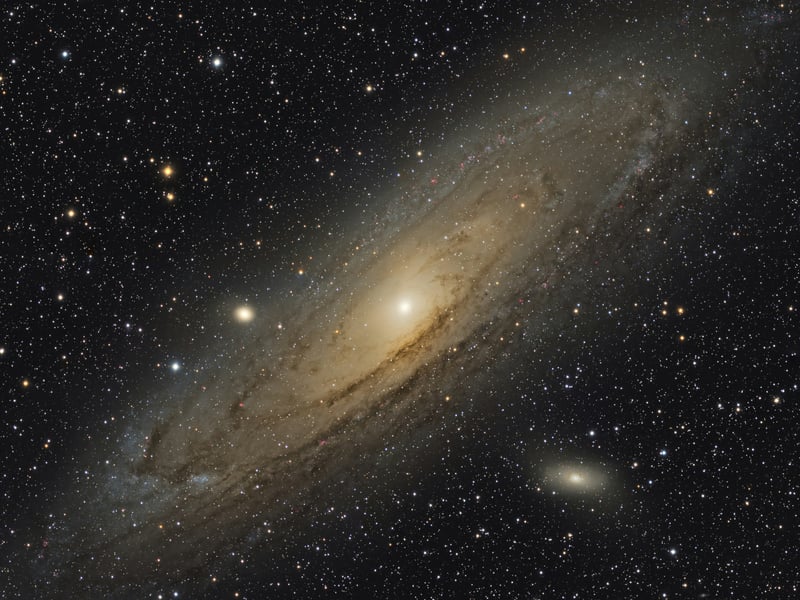
(CN) — For years, astronomers have believed the Milky Way was on a collision course with our largest galactic neighbor Andromeda — a cosmic event expected to unfold in about 5 billion years. However, new simulations suggest that smash-up might never happen.
Using fresh data from the Hubble and Gaia space telescopes, researchers at the University of Helsinki ran a series of simulations to project the future of our galaxy and its neighbors. Their conclusion is that there’s only about a 50% chance the Milky Way and Andromeda will actually collide in the next 10 billion years.
The results, published Monday in the journal Nature Astronomy, upend what many thought was a settled prediction and offer a revised view of our galaxy’s long-term trajectory.
The updated model takes into account something previous forecasts hadn’t: the gravitational tug of the Large Magellanic Cloud, a smaller galaxy that orbits the Milky Way.
“The Large Magellanic Cloud, a satellite galaxy of the Milky Way, pulls the Milky Way away from the orbital plane on which the Milky Way and Andromeda would evolve as a two-body system,” said Till Sawala, lead author of the study and a cosmologist at the University of Helsinki, in an email. “It thereby reduces the chance of a collision between the Milky Way and Andromeda.”
The addition of the cloud’s gravitational influence changes the game. Rather than drifting directly into Andromeda, the Milky Way’s course could be veering off, pulled by this smaller companion.
It’s not that earlier simulations were wrong, Sawala said — they just didn’t have all the data. When his team used the same assumptions as previous models, they ended up with the same results.
“The main difference is that we can use more recent, and more accurate observational data, and that we include the effect of the Large Magellanic Cloud,” he said.
Ironically, while a Milky Way-Andromeda collision may be less likely than once thought, another galactic encounter is almost certain. The Milky Way is on track to merge with the Large Magellanic Cloud itself, likely within the next 2 billion years.
Sawala said it’s still unclear what that will mean for our galaxy, though it likely won’t be as dramatic as a collision with Andromeda.
“Other studies have shown that the Milky Way’s merger with the Large Magellanic Cloud could, for example, lead to a growth of the Milky Way’s central supermassive black hole,” he said. “Unlike a potential merger with Andromeda, the merger with the Large Magellanic cloud will not lead to a complete change in the structure of the Milky Way.”
In a press release, the team notes that even their latest simulations come with uncertainties. Future observations, especially a new data release from the Gaia telescope expected in 2026, could sharpen our understanding of how the Milky Way and Andromeda are moving relative to one another.
“Gaia will make its next data release, which will improve the crucial ‘proper motion’ measurements, which determine the transverse velocity of Andromeda with respect to us,” Sawala said. “I don’t expect that we will definitively know already next year whether a merger will happen, but the new data could change the probability of a merger in either direction.”
Whether the Milky Way and Andromeda eventually collide or pass each other by, both possibilities fall within the bounds of what scientists expect from galaxy evolution. But the findings show just how much these predictions can shift as new data comes in, and how many questions we still haven’t answered.
“One thing that fascinates me, and that I often think about, is why we are interested in events that happen so far in the future,” Sawala said. “These are events on time scales that are far, far longer than the entire existence of humanity until now. I suppose that’s a question astrophysics cannot answer.”
Subscribe to our free newsletters
Our weekly newsletter Closing Arguments offers the latest about ongoing trials, major litigation and rulings in courthouses around the U.S. and the world, while the monthly Under the Lights dishes the legal dirt from Hollywood, sports, Big Tech and the arts.