
 Search Articles


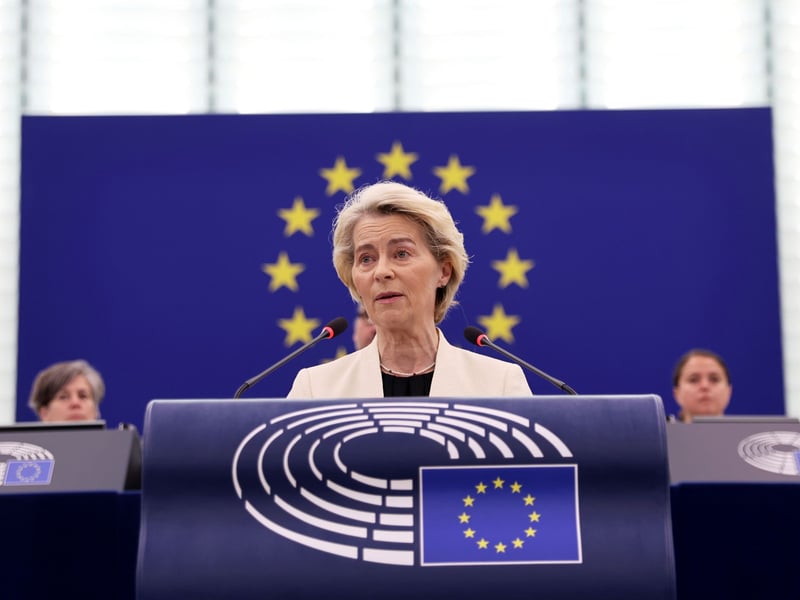
BRUSSELS (CN) — When European Commission President Ursula von der Leyen unveiled the bloc’s 2 trillion-euro ($2.18 trillion) budget proposal Wednesday, she outlined Europe’s ambitious comeback story: strategic autonomy, industrial competitiveness, and a continent ready to compete with China and the United States. The reality is considerably more complex.
The EU executive claims the proposal would increase EU spending to 1.26% of gross national income — the total income earned by EU countries — up from the current 1.1%. However, this figure includes debt repayments from pandemic borrowing, which critics say is misleading. The actual new spending amounts to 1.82 trillion ($1.98 trillion), representing just 1.15 percent of GNI.
Despite ambitious language about reshaping European priorities and building technological independence, the EU’s structural constraints make these grand ambitions largely unrealistic. The crucial point: the EU controls only about 2% of total public spending in Europe — the remaining 98% comes from national and local governments.
“This is a budget for the realities of today, as well as the challenges of tomorrow,” von der Leyen declared Wednesday. “A budget that equips us to act on our political choices in a very fast moving world.” Yet experts and lawmakers argue the gap between these ambitions and Europe’s actual fiscal capacity tells a different story.
The transformation began with a phone call in September 2023. Von der Leyen’s office reached out to Mario Draghi — the former Italian prime minister and European Central Bank president and asked him to assess why Europe’s economy was falling behind. Draghi initially hesitated before delivering a report that would reshape European thinking about competitiveness.
His stark warning: “Without action, we will have to compromise our welfare, our environment or our freedom.”
But the real driver behind this budget overhaul is Europe’s looming debt crisis. The bloc borrowed 800 billion euros during the pandemic, and those bills are now coming due — 140-168 billion euros ($153-183 billion) in debt payments over the next seven years, or roughly 25-30 billion euros ($27-33 billion) annually starting in 2028. Unlike the United States, Europe lacks the monetary flexibility to address these fiscal pressures, forcing Brussels to make difficult choices about priorities while member countries grow increasingly reluctant to contribute more.
The arithmetic reality
The budget allocations reveal Europe’s shifting priorities. 865 billion euros ($943 billion) go to national and regional partnership plans — encompassing agricultural subsidies and regional development — but these traditional areas represent a smaller share of an expanded budget. Meanwhile, 410 billion euros ($447 billion) flow toward the European Competitiveness Fund, reflecting Europe’s growing anxiety about falling behind in an increasingly intense technology and economic rivalry with China and the United States.
Scratch beneath the surface of this ambitious rhetoric, however, and a different picture emerges. “The EU budget is barely 1% of EU GDP,” Iain Begg, from the Europe Institute at the London School of Economics, said in an interview. “In U.S. terms, it’s a third to a quarter of the defense budget.”
This arithmetic reality fundamentally limits what Brussels can accomplish. Even major U.S. industrial policy initiatives like the Inflation Reduction Act, while substantial in absolute terms, represent a fraction of American economic output.
Europe has perhaps 0.2-0.3% of GDP available for shifting priorities — “trivial in U.S. terms,” according to Begg.
Not all experts are pessimistic, however. “The EU is not a nation state like China and United States, and therefore structurally has a disadvantage,” said Philipp Lausberg, from the European Policy Centre, in an interview. “But the most risky thing is to do nothing.”
Lausberg points to genuine efficiency problems that this budget attempts to address. While the United States can offer automatic tax credits for electric vehicles, European companies face what he calls “bureaucratic nightmares” when seeking support across different levels of government. The Competitiveness Fund’s attempt to “bundle together 14 existing programs and make this more lean” reflects recognition that Europe’s multilevel governance creates coordination problems that more centralized systems avoid.
Rather than genuine transformation, what’s happening is more like “changing the position of the sun loungers around the swimming pool, but without changing what was there for,” Begg said. The language of competitiveness may change, but the substance remains constrained by institutional realities that have persisted for decades.
Defense spending realities
The Ukraine war has accelerated Europe’s defense spending transformation, with von der Leyen proposing 131 billion euros for defense and space — five times current levels. An additional 100 billion euros ($109 billion) for Ukraine over seven years serves multiple purposes: supporting Kyiv while field-testing European military technologies and building supply relationships that favor European companies over American alternatives.
However, defense remains fundamentally each country’s responsibility, not the EU’s. Even ambitious initiatives like the proposed 150 billion-euro ($164 billion) SAFE program for defense equipment procurement operate “outside the formal EU budget,” as Begg notes, and remain “a long way from being the Pentagon.”
When European officials discuss reducing dependence on American defense contractors like Lockheed Martin and Raytheon, the substantive action happens through national budgets and procurement decisions, not EU-level spending.
The budget demonstrates the increasing securitization of EU spending — reframing traditional programs through security and competitiveness frameworks. This approach allows the EU to invest in dual-use technologies and defense-related research while respecting constitutional constraints in member states with pacifist provisions.
Parliamentary revolt
The budget proposal immediately faced withering criticism from the European Parliament, the EU’s co-legislative arm. Siegfried Mureşan, the parliament’s budget rapporteur from von der Leyen’s own center-right party, delivered a scathing response that laid bare the political resistance ahead.
“We cannot accept that the budget of the European Union becomes the sum of 27 national, eventually conflicting different agendas,” Mureşan said. “This means that EU becomes a cash machine — we want a shared vision, a common vision.” He accused the commission of preparing the proposal “against the demands of the Parliament, against the demands of beneficiaries, and against the demands of regions.”
The 2 trillion-euro figure “sounds well in theory,” he said, but consists primarily of “inflation” and “repayment for next generation EU” with no additional resources for actual programs.
He warned the commission against “creating the false impression that there will be more” for EU funding recipients, as associations of European farmers gathered to protest Wednesday in front of the Berlaymont — the commission’s headquarters in Brussels.
These internal dynamics reflect broader institutional constraints. Germany and the Netherlands — the self-described “frugal” nations — have consistently opposed budget expansion, and their resistance is intensifying.
The most significant obstacle is procedural — every EU budget requires unanimous approval from all 27 member states, giving each country effective veto power over the entire proposal.
While the EU discusses strategic autonomy and reducing dependence on American and Chinese suppliers, the actual capacity for coordinated industrial policy remains fragmented. “All the power within the EU remains with individual member states. And the EU is at the margin [at the global scale] when it comes to public finances,” said Begg.
Von der Leyen’s proposal now faces up to two years of intensive negotiations with the parliament and all 27 member states, each of which holds effective veto power over the final framework. Historical precedent suggests that initial proposals typically undergo significant modifications before reaching agreement, with negotiations likely to extend close to the 2027 deadline when the current budget framework expires.
The fundamental risk, experts warn, is spreading limited resources too thinly.
“If you dilute that among all these goals and none of those get enough that you get the private financiers in because you don’t have enough risk, then it’s not going to help,” Lausberg says. Europe needs massive investment in clean energy, advanced technology and mining, but lacks the fiscal capacity to fund all priorities adequately.
If successful, the 2028-2034 budget would establish Europe as a distinctive model — maintaining democratic institutions and market competition while coordinating investment for strategic objectives. But whether this more constrained approach can address the continental challenges Europe faces, from technological competition to climate change, remains uncertain.
With an EU-China summit scheduled in Beijing this month, European leaders will face questions about their capacity to deliver on competitiveness promises with limited fiscal tools as China dominates critical supply chains from batteries to rare earth minerals. The challenge isn’t simply matching American or Chinese spending levels, but demonstrating that Europe’s democratic, multilevel governance model can generate effective responses to technological and economic competition.
Subscribe to our free newsletters
Our weekly newsletter Closing Arguments offers the latest about ongoing trials, major litigation and rulings in courthouses around the U.S. and the world, while the monthly Under the Lights dishes the legal dirt from Hollywood, sports, Big Tech and the arts.