
 Search Articles


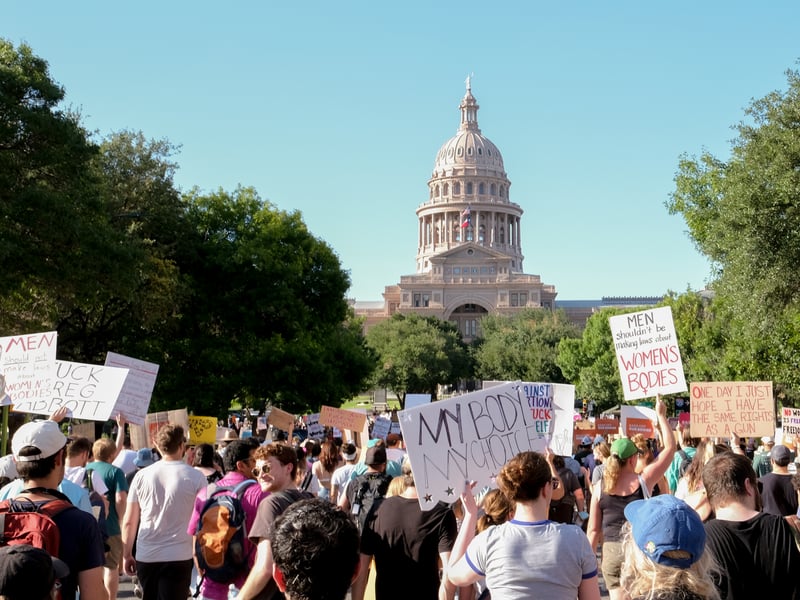
AUSTIN, Texas (CN) — A Texas Senate Committee on Thursday reignited the question of how far the state will go to stop abortion with the introduction of an expansive bill that would criminalize the funding of abortions and create civil liabilities for those distributing abortion drugs.
Republican State Senator Bryan Hughes of Mineola’s Senate Bill 2880, introduced before the Senate Committee on State Affairs, aims to flow of abortion drugs into the state.
The bill echoes Hughes’ Senate Bill 8, a 2021 law that effectively banned abortion in the state before the U.S. Supreme Court overturned Roe v. Wade in 2022.
“It’s already illegal in Texas to mail these pills, used to take the life of an unborn child and to put the mom in danger,” said Hughes. “The enforcement is what’s key in this bill. Enforcement is enacted through a qui tam lawsuit brought by private citizens in the name of the state, in the same category as what was done with the heartbeat law, where private citizens can enforce the law.”
A private citizen would be allowed to sue anyone suspected of delivering or providing information, including online, about abortion drugs to anyone in the state, or of facilitating the procurement of abortion drugs. A successful plaintiff under SB 2880 would be awarded a minimum of $100,000 in statutory damages. Citizens are also empowered to bring lawsuits against online companies that host abortion drug information to block the information from being viewed in the state.
Hughes’ 2021 bill stops at bringing lawsuits against suspected abortion providers, but SB 2880 would allow the parents of an aborted fetus to bring wrongful death lawsuits against the distributors of abortion pills.
The bill also allows the Texas Attorney General can bring second-degree felony charges against anyone who violates the provision, carrying a punishment of between two to 20 years imprisonment and up to a $10,000 fine. That charge is elevated to a first-degree felony — carrying a potential prison sentence of life — if a mother who received the funds is successful in terminating her pregnancy or if she were to die as a result of the abortion.
These severe punishments may be assessed against a person regardless of who the abortion is performed on, where the procedure took place and the laws of the jurisdiction in which abortion was performed.
During public testimony, Veronikah Warms, staff attorney at the Texas Civil Rights Project — a progressive law and policy organization — told the committee that SB 2880 was an incursion on the constitutional rights of Texans.
“Under this bill, as written, a person could potentially go to prison for life for paying for a woman’s sandwich while knowing that she was traveling to get a legal out-of-state abortion,” said Warms. “What is the point of having state laws defining legal content in their borders if a legislature can just decide to prosecute people for legal activity in other states? Where does that end?”
However, others, like Leanne Jamieson, executive director of the Dallas-area Prestonwood Pregnancy Center, asked lawmakers to act to stop Texas women from being harmed by these abortion drugs.
“We are allowing this proliferation of online access to abortion drugs with no medical oversight,” said Jamieson. “I believe doctors are to do no harm. This is not doing no harm.”
The committee also took upSenate Bill 33, authored by Republican Senator Donna Campbell of New Braunfels, which would prohibit local governments from providing logistical support — including money, child support, transportation, lodging, food or counseling services — to abortion seekers.
The bill responds to aid schemes adopted by Texas cities like Austin and San Antonio. The state sued the Austin last year to stop its “Reproductive Health Grant” program, arguing it violated the Texas Constitution’s prohibition of gifts to private entities that do not serve a “legitimate public purpose.”
The committee also heard Hughes’ Senate Bill 31 which looks to clarify the state’s abortion laws so that a doctor may terminate a pregnancy when it threatens the mother’s life or seriously risks impairment of a major bodily function.
Texas’s abortion laws already provide such exceptions; however, doctors across the state have refused to provide care or delayed it until a mother’s life is in immediate jeopardy out of fears of being prosecuted.
Amanda Zurawski — the lead plaintiff of a 2023 suit over such denied medical care that resulted in the Texas Supreme Court decision holding that the the state’s laws already clearly allow doctors to perform life-saving abortions — urged the committee not to pass SB 2880 and SB 33.
Zurawski did not take a stance on SB 31 but said that she respected Hughes’ effort to clarify the state’s laws but saw some flaws in it.
“It is unclear whether Senate Bill 31 would have prevented my trauma and preserved my fertility had it existed in 2022 and I find that to be problematic,” said Zurawski.
All three bills are expected to be approved, as Republicans hold 10 of the 11 seats on the committee.
 Follow @KirkMcDanie1
Subscribe to our free newsletters
Our weekly newsletter Closing Arguments offers the latest about ongoing trials, major litigation and rulings in courthouses around the U.S. and the world, while the monthly Under the Lights dishes the legal dirt from Hollywood, sports, Big Tech and the arts.