
 Search Articles


AUSTIN, Texas (CN) — Texas Lawmakers returned to the state Capitol on Monday to take up a varied list of legislative priorities from Governor Greg Abbott.
After a historic regular legislative session that resulted in several wins for the Texas GOP, Abbott said in a proclamation announcing the 30-day special session agenda that more work lies ahead for lawmakers after floods on July 4 wrecked the Texas Hill Country, leaving more than 130 people dead.
“There is more work to be done, particularly in the aftermath of the devastating floods in the Texas Hill Country,” Abbott said. “We must ensure better preparation for such events in the future."
Over two weeks after flood waters rose, many lawmakers are keenly focused on acting on the lessons being learned in the wake of the tragedy. Abbott has asked lawmakers to approve funding for recovery efforts, beef up state preparedness to natural disasters and improve flood warning systems.
Texas House Speaker Dustin Burrows and Lieutenant Governor Dan Patrick, who acts as the president of the state Senate, have responded to Abbott’s demands by creating Select Committees on Disaster Preparedness and Flooding. Through these committees, lawmakers will get an opportunity to examine the state’s preparedness before the floods and assess its response to them.
AccuWeather estimates that, on top of the countless lives lost, the July 4 floods caused a total of $18 billion–$22 billion in damage. On Saturday, officials in Kerr County, one of the hardest hit regions along the Guadalupe River, reported that three people are still missing.
While addressing the recent floods in this state has been a uniting cause for lawmakers in the statehouse, other issues on Abbott’s agenda are likely to fuel immense partisan division. At the top of that list is the request for lawmakers to do the rarely seen task of redrawing the state’s congressional districts in the middle of a decade.
Following the 2020 census, lawmakers did the arduous work of creating new political maps. Those maps have been the bedrock upon which Texans select who will represent them in the United States Congress every two years. But Abbott wants to change those maps ahead of the 2026 midterms, citing a letter from the U.S. Department of Justice accusing majority minority districts in Houston and the Dallas-Fort Worth metroplex of being unconstitutional coalition districts.
The letter provided some level of cover to Texas Republicans who claim the mid-decade redistricting was not just a ploy to craft districts that will favor them and possibly keep the U.S. House in GOP control. But President Donald Trump gave the game away during a press conference outside the White House, when he said he wanted a “simple redrawing” for Republicans to “pick up five seats.”
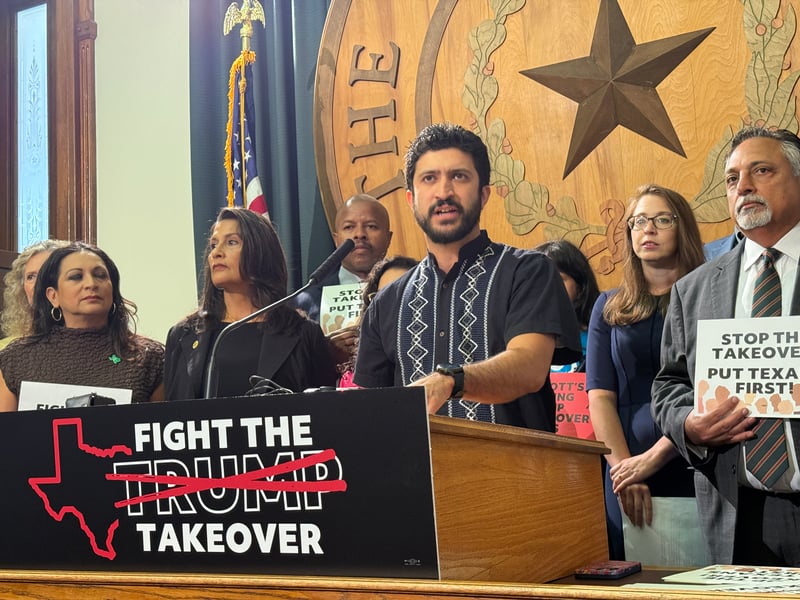
At a press conference with members of the Texas House Democratic Caucus on Monday, Congressman Greg Casar, a Democrat representing Austin, said the push for redistricting amounts to Republicans rigging the midterm elections.
“[Trump] wants Texans to give up their power to elect their own representatives so that Trump himself can avoid any accountability in the upcoming elections,” Casar said. “Whether you’re conservative, liberal or right up the middle, you should have the opportunity to pick your politicians, not the other way around.”
Texas House Democratic Caucus Chair Gene Wu, from Houston, said he will be looking to see if Republicans choose to prioritize flood relief or “serve themselves.” And if they choose the latter, then all tools are on the table to stop them.
“Democrats are here to not only defend Texas, but we are defending America as well,” Wu said.
Democrats lack substantial power in the GOP-controlled legislature, but they do have ways to gum up the gears of lawmaking to run out the clock on the special session. One such tactic is not to show up to the Capitol and block laws from being considered through a lack of a quorum.
Wu did not commit to saying House Democrats were planning on breaking quorum but said it will remain an option as the special session drives on.
Another issue that is likely to sow division during the special session relates to the future of the Lone Star State’s legal THC market.
Abbott saved THC from becoming illegal last month when he vetoed a bill that would have banned the intoxicating products from being manufactured and sold in the state. His veto came as a welcome win for the thousands of THC retailers in the state but was a bitter loss for Patrick, who was a staunch supporter of prohibition.
Currently, products that contain THC derivatives from the hemp plant are permitted for sale and consumption in the state, while plants that contain more than 0.3% THC are illegal. However, by concentrating the THC found in legal hemp plants, product makers can make edibles, oils and prerolled joints that provide the same intoxicating effect as regular marijuana.
Patrick argues these products are dangerous for people’s health and that makers have specifically targeted children through packaging and making them into candies that are appealing to kids. As of now, there are zero rules on where THC shops can be located, on what kinds of products they can offer or prohibiting them from selling to minors.
Abbott has directed lawmakers to do the hard work of regulation, prohibiting the sale of THC-derived products to people under the age of 21 and setting standards on potency and the use of synthetic compounds.
While Abbott passed the issue back to the legislature, it looks likely that Patrick will renew his opposition to the industry.
“I am staying with the ban,” Patrick said during a June press conference. “You cannot regulate 8,000 stores. Law enforcement knows that, and we talked about it during the session — can’t do it.”
Packing the 30-day session even further, Abbott has also asked lawmakers to limit transgender people from using sex-segregated facilities that are different from their sex assigned at birth. Furthermore, Abbott has asked for the legislature to further restrict access to abortion after lawmakers failed to enact a bill during the regular session that would have created new criminal and civil penalties for abortion medication providers.
The countdown has begun for lawmakers to tackle this jam-packed special session. If they are unable to deliver on Abbott’s agenda items, they run the risk of being called back to Austin for follow-up sessions until the issues have been addressed.
 Follow @KirkMcDanie1
Subscribe to our free newsletters
Our weekly newsletter Closing Arguments offers the latest about ongoing trials, major litigation and rulings in courthouses around the U.S. and the world, while the monthly Under the Lights dishes the legal dirt from Hollywood, sports, Big Tech and the arts.